Politics
Trump ‘Declaring War’ on Public Broadcasting After Funding Reversed, Sen. Dick Durbin Says
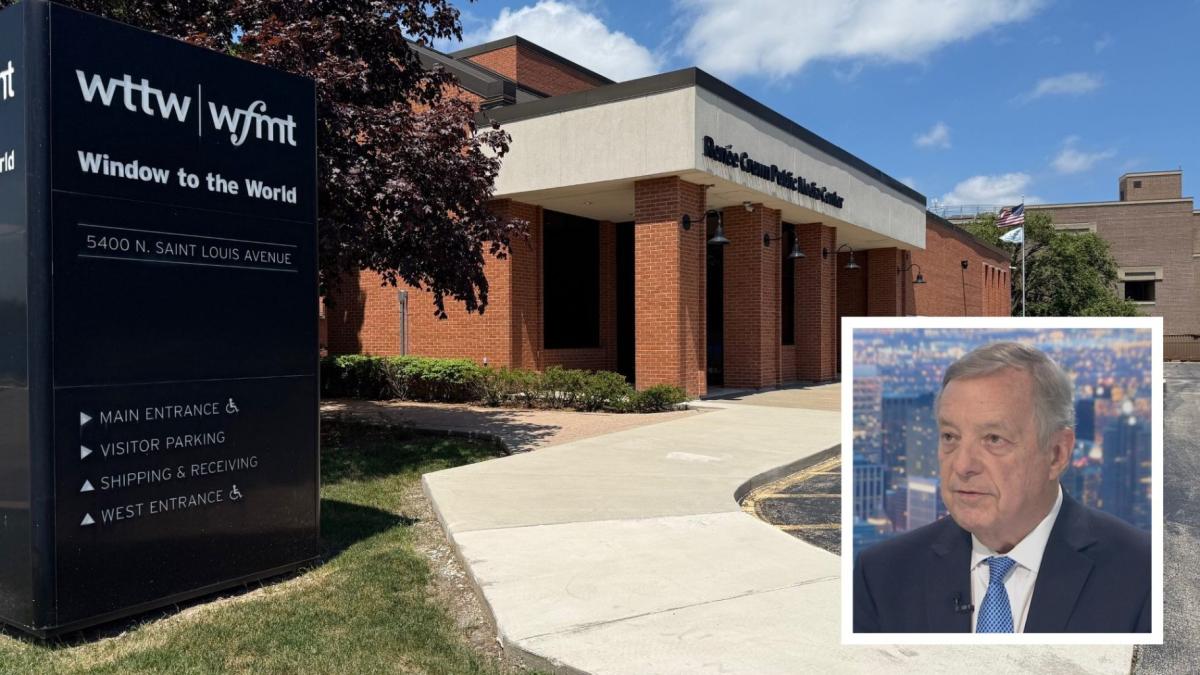 The Renée Crown Public Media Center, home to WTTW, is pictured. (WTTW)
U.S. Sen. Dick Durbin on Friday said Donald Trump is “declaring war” on public broadcasting, hours after Congress approved more than $1 billion in cuts to radio and television stations across Illinois and the rest of the country.
The House early Friday gave final approval to President Donald Trump’s request to claw back more than $1 billion for public broadcasting and nearly $8 billion in foreign aid early Friday as Republicans intensified their efforts to target institutions and programs they view as bloated or out of step with their political agenda.
The Illinois senator on Friday said those cuts will require PBS and NPR stations across the state to make difficult funding decisions and could even spell the end for some networks.
“In this situation, when it comes to basic information in a Democracy, to end $1 billion — which is large by most standards, but not by federal standards — is a statement by this president that he’s declaring war on this entity,” Durbin said during a press conference at Navy Pier, outside the offices of WBEZ, Chicago’s NPR news source. “I think that’s a serious mistake.”
The package cancels about $1.1 billion for the Corporation for Public Broadcasting (CPB) and nearly $8 billion for a variety of foreign aid programs, many designed to help countries where drought, disease and political unrest endure.
The vote marked the first time in decades that a president has successfully submitted such a rescissions request to Congress, and the White House suggested it won’t be the last. Some Republicans were uncomfortable with the cuts, yet supported them anyway, wary of crossing Trump or upsetting his agenda.
The House passed the bill by a vote of 216-213. It now goes to Trump for his signature. No Democrats supported the measure when it passed the Senate, 51-48, in the early morning hours Thursday.
Durbin on Friday called public broadcasting “an important part of (Americans’) source of information” and said those stations need to withstand what he called “thought policing” from the Trump Administration.
“We don’t want them to be the president’s favorite or the president’s enemy,” Durbin said. “Just tell us the news, let us draw our own conclusions. That has been the guiding light when it comes to public broadcasting throughout its existence.”
WTTW President and CEO Sandra Cordova Micek said in an email sent Thursday to WTTW members and viewers that she was “disappointed in this outcome,” following the Senate vote, but added “we are also grateful for the millions of people who voiced their support for public media and stood with PBS and stations across the country.”
“In the coming days, we will be working closely with PBS, CPB and our member station colleagues across the country to work through the implications of this legislation,” she wrote. “And here in Chicago we will chart a path forward that is audience and mission-driven and grounded in long-term sustainability.”
Heather Norman, president of Illinois Public Broadcasting Council — which is comprised of 14 NPR and PBS affiliate stations, including WTTW — said Friday those networks provide vital resources for communities across the state, from children’s programming and local candidate forums to emergency communications and reports.
She said 70% of that now-eliminated funding would have gone directly to independently owned and operated stations. Illinois stations are set to lose out on around $12 million in community service grants, she said, as well as indirect support provided by the CPB.
But the cost to replace those services would nearly double the investment from the CPB, according to Norman. She said for many stations in Illinois, those grants make up between 10% and 50% of their budgets.
Norman was unsure how stations at the highest end of that range would be able to survive.
“The public media system will lose efficiencies because stations will shut down because of these cuts,” she said. “Illinois has been hit hard by the closure of local newspapers. Public media has been trying to fill the gap (but) these cuts will make it more difficult for us to do so.”
The Associated Press contributed to this report.