Investigations
Heat Stress ‘Significant Contributing Condition’ in Death of Michael Broadway, Who Died While Incarcerated at IDOC’s Stateville
 Michael Broadway is pictured in November 2023 during a Northwestern University graduation ceremony at Stateville Correctional Center. (Credit: Northwestern University)
A nurse inside Stateville Correctional Center called 911 on June 19 over an individual in custody who was unresponsive and in and out of consciousness.
In the 911 call audio obtained by WTTW News, the nurse tells the dispatcher that “it’s a possible overdose, probably possible heat stroke.”
The dispatcher asked how long the individual had been outside if there’s a chance he had a heat stroke.
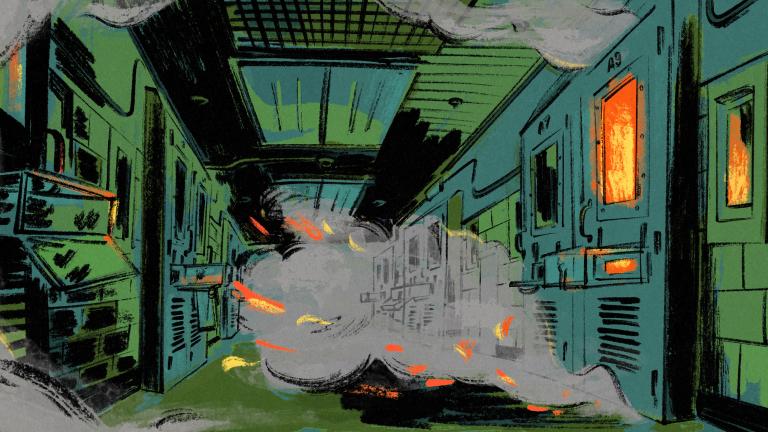
“No, he’s been in his cell, but it’s like 100 and something degrees in here,” the nurse replied.
That nurse was calling about Michael Broadway, a 51-year-old man who died in custody that day.
Broadway’s death is due to bronchial asthma, with hypertensive cardiovascular disease and heat stress as “significant contributing conditions,” according to an autopsy report from the Will County Coroner’s Office that was provided to WTTW News.
Terah Tollner, who along with the firm Kaplan & Grady is representing Broadway’s family over the death, said the autopsy “confirms everything that (they’ve) been hearing.”
“The main takeaway is just that he died of asthma, which is extremely preventable and that heat stress contributed to his death,” Tollner said.
“If correctional staff had responded appropriately and initiated an emergency medical response, and if Wexford (Health Sources) staff had responded with urgency and provided adequate care, then Michael would still be alive,” she added.
The family plans to file suit over the death, but has not done so yet.
The Illinois Department of Corrections did not respond to an immediate request for comment.
Broadway was among the first group of incarcerated men to receive a bachelor’s degree from a top 10 university when he was awarded a diploma in November 2023 along with 15 others from Northwestern University.
Friends who witnessed his death previously told WTTW News that he “didn’t have to die.”
Broadway’s death came just months before those incarcerated at Stateville are set to be transferred out of the prison. On Aug. 12, a federal judge ordered that most of the facility’s prison population needs to be transferred by Sept. 30.
The court found a probable risk of irreparable harm from falling concrete attributed to the deteriorated masonry walls, ceilings, steel beams and window lintels at Stateville.
The transfer comes as IDOC proposed a $900 million plan to close both Stateville and Logan Correctional Center, rebuilding both on Stateville’s sprawling Crest Hill property. The rebuilds could take about five years.
‘People Here is Afraid of Becoming the Next Broadway’
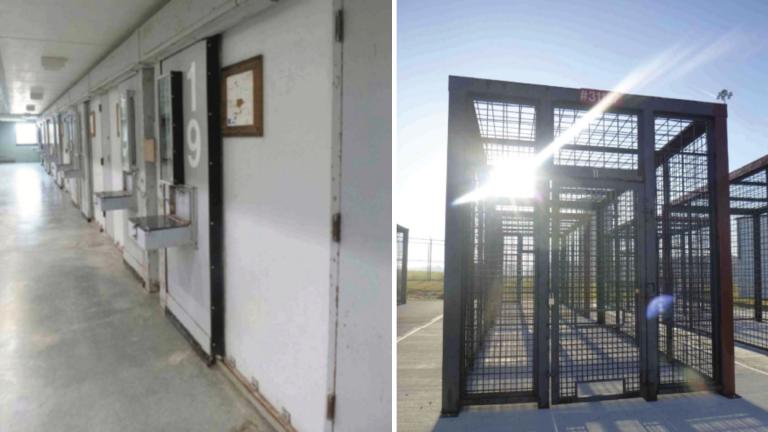
The days before Broadway’s death were some of the hottest in June, with the heat index in nearby Joliet reaching 100 degrees on June 17, according to weather data. Heat only intensified on the higher floors of the prison, said Anthony Ehlers, a friend whose cell was near Broadway’s, in a written statement provided to WTTW News.
Not a single window was open, Ehlers wrote; everything for ventilation purposes in the area of their cells was either closed or locked. In front of his and Broadway’s cell there was a padlocked exhaust fan, he added.
A month after Broadway’s death, those incarcerated in Stateville said conditions did not change, writing to WTTW News in late July that the threat of heat continued with nailed-shut windows and broken industrial fans trapping in heat.
“So many people here is afraid of becoming the next Broadway,” wrote Abdul Malik Muhammad, who’s currently incarcerated at Stateville.
IDOC’s medical director sent out a memorandum the day after Broadway’s death on the prevention of heat-related illnesses, according to documents provided to WTTW News.
“All non-essential labor shall be stopped” and “essential labor should be approved only by the Warden” in a heat index 95 degrees and above, the memorandum states.
“Medical personnel should be especially vigilant of the needs of persons with chronic conditions,” it continues.
Incarcerated people are at high risk for heat-related morbidity and mortality due to confinement, social isolation and high rates of chronic mental and physical illnesses, according to a March report from Nature Sustainability.
As climate change accelerates, the U.S. will experience more frequent, intense and longer heat waves that may disproportionately affect incarcerated people, the report found. This is especially prevalent in facilities in areas of the southern U.S.
“Those hazards in the short to long term are risky enough,” Robbie Parks, one of the report’s authors and an assistant professor of environmental health sciences at Columbia University, previously told WTTW News. “But if you’re lacking any agency … and you’re sort of confined, largely the risk necessarily becomes even greater.”
Medical issues faced by people living with chronic conditions like cardiovascular disease and respiratory problems become exacerbated by high levels of heat and not having recourse to care, Parks added.
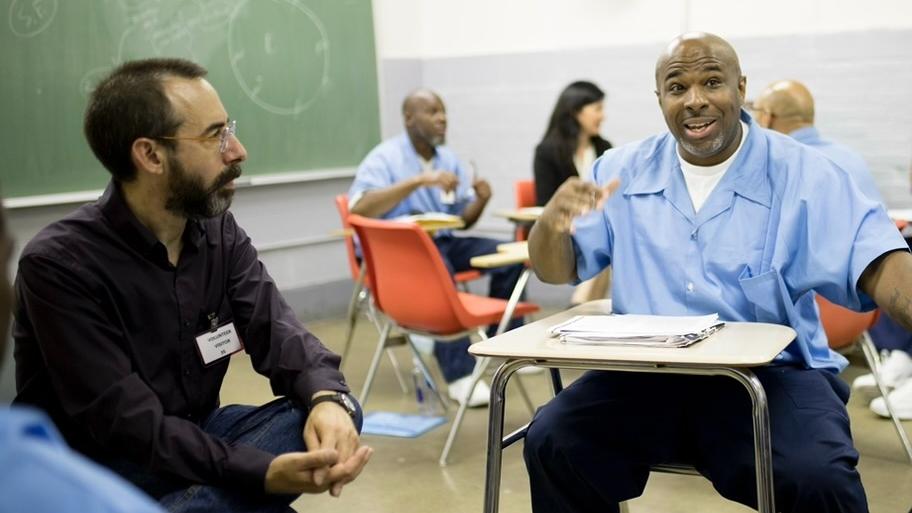 Michael Broadway participates in Northwestern’s Prison Educator Program at Stateville Correctional Center. (Credit: Northwestern University)
‘It Was a Clown Show From Start to Finish’
On June 19, Broadway, who had severe asthma, began struggling to breathe, Tollner, the family’s lawyer, said. While he was still physically able to, Broadway and friends called correctional officers for help. In an affidavit provided to WTTW News, Ehlers wrote that at approximately 4:09 pm., Broadway said he was having trouble breathing. He and another man in a nearby cell, Robert Cloutier, yelled for a med-tech.
A med-tech was called, arriving at approximately 4:25-4:30, Ehlers wrote. The med-tech told the staff that “it’s too hot, I’m not going up there, tell him to come down here,” and walked back outside, the affidavit states. Broadway was in the nine gallery, which Tollner said is the highest floor on which men are living.
“It took the med-tech several minutes to actually walk up to 9 gallery,” Ehlers wrote. “She walked down the gallery very slowly. I know this because I saw it in my mirror.”
According to an offender outpatient progress note provided to WTTW News, a licensed practical nurse wrote that at 4:20 they were called to E-house, where Broadway’s cell was, for a patient having trouble breathing.
“Upon arrival at cell, pt. was sitting on bed, leaning against the wall but not responding to verbal commands,” the LPN writes.
A code 3 was called at 4:23 p.m., the nurse writes. A code 3 requires nurses to show up and bring an AMBU bag, which is a device used to provide respiratory support, according to Tollner.
Tollner said that code 3 should have been called once Broadway’s friends alerted staff that he couldn’t breathe. Ehlers wrote in his affidavit that code 3 was not called.
After code 3 was called, the LPN wrote that they gave a dose of the opioid overdose reversal medication Narcan. At 4:25 p.m. no pulse was detected and CPR was administered, the note continues, and a couple minutes later a second dose of Narcan was given.
“I yelled out ‘he doesn’t do drugs, he has asthma.’ I yelled it over and over until she said ‘okay, I hear you.’ I told her ‘then do something for him,’” Ehlers wrote in his affidavit.
Then, correctional officers performed chest compressions on Broadway, according to Ehlers.
The LPN wrote that 911 was called from E-house at 4:29. That’s 20 minutes after Ehlers first noted that Broadway was having difficulty breathing.
According to audio of a 911 call of the incident, at 4:34 a call was made to the dispatcher. A nurse explains to the dispatcher that “it’s a possible overdose, probably possible heat stroke.”
The dispatcher asked how long he’s been outside if there’s a chance he has heat stroke.
“No, he’s been in his cell, but it’s like 100 and something degrees in here,” the nurse replied.
The correctional officers were told by the nurse to “grab the stretcher” to take Broadway down the stairs, Ehlers wrote. However, the stretcher had no straps to hold Broadway and no handles to carry him, the affidavit continues. Because it had no straps, one of Broadway’s close friends had to help carry him down the stairs in a bed sheet, said Tollner.
“Robert Cloutier (who’s cell was also on nine gallery) yelled out ‘I have a sheet, let’s put him in this and take him down.’ They keyed out Cloutier, he came … to Broadway’s cell with a sheet, started pulling him onto it, two of the (correctional officers) helped,” Ehlers wrote.
At 4:40, the LPN writes they were met with EMTs at a gate and Broadway was transferred into their care, leaving the grounds in an ambulance.
“It was a clown show from start to finish and as a result our brother died. Needlessly,” Ehlers wrote to WTTW News in June. “What that tells me is we are not safe here. As a result of these conditions, our brother died.”
According to documents provided to WTTW News, five IDOC staff received “team effort award commendations” over an “urgent incident” on June 19.
The commendations do not mention Broadway by name; they say there was an “individual of custody experiencing severe respiratory distress” on the ninth gallery, where Broadway lived.
“The response was nothing short of remarkable,” the commendation states.
It said the officers and sergeant “expertly facilitated the safe transport of the individual down multiple flights of treacherous stairs to reach the waiting stretcher.”
Family Remembers Broadway as Author, Student
Broadway, an author and stage 4 prostate cancer survivor, was given a special acknowledgement during the graduation ceremony at Stateville Correctional Center on Nov. 15 by renowned writer Ta-Nehisi Coates, the commencement speaker, who held up a copy of Broadway’s book.
Broadway was a self-described “regular student,” but had ambitions exceeding that framing, one of them being publishing a second book. His first, “One Foot In,” was published while he was incarcerated last year.
“He wanted to help the other guys that were incarcerated,” said Karen Ranos, the lawyer litigating his post-conviction petition. “He wanted to go out (and get) an understanding of not only what causes people to be caught up in crime, but also how to prevent it. What do these people really need?”
Broadway had served 18 years of his 75-year sentence.
Ranos said she was litigating a petition claiming his innocence on his first-degree murder conviction “as well as some other claims we had about constitutional violations.”
Pending his release, Broadway had plans to start the Rich Soil Foundation, a nonprofit promising to “plant seeds of encouragement for today’s youth through art, sports, music, and STEM.”
“I imagined him standing on the stage, listening to other stories and talking to people and sharing his stories and experiences and being an inspiration to those who live that type of life,” his companion, Shawn Hardy-Hatchett, told WTTW News in June.
Hardy-Hatchett and Broadway met as teenagers at her aunt’s house, she said. Even at a young age, she could count on Broadway for quality conversation — “it wasn’t that mushy stuff.”
She remembers writing a letter of what she’d want in a companion — intellect, kindness, patience — and one day her sister read the letter and said, “Michael’s everything on that list.”
“He always was willing to learn,” Hardy-Hatchett said. “He would ask questions and his humility, … he truly helped me with his humbleness. That has always been Michael … even as a child that has always been him, always.”
Leonard Broadway, Michael’s older brother, said they’d protect one another; “that’s how it’s always been all our life,” he told WTTW News in July.
“We’re always going to be together,” Leonard Broadway said.