Business
House Prices Jump in Illinois Amid Slow Pace of New Construction
Home prices in Chicago and around the state are skyrocketing, as Illinois struggles to keep up with the demand for new housing.
The median sale price for homes in Chicago hit $425,000 in July, according to data from Illinois Realtors. That’s a 13.3% increase from last year. Across the state, the median price of $338,000 represented a 6% increase in a year.
At the same time, the number of homes for sale dropped. And the ones that did hit the market moved fast. For many looking to explain these rising costs, the issue is with supply.
“Our shortage would require us to triple the amount of new home construction every single year for the next five years, just to meet today’s demand,” said Jeff Baker, CEO of Illinois Realtors.
Although not every barrier to building new housing can be addressed at the local level, Baker said there are some important areas to focus on. Municipalities can have building and zoning codes that are decades old and haven’t been refreshed for new needs, and long review times can slow down approvals.
“All of that can add up to increase the costs of new homes and force builders to say, ‘This just isn’t worth it in Illinois,’” Baker said.
David Doig, president and CEO of the real estate development group Chicago Neighborhood Initiatives, pointed to a few challenges the city faces, including a restrictive building code, long waits for permits and access to public infrastructure.
“There’s no one thing that we can point to and say, ‘If we just fix this, that would take care of it,’” Doig said.
“If you look at other states around the country, they’re passing us up,” Doig said. “And not just marginally, but by big numbers. We’ve got to be intentional, we’ve got to be much more specific and directed around building homes at a scale and a pace that starts to meet the demand.”
After statewide legislative efforts — including the BUILD plan backed by Gov. JB Pritzker — stalled in the spring legislative session, Illinois Realtors looked at what could be done without action from the General Assembly. This month, the group released the Illinois Housing Supply Accelerator Playbook intended to help municipalities work through their own reforms.
“We created an entire blueprint that can walk them through the process to study their own code, study their own processes, figure out where they’ve inadvertently created some burdens, and then help them develop the solutions that can start to alleviate those burdens,” Baker said.
“Middle” housing, which is affordable for middle-income earners, is a particular need right now, according to Baker.
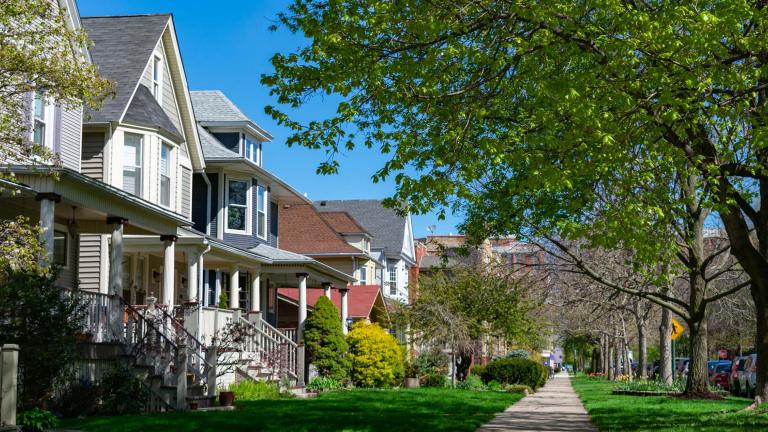
“The most ironic thing is that Chicago could be better at building three-flats, four-flats, which are considered classic Chicago architectural icons,” said Chloe Groome, a board member at Strong Towns Chicago. “But right now, they’re not allowed to be built on more than 60% of the city’s residential land.”
According to Groome, a mixed housing stock with a variety of different building types can make neighborhoods more accessible for long-time residents and people who work there.
Aging residents who want to downsize might be looking for a smaller home nearby, or a family might want to expand their existing home to accommodate multiple generations.
New construction and changing neighborhoods often come with fears of displacement for current residents, but Groome said there’s a path forward for development without displacement.
“Empowering people in the neighborhoods to be small homebuilders themselves,” Groome said, a goal that can be accomplished with the right education, code reforms and financing.