Politics
Key City Panel Backs $202M Subsidy for New Development on Lincoln Yards Site
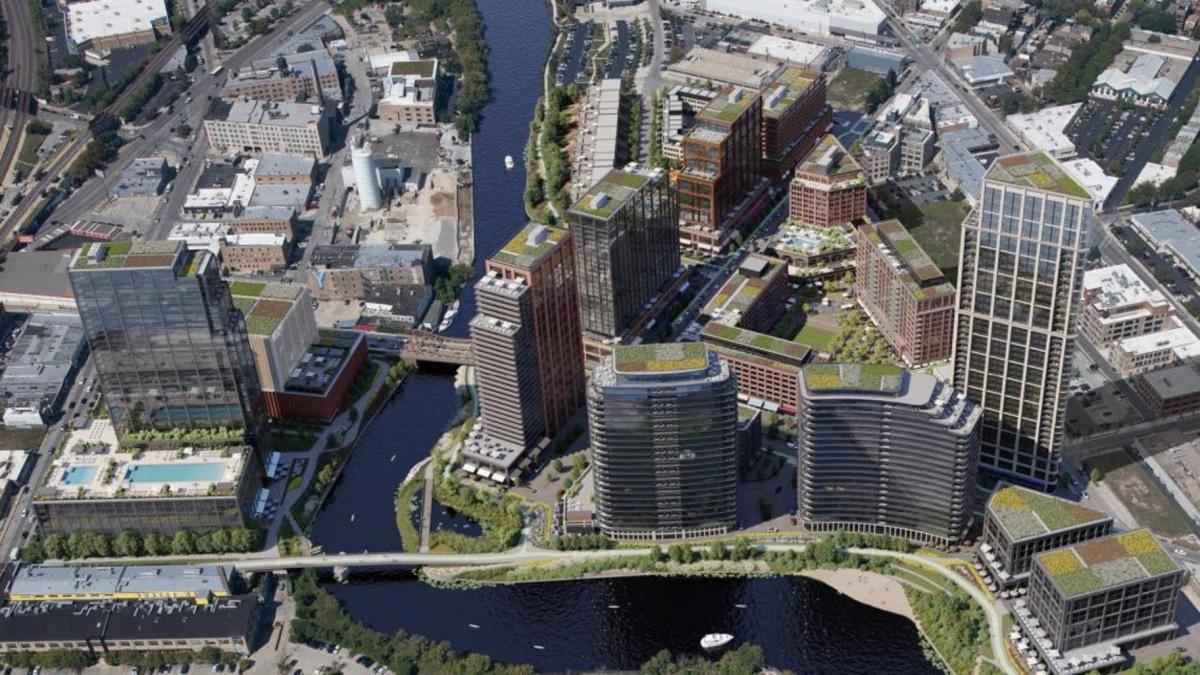 A rendering of the proposed Foundry Park development along the Chicago River. (Chicago Department of Planning and Development)
Efforts to transform long vacant land along the north branch of the Chicago River between Bucktown and Lincoln Park into a new neighborhood advanced Tuesday with a vote by a key city panel to use $201.6 million from the area’s Tax Increment Financing districts to subsidize the project.
Once slated to be part of the Lincoln Yards megadevelopment, JDL Development and Kayne Anderson Real Estate now plan to build more than 3,700 homes as well as a hotel, office buildings, shops and restaurants as part of the $3 billion Foundry Park, named to honor the property’s history as the former home of the AJ Finkl & Sons steel company.
The City Council’s Finance Committee voted unanimously to advance the subsidy, which will be used to connect the new 31-acre neighborhood to the city’s road network and electrical grid while building a riverwalk and parkland. A final vote by the full City Council is set for Wednesday.
The plan calls for $71 million to be used to build new roads as well as $69 million for new parks, records show. An additional $33.5 million would be used to expand the city’s riverwalk, while an additional $7 million would be used to prepare the once-industrial land to be used for living, working and shopping.
The city subsidy includes $21.5 million to extend the 606’s Bloomingdale Trail over the Chicago River, first envisioned a decade ago as part of the Lincoln Yards development, which was championed by former Mayor Rahm Emanuel over the vehement objections of progressive groups and politicians.
Plans also call for a 777-space underground parking garage to be built, records show.
The $6 billion Lincoln Yards plan relied on a $900 million subsidy from a newly created TIF district and $400 million in tax credits. It was to have built 6,000 new apartments and condominiums on the city’s booming North Side.
However, the high-profile project collapsed amid the COVID-19 pandemic. Sterling Bay only constructed one building on the site, a life sciences center that never found a tenant and was put up for sale.
Eventually, Sterling Bay split up the 53 acres, selling the north half of the property to JDL Development.
Mayor Brandon Johnson and Ald. Scott Waguespack (32nd Ward) — who have clashed frequently over a number of issues — both eagerly embraced the new vision for the property, and the City Council unanimously approved the new development in February.
The city subsidy means that Chicago’s affordable housing ordinance requires 20% of the new units, or 709 new homes, to be set aside for low- and moderate-income Chicagoans. Plans call for 95 affordable units to be built on site with another five units set to be built close to the new neighborhood, as allowed by city ordinance. The developer is set to pay an additional $7 million into the city’s Affordable Housing Opportunity Fund to fulfill the rest of their obligation, records show.
Tax Increment Financing, or TIF, districts capture all growth in the property tax base in a designated area for 23 years in an effort to spur redevelopment and eradicate blight.
City officials expect the property to generate $30.5 million in property taxes in 2031, when the first phase of construction is scheduled to be finished, and $68 million annually by 2036, when construction is complete, according to the mayor’s office. The project is expected to generate 700 construction jobs annually for the next decade, and 2,500 permanent jobs, officials said.
The southern half of what was to have been Lincoln Yards is now owned by Chicago-based Novak Construction, which has not yet announced what it plans to do with that property.
Contact Heather Cherone: @HeatherCherone | (773) 569-1863 | [email protected]