Education
CPS Board Members Talk $10B Approved Budget, State Funding Assumption
A divided Chicago Board of Education at a meeting last week approved a nearly $10 billion budget that relies on an additional $150 million in state funding.
The spending plan comes after weeks of debate among Chicago Public Schools officials, board members and labor unions over how the district should close a $732 million budget gap.
CPS CEO Macquline King had hoped board members would approve a plan that avoided furlough days by increasing the district’s Tax Increment Financing (TIF) assumption from $200 million to $285 million, but still included more than 1,600 layoffs to teachers, service personnel and assistant principals to balance the budget.
But her proposal caught the ire of the Chicago Teachers Union and CTU-aligned board members, who amended King’s budget to assume more state funding and avoid around 1,000 layoffs.
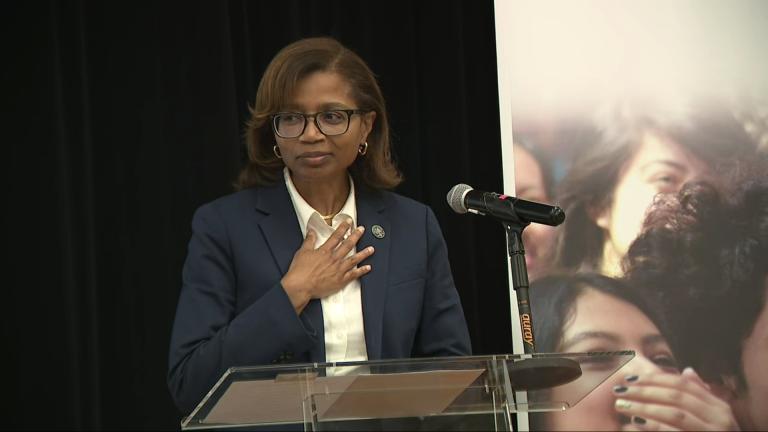
Michilla Blaise, a CPS board member representing District 5B, introduced the amendment. Blaise said she couldn’t accept the layoffs included in King’s budget.
“I have 64 schools in my district,” Blaise said. “I’ve never been to one of them where they said, ‘There’s way too many teachers around here.’ I feel I have a mandate from my folks to make sure that our schools have what they need.”
Illinois House Speaker Emanuel “Chris” Welch last week said he was “committed” to supporting a bill that would provide supplemental school funding during the upcoming fall veto session.
But any effort to pass funding that would be available in time for CPS to avoid midyear cuts would require a three-fifths supermajority in both houses, a difficult bar for any legislation.
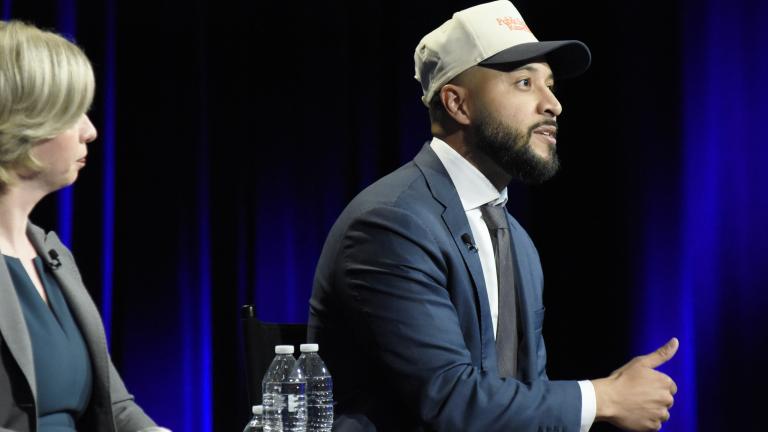
Jessica Biggs, a CPS board member representing District 6B, voted against the amended budget. She said the additional state revenue adopted by her colleagues on the board shouldn’t be considered a “reasonable source of revenue.”
“We’re in a moment where we have to live within our means,” Biggs said. “We were presented with a balanced budget that assumed reasonable sources of revenue. Additional money from the state is not a reasonable source of revenue.”
CPS made a similar funding assumption in 2017, when district officials assumed around $215 million in funding from the state to cover teacher pension costs. That money ultimately never materialized, forcing CPS to make deep midyear cuts to school budgets and staff.
“I very clearly recall, in the middle of the school year, when that money did not arrive,” Biggs said. “We were forced into numerous furloughs. About twice as many teachers had to be laid off during that time to make up for that first part of the year. We had staff lose cost-of-living adjustments.”
Biggs added that CPS was forced to borrow to cover costs that came with unrealized state funding.
“Even today, we’re paying about $200 million in debt service and interest on the borrowing that occurred during that time just to keep our doors open,” Biggs said. “That’s money taken away from teachers and classrooms.”
At last week’s meeting, King warned board members that assuming more state funding could be a red flag for banks who are already skeptical of CPS’ ability to pay its debts. King said CPS’ ability to avoid a credit downgrade and continue borrowing would be the only way for the district to meet payroll due Sept. 4.
Blaise is urging board members and CPS leaders to see this as an opportunity to finally address the district’s long-term financial challenges.
“As a result of inserting that budget requirement, we’ve changed the conversation,” Blaise said. “Gov. JB Pritzker earlier in the year said there’s money for CPS and now he’s saying he’s interested in seeing the plan. Speaker Chris Welch, as you mentioned, demonstrated his support. Senate President Don Harmon also.”
Blaise pointed to last fall’s $1.5 billion public transit legislation, a massive funding increase for the Chicago Transit Authority, Pace and Metra, which were in similar financial waters as CPS.
“The buses and trains were about to stop running, but we were able to get that funding in veto session,” Blaise said. “We shouldn’t just give people a pass. Everyone on campaign trail after campaign trail says, ‘The kids are the most important, education is the most important.’ … It’s time to invest in them.”
Illinois’ own evidence-based funding formula shows CPS is $2 billion short of what it’s owed from the state. State lawmakers will return for the fall veto session Nov. 17.
WTTW News education reporting is supported, in part, by Press Forward Chicago.