Arts & Entertainment
Chicago Buildings Keep Killing Birds. New ‘Flyway City’ Exhibit Is Architect Jeanne Gang’s Plea To Take Action
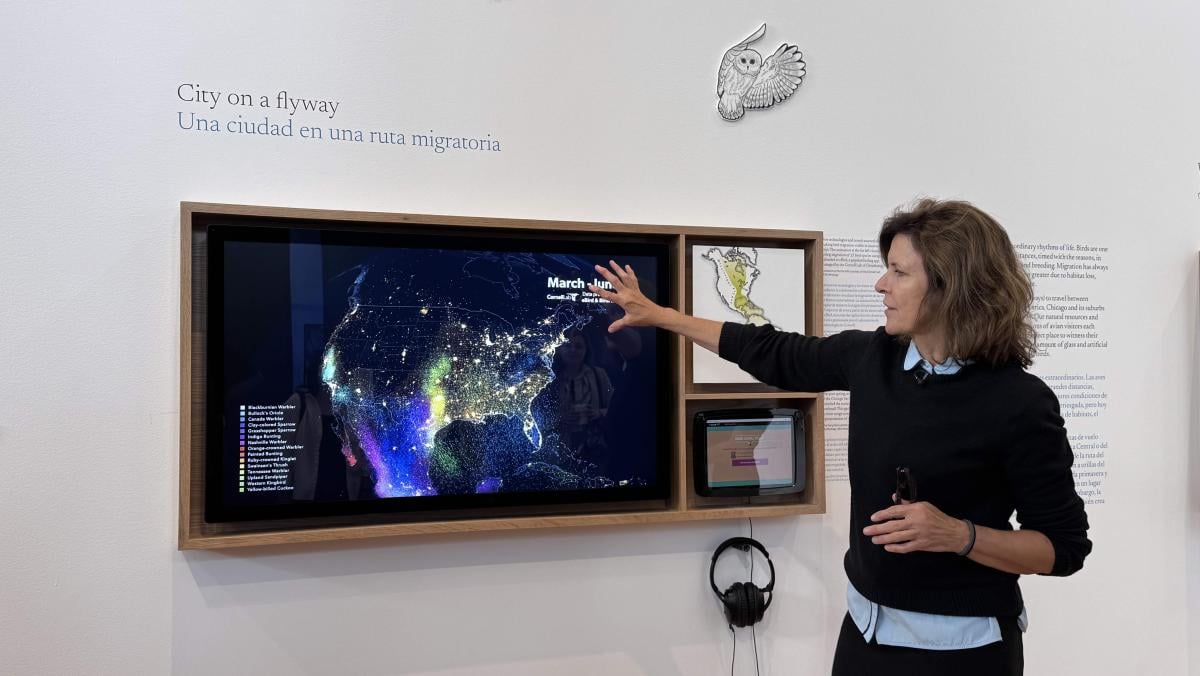 Jeanne Gang, at a preview of “Flyway City,” describes an animation that shows the massive number of birds that migrate along the Mississippi Flyway. (Patty Wetli / WTTW News)
Chicago’s Jeanne Gang is arguably one of the best-known architects working today. She’s spending whatever social capital comes with that reputation to argue for better building design — not just for humans but for wildlife, particularly birds.
A passionate birder herself — the kind who takes binoculars with her when she goes jogging on the lakefront — Gang has made bird-friendly design central to her practice, from the highly lauded Aqua Tower that soars above Lakeshore East to her company’s studio in the West Town neighborhood.
It’s past time for others to do the same, she said, and that includes Chicago officials who have yet to pass a bird-friendly building design ordinance.
“I see this as a sustainability issue. Loss of biodiversity is one of the most important parts of what’s happening with climate change, and we really don’t need to be killing birds with our buildings. It’s not necessary and it’s so avoidable,” Gang said at a preview of the new exhibit, “Flyway City,” opening Thursday at the Chicago Architecture Center and co-curated by her firm, Studio Gang.
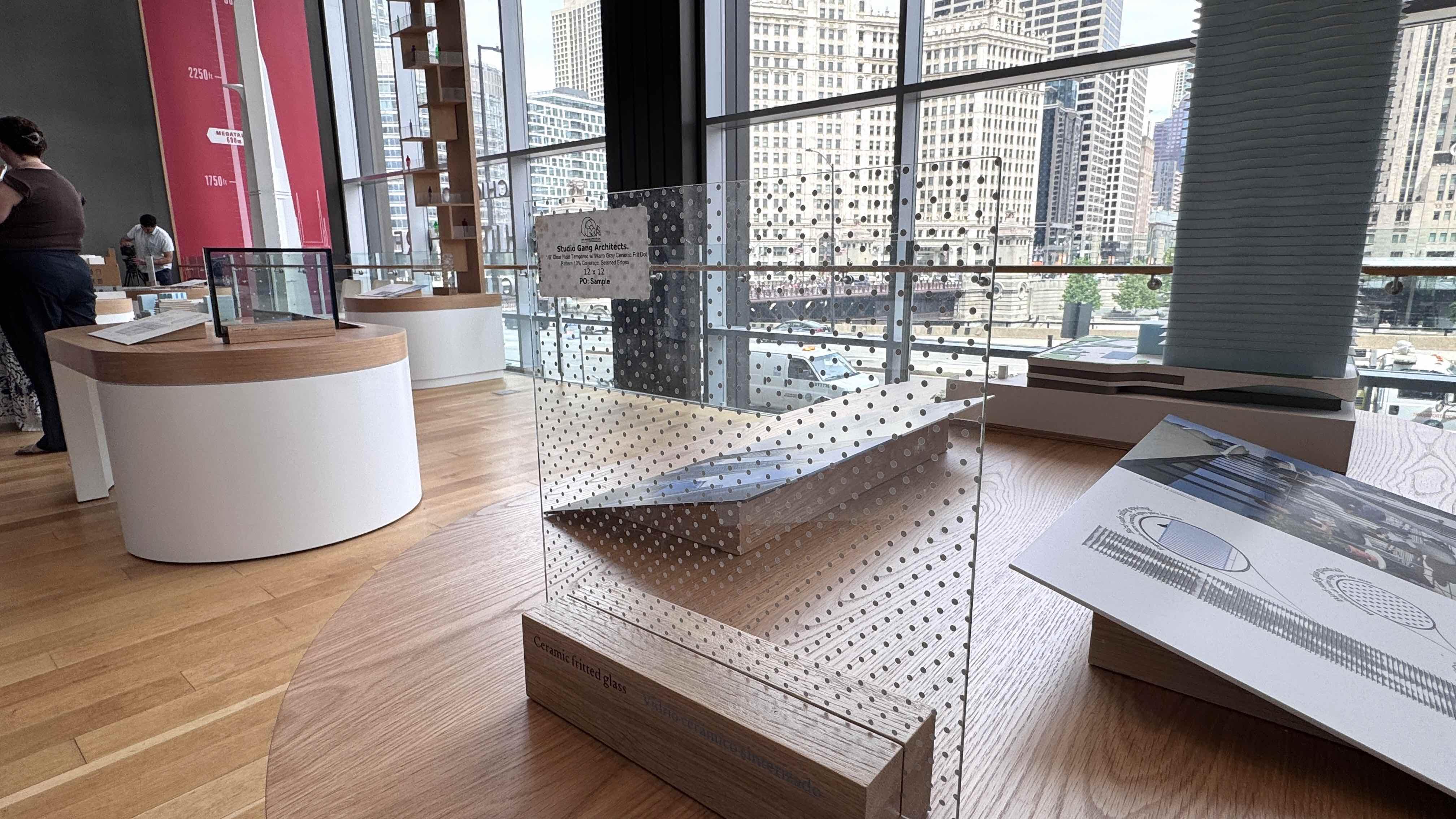 “Flyway City” includes models of some of the bird-friendly solutions developed by Jeanne Gang’s firm, Studio Gang. Here, bird-friendly glass used in the Aqua Tower is on display. (Patty Wetli / WTTW News)
The exhibit grew out of conversations between Gang and Eleanor Gorski, CEO and president of the Chicago Architecture Center, regarding the intersection of the built environment and the natural environment.
“We were talking about wildlife, cities, buildings and how the design of both need to respond more fully to wildlife and welcoming wildlife into cities,” Gorski said.
“Flyway City” feels very much like a continuation of those discussions, examining the city’s relationship with its winged residents, warts and all.
Throwing Stones at Glass Houses
Visitors enter “Flyway City” via a gallery housing a companion exhibit, “Chicago’s Living Habitat,” which was co-curated by the conservation organization Openlands and spotlights the region’s wealth of natural areas that surround the great metropolis. (See sidebar below.)
“We do think it’s important for people to understand this city and these buildings didn’t just rise out of nowhere. They exist in an ecosystem,” said Eve Fineman, senior director of exhibitions at the Chicago Architecture Center.
From there, guests are introduced to the Mississippi Flyway — a key route for migratory birds that gives the exhibit its name and also explains why a city as large as Chicago, which occupies a prominent position on the route, is so attractive to birds.
“You think of the city for people, but it’s really a habitat for many different kinds of living things,” Gang said.
On just a single run along Lake Michigan in late May, Gang notched sightings of a common yellowthroat, a magnolia warbler and a red-eyed vireo.
“The highlight of the year is spring migration,” Gang said. “Chicago is such an amazing place because it’s on this migratory flyway.”
The downside is that Chicago buildings kill a lot of those visiting birds (and year-round avian residents, too). “Flyway City” doesn’t shy away from this harsh reality, courtesy of a display of specimens of dead birds on loan from the Field Museum.
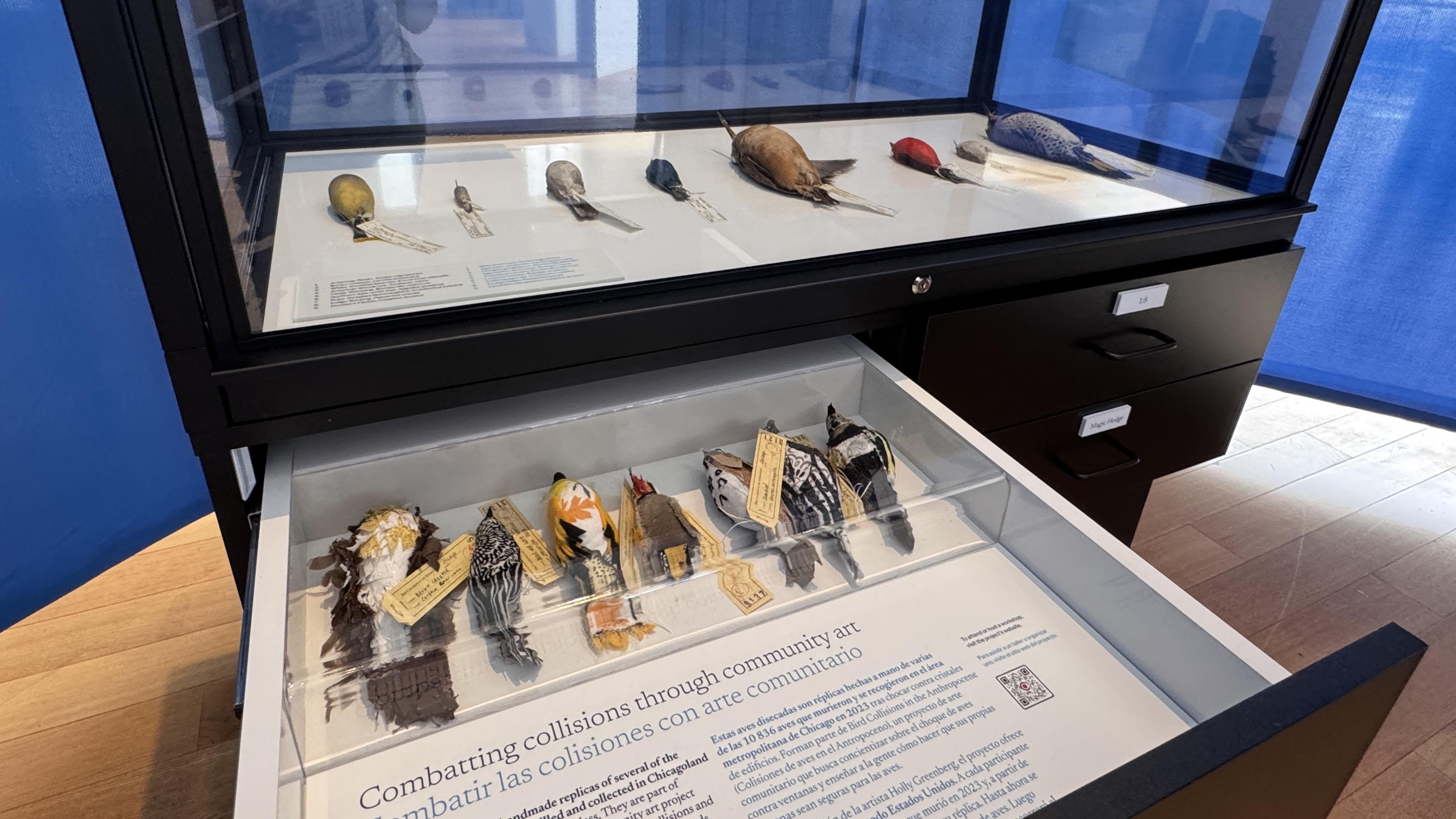 Chicago’s Field Museum loaned specimens of birds killed in collisions with the city’s buildings. A community art project is underway to create representations of the thousands of birds collected by the Field. (Patty Wetli / WTTW News)
The exhibit pulls zero punches in pointing a finger at the cause of so much carnage.
“Glass is the No. 1 problem with architecture,” Gang said, due to its transparency and reflectivity, both of which play tricks with birds’ vision.
“It’s a design issue … and a materials issue and a technical issue,” she said. “How do you make glass that birds can see and people can still see out of?”
“Flyway City” answers that question with real-world examples of buildings that have incorporated bird-safe elements. It’s this emphasis on solutions that forms the backbone of the exhibit.
There are models of original designs, including Gang’s Aqua Tower, where the balcony spindles were placed in a precise configuration to give birds a visual warning. Exhibit-goers will also find material samples, like a segment of the curving aluminum screen architect John Ronan devised for the Chicago Park District’s new headquarters to prevent bird collisions.
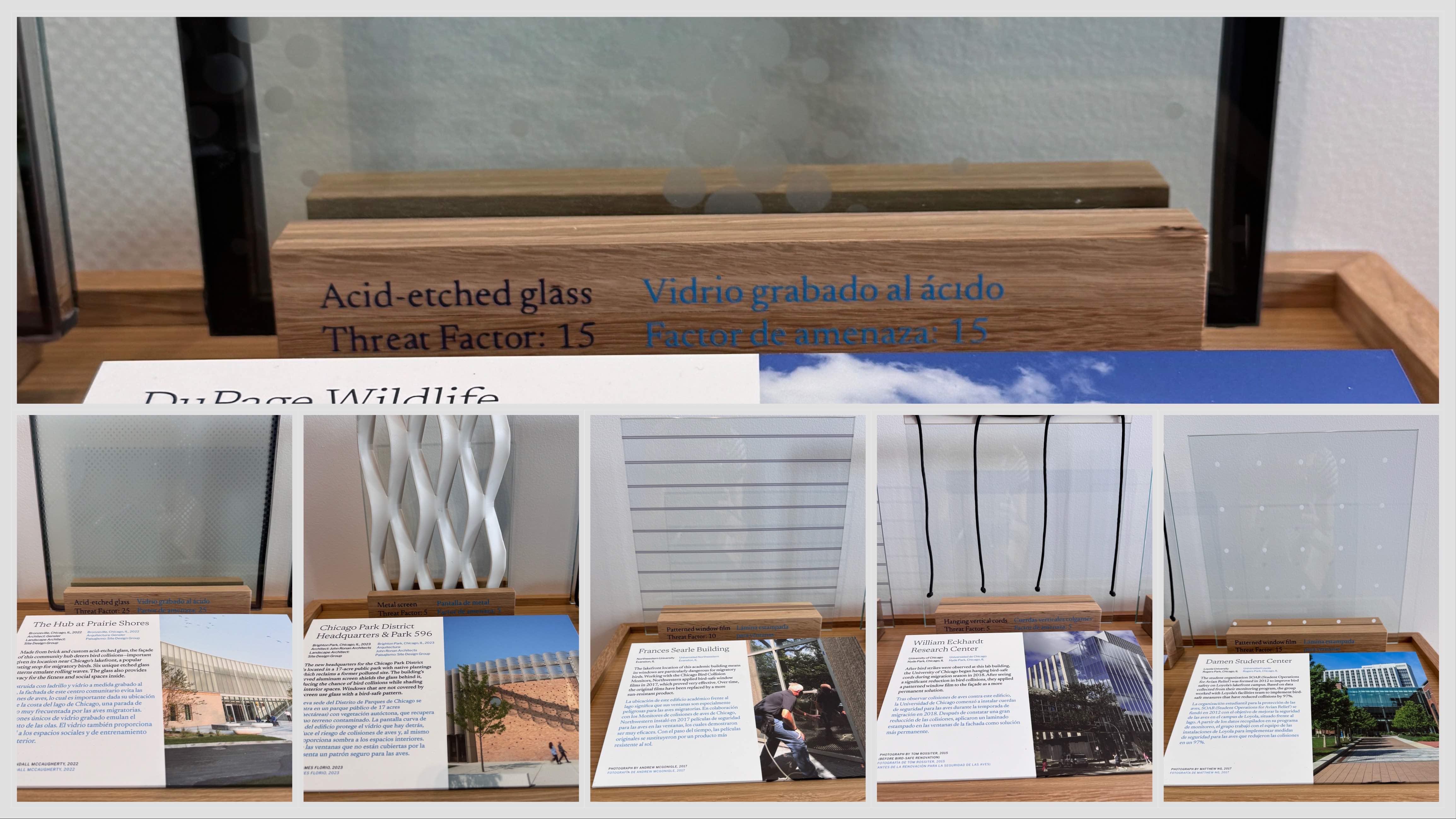 Different solutions to the same problem: “Flyway City” features samples of various bird-friendly window treatments. (Patty Wetli / WTTW News)
But new construction is less than half the battle, Gang said, and so the exhibit also confronts the problem of Chicago’s large stock of existing commercial and residential buildings — all those facades that never factored bird collisions into the equation. Retrofits receive their own spotlight in “Flyway City,” including formerly dangerous buildings on the campuses of Northwestern University, Loyola University and the University of Chicago, each of which deployed a different bird-friendly solution and managed to successfully reduce bird collisions.
Gang has seen with her own eyes that these methods save lives.
Studio Gang’s offices put many of her ideals into practice, including a rooftop prairie full of native plants and even a bur oak.
“Of course we want birds to come here,” Gang said. But she also wants them to be safe, so the roof’s glassed-in communal space has a bird-safe pattern to deter collisions.
“I can tell you I’ve been standing in this and I can see a bird coming toward the glass and it just up and turns,” she said. “Yeah, it really works.”
Walking the Walk
There’s one retrofit that technically isn’t part of the “Flyway City” exhibit, but can be viewed by visitors if they look closely out the architecture center’s windows.
“As part of walking the walk, the Chicago Architecture Center has put up bird-friendly film on our windows," Gorski announced during the exhibit preview.
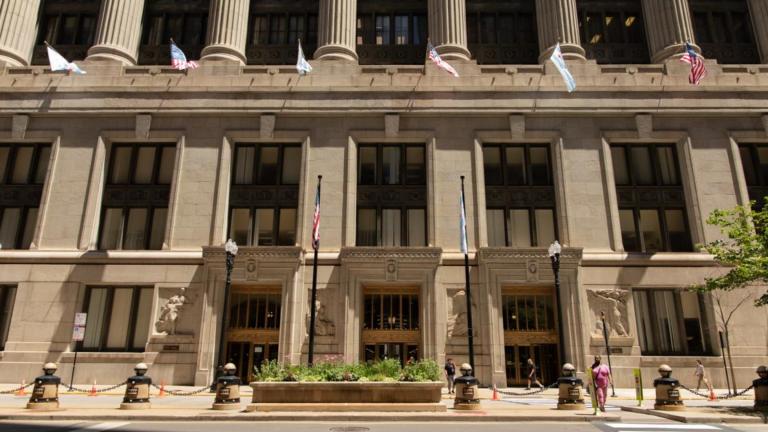
Shortly after arriving at the center in late 2022, Gorski said she began noticing bird strikes at the building, which rises up on Wacker Drive, near Michigan Avenue, along the Chicago River.
It took some back-and-forth with the building’s ownership before the alteration was approved, she said, and then the nonprofit needed to save up the funds to install the film.
“Any capital expense like this is a big deal for us, but we felt like this was so important both to educate the public as well as just for the health of the city and to be a good neighbor,” Gorski said. “We want to demonstrate that if we can do, everyone can do it.”
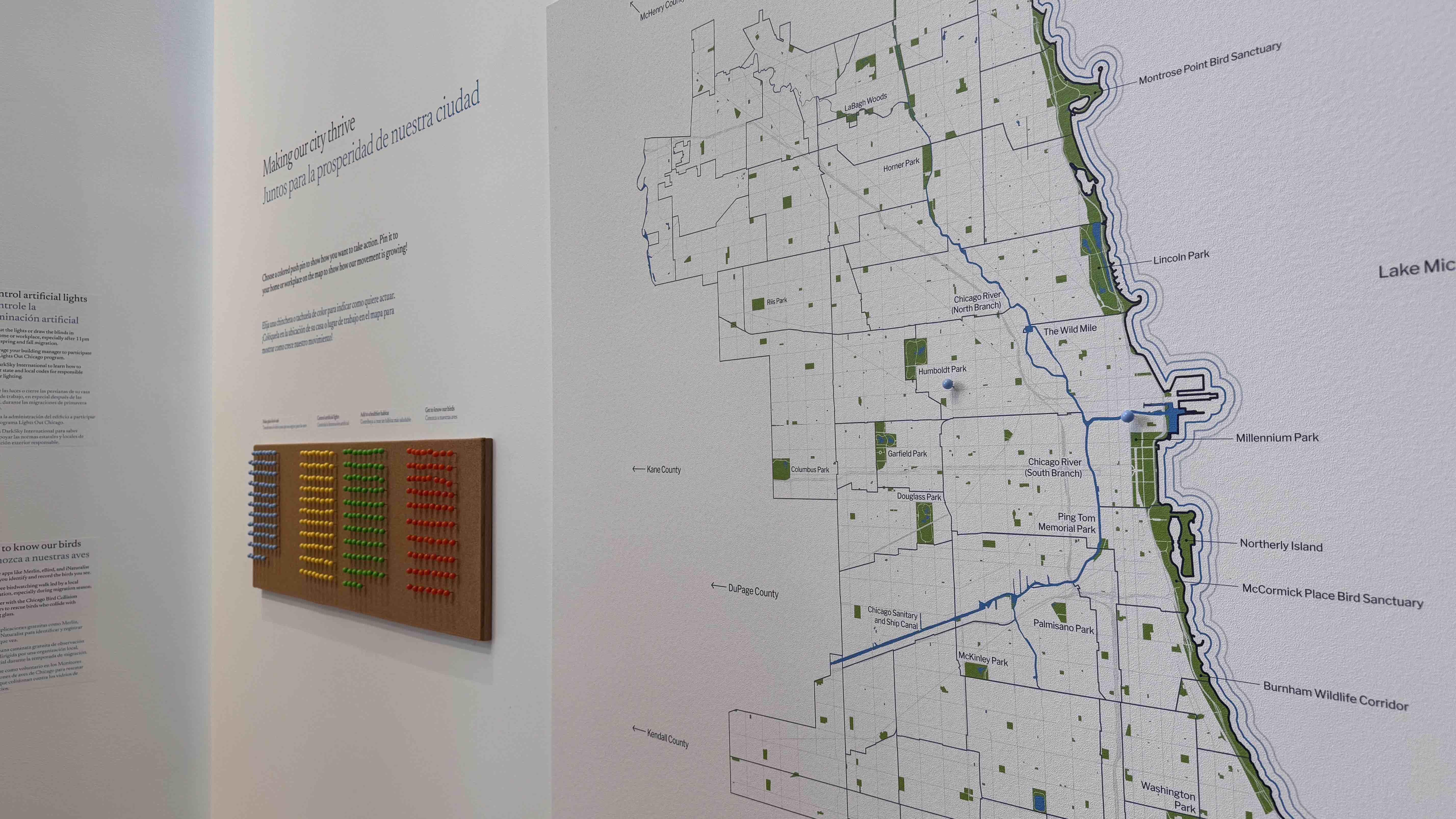 Visitors to “Flyway City” can commit to taking one of several bird-friendly actions at home and place a pin near their building. (Patty Wetli / WTTW News)
Indeed, “everyone can do it” is the parting message of “Flyway City.”
The exhibit closes with DIY solutions people could implement at home to make their own windows safer for birds. There’s also a call to action, specifically for Chicagoans, to reach out to elected officials and ask for the passage of a bird-friendly ordinance.
“We want to turn people on to the amazing quality of the birds that are in our city and impress upon them that there needs be change made so that it is safe for wildlife,” Gang said. "We’re going to try to create this whole new class of advocates for bird safety in the city.”
“Flyway City” runs from June 11 through the end of 2026.
‘Chicago’s Living Habitat’
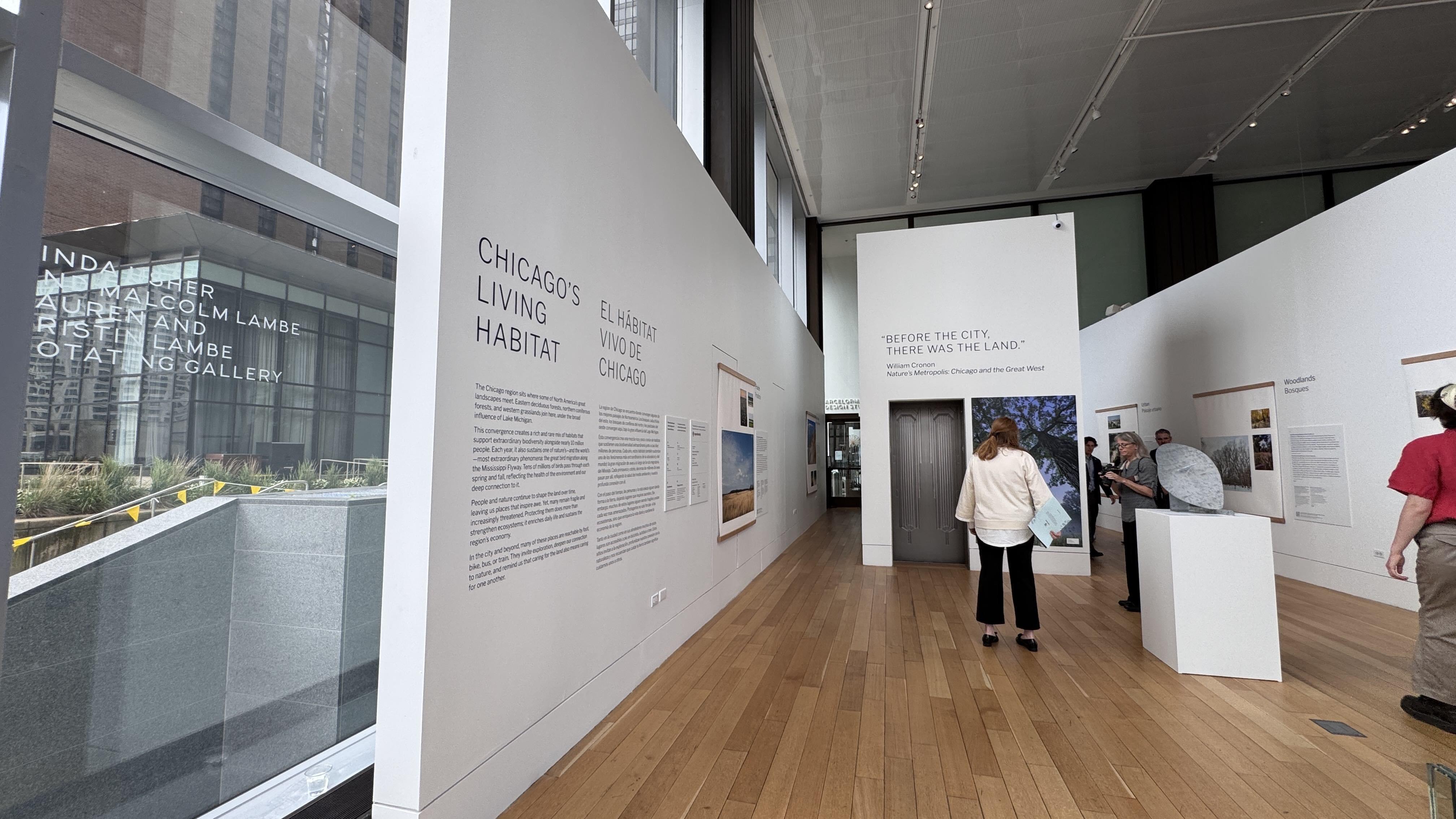 “Before the city, there was the land” is the dominant theme of “Chicago’s Living Habitat,” which leads into “Flyway City.” (Patty Wetli / WTTW News)
The Chicago region is one of the most unique places in the world, ecologically speaking. It’s just hard to see the forest (or the prairie or the wetlands) for the skyscrapers.
Openlands’ “Chicago’s Living Habitat” exhibit aims to bring that biodiversity to the forefront, as the companion to “Flyway City.”
“This is where the deciduous forests of the east, the grasslands of the west, hints of the coniferous forests from the north, and the Great Lakes all converge,” said Michael Davidson, president and CEO of Openlands.
The exhibit features examples of those myriad ecosystems — prairie, wetland, woodland, dune and swale, and urban nature — in various states, be it a near-pristine remnant, acreage under restoration, or a natural area created from scratch.
“What I hope that people feel as they leave ‘Chicago’s Living Habitat’ and move into ‘Flyway City’ is a sense of, ‘Wow, this place is a lot more important than I ever thought it was, and it’s worth protecting,’” Davidson said.
Contact Patty Wetli: [email protected]