Politics
Yusef Jackson on His Father’s Legacy, Bringing the Rainbow PUSH Coalition Into the Future
A new chapter begins for the Rainbow PUSH Coalition following the death of civil rights icon the Rev. Jesse Jackson Sr.
The organization Jackson Sr. made into a national force for economic and racial justice has new leadership: the reverend’s youngest son, Yusef Jackson, who was unanimously chosen by the Rainbow PUSH board.
He’s inheriting an organization with decades of history and is charged with taking it into the future.
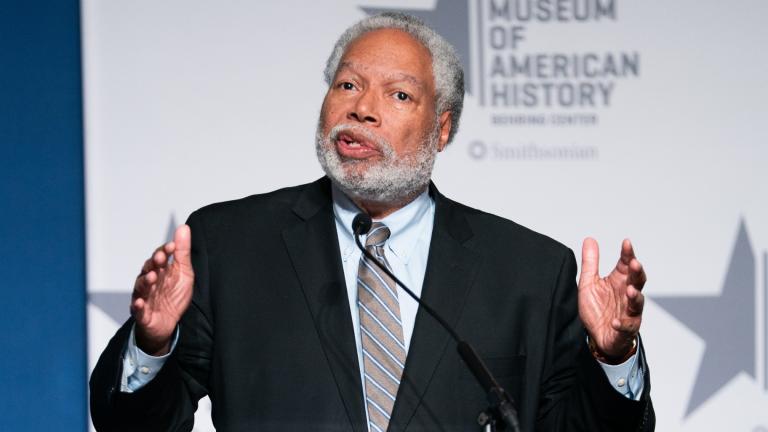
Newly appointed Rainbow PUSH CEO and President Yusef Jackson joined “Chicago Tonight” to discuss his father’s legacy and modernizing the social justice organization. Here’s what he had to say:
On heading the organization his father founded:
“I’m honored that the board of directors had faith in me. I thank my mother; I thank my father, Rev. Jesse L. Jackson Sr., for the faith he had to entrust me with this legacy of service and to take it into the future.”
On his father’s legacy:
“My father has always said he never wanted to retire. He’s not the retiring kind of guy, he just retired in the kind of work that he does. It was in his spirit. The spirit of service was in his body, and so he wanted to die with his shoes on, and that’s how he did it, well-worn shoes. He had holes and he had a dirty uniform on, and that’s how he would have it. So it was important for me that he passed with the titles that he earned.”
“It remains our mission to gain, protect and defend civil rights — but he (Jackson Sr.) was coming out of Jim Crow. He was coming out of ‘separate but equal,’ and so he saw the law change with the ‘64 Civil Rights Act, the Voting Rights Act, the public accommodations bill, but even the cultures had to change. So he went and touched almost every part of American culture he could: public accommodations, the libraries, the water fountains, the staffing. He had to convince African Americans that they are somebody, that they had dignity to believe in (themselves) and that (they) deserve these new rights. You have to remember, there was a time when they questioned the size of our brains. Can an African American person have the capacity to play quarterback? Do you have the capacity to manage a game pitching from the mound? Do you have the capacity to coach a football team? And so he had to make changes from music to automobile industries to manufacturing, all the industries he went to touch.”
On taking Rainbow PUSH into the future:
“What we’ve got to do is we’ve got to teach civics on a block by block, person by person, group by group level, state by state, city by city. What does that mean? There are civil rights advocates, (from) ‘64 and ‘65, a lot of them are passing on, as my father has, but the beneficiaries of civil rights is 80% of the country. Every woman in sports, every woman in jobs who has a chance to get dollar for dollar compared to a male, every African American, every non-western European immigrant since 1965, every immigrant since 1965, you are a beneficiary of the civil rights advocacy groups. You wouldn’t be here and have the opportunities you have but for civil rights, and so it’s up to you, advocates and beneficiaries who’ve taken the gains that we’ve offered you from advocacy and to teach other generations.”
On modernizing the fight:
“We went to Minneapolis and we brought together groups of African Americans and Haitian, Somalis and Jewish groups and peace groups and learned firsthand what ICE was doing. It occurred to us that the fight in Minneapolis was about citizenship and the right to vote. The former attorney general said, ‘If you give us your voter registration list, we’ll send ICE home.’ Citizenship and the right to vote. It’s the same fight John Lewis, Jesse Jackson and young Dr. King were having in March 1965 at Selma. Citizenship and the right to vote. So the bridge between Minneapolis and Selma is one of continuous legacy, but the folks in Minneapolis didn’t really see the relationship to Selma. Citizenship and the right to vote. So we took five busloads of people from Minneapolis to Selma, and from Washington, D.C., and Chicago to march across the bridge to baptize themselves. Selma, the Edmund Pettus Bridge, is our Jordan River.”
On main priorities:
“We have a big trade deficit with the country — Black and Brown people. If we close those gaps with the Civil Rights Act alone, the Voting Rights Act alone, the public accommodations bill, education, housing, life expectancy, affordable health care, then Black and Brown people would represent over the next five years $5 trillion of additional GDP. $5 trillion. It’s worth investing in African American and Brown people in the country right now because it’s a safe bet. We’re right here, right next to you. And over the last 20 years, we’ve lost $30 billion based on the disinvestment in African American and Brown communities.”
On how he and his family are doing following the death of Jackson Sr.:
“Every day we have four seasons in our lives. It’s still hard to talk about. I want to give you a good answer for that, but I’m not sure I can answer it appropriately on television because it’s still very painful for us.”