Crime & Law
An Incarcerated Pregnant Woman in Illinois Was Forced Into Induced Labor, Lawsuit Alleges
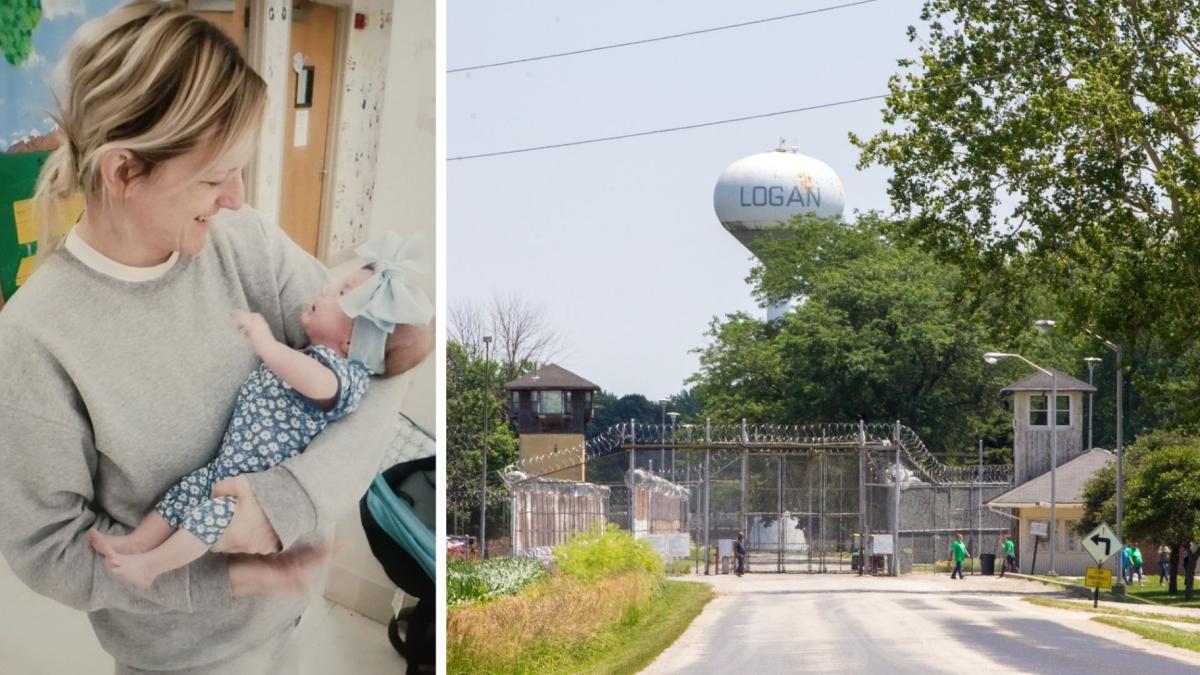 Left: Amy Hicks filed a lawsuit against the Illinois Department of Corrections and Wexford Health Sources alleging she was forced to undergo induced labor during the birth of her third child. (Courtesy of Amy Hicks) Right: Logan Correctional Center is pictured in a file photo. (Blair Paddock / WTTW News)
When Amy Hicks was pregnant and incarcerated at Logan Correctional Center in 2024, she said prison staff didn’t give her a choice as to how she’d give birth to her third child.
Despite her wish for a natural pregnancy, she said prison employees scheduled her for an induction of labor prior to her due date.
“I was scared; I didn’t believe it at first,” Hicks told WTTW News.
Hicks alleges her experience isn’t singular: Prison employees told her that an induction of labor scheduled by officials was the policy for all those pregnant at Logan — regardless of individual medical need or consent.
Now, Hicks is suing the Illinois Department of Corrections and Wexford Health Sources, which up until last year provided health care to the prison system. The federal lawsuit, recently filed in part by the ACLU of Illinois, alleges the defendants violated the Illinois Reproductive Act when they ordered and/or facilitated the induction of Hicks’ labor against her will.
That act says people have the fundamental right to make autonomous decisions about their own reproductive health care. It also prohibits the state from denying, restricting, interfering with or discriminating against an individual’s exercise of that fundamental right, including people under state custody, control or supervision.
The lawsuit further alleges that IDOC and Wexford violated Hicks’ right to refuse medical treatment when they caused her to be induced against her will.
“The forced induction was painful, physically violating, and emotionally traumatizing,” the lawsuit states.
IDOC spokesperson Naomi Puzzello said in a statement that “all medical procedures provided to individuals in custody, including those related to pregnancy and childbirth, require the informed consent of the patient. Informed consent is fundamental to medical care and is the policy of the Department.”
The department declined to comment further citing ongoing litigation.
Wexford Health Sources did not respond to requests for comment by publication time.
‘In Hell’ Being Pregnant
Hicks was in her third trimester when she arrived at Logan Correctional Center in January 2024. During her first medical appointment with the OB-GYN, medical staff did not note any complications or concerns with Hicks’ pregnancy, the lawsuit details. Years before, she did not have complications during the births of her first two children.
Hicks “strongly desired” to go into labor naturally and did not want her labor to be artificially induced — especially not prior to her due date, according to the lawsuit.
But within days of her arrival, Logan staff informed her that it was the prison’s policy that all pregnant incarcerated people would be scheduled for induction of labor, in lieu of waiting for spontaneous labor, the lawsuit alleges.
Prison staff scheduled Hicks to be induced two weeks before her estimated due date, the lawsuit alleges.
In fear of harm to her child and herself, Hicks filed grievances indicating she did not want to have her labor induced. Her counselor told her that she could not “pick and choose” how to deliver her baby because she was in prison, the lawsuit alleges. Hicks said she sent two more grievances on the issue and never received responses.
“(Hicks) felt like she was ‘in hell’ being pregnant while incarcerated at Logan because her expressed wish not to be induced was being disregarded by all the IDOC and Wexford staff she encountered,” the lawsuit states.
During one of her prenatal appointments, the lawsuit alleges, Hicks was told she would be tested for gestational diabetes and given advanced notice of the test.
The lawsuit alleges that a planned appointment was canceled. Then, after a morning of sweet foods, Hicks alleges she was called in to test without advance notice. Based on those results, the OB-GYN told Hicks she had gestational diabetes, resulting in a week-long stay in the prison infirmary for monitoring, according to the lawsuit.
Throughout this period, the lawsuit alleges, Hicks’ glucose levels were normal or even low.
Despite that, notes from a nurse practitioner state that the induction of Hicks’ labor was being scheduled for 38 weeks gestation “due to uncontrolled (gestational diabetes),” the lawsuit states.
Early on the morning of Feb. 12, 2024, Hicks was woken up to be taken to the hospital for induction.
“(Hicks) told the correctional officer who woke her up that she did not want to go and did not want to be induced,” the lawsuit alleges. “The correctional officer told (Hicks) once again that she did not have a choice, and that correctional officers were already on their way to come get her and take her to the hospital for the induction.”
At the hospital, Hicks was given an epidural and IV infusion to induce labor. A doctor, not employed by IDOC or Wexford, said she was not dilating quickly enough and he had to break her water and may need to sweep her “membranes,” causing a “pain worse than the subsequent birth itself,” the lawsuit alleges. The doctor did not stop despite Hicks’ protest and told her that it was the “bloody show,” but did not explain what that meant, frightening Hicks, the lawsuit continues.
Hicks then gave birth to a baby girl, left the hospital and soon after was transferred to Decatur Correctional Center for the “Moms and Babies” prison nursery program to care for her newborn. Hicks was released a few months later and took her baby home in June 2024.
During her incarceration, Hicks told WTTW News, she heard of several other women who had similar experiences. She said she hopes the lawsuit will help other people stand up for their right to have their child as they want.
“Just because we are going through something with our criminal past does not have anything to do with our reproductive rights,” Hicks said.
Contact Blair Paddock: @blairpaddock.bsky.social | [email protected]