Politics
As Chicago Ethics Board Surpasses 6 Months Without a Leader, Enforcement Actions Stall
 (WTTW News)
The Chicago Board of Ethics, which has been without a permanent leader for more than six months, was forced to cancel two recent meetings, stalling several probes into campaign finance law violations, nepotism in city hiring and bribery.
Mayor Brandon Johnson’s failure to name a new Ethics Board chair has infuriated good-government advocates who are again demanding that he do more to combat Chicago’s reputation as the most corrupt of corrupt American cities.
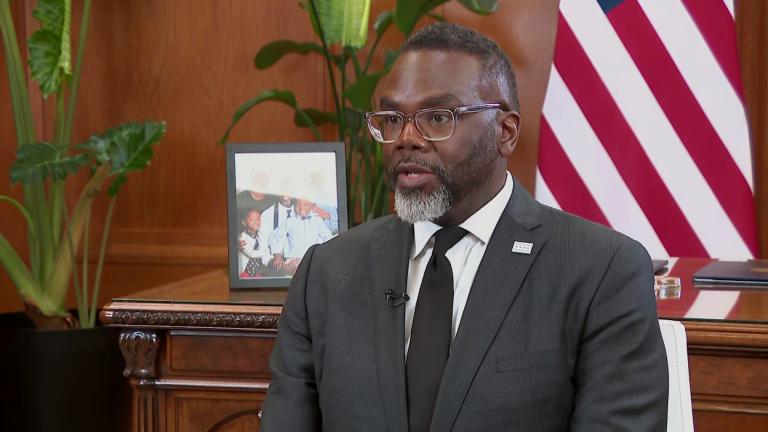
Johnson told WTTW News on Wednesday that the fact that he has not yet named a replacement for former Ethics Board Chair William Conlon, who stepped down in July after nine years on the board, is not an indication that he has not prioritized ethics as mayor.
“Ethics are important,” Johnson said. “We have an entire process we go through to vet people. It’s about getting the right people in place, but absolutely ethics are important to us.”
Ald. Matt Martin (47th Ward), the chair of the Ethics and Government Oversight Committee, said there was no reason the mayor’s office has not found a replacement for Conlon, who announced in June he would step down when his term expired in July.
“The mayor’s record shows a continued lack of commitment to ethics and government oversight,” said Martin, who has long been critical of the time it has taken Johnson to fill vacant seats on the Ethics Board.
There are nine pending enforcement actions before the board, which was unable to meet in October and January to review probes completed by Inspector General Deborah Witzburg that found wrongdoing.
Officials have a “critical” obligation to enforce the city’s ethics law, Martin said.
“We are not hitting that mark now,” Martin said.
Bryan Zarou, vice president of the Better Government Association, called the mayor’s failure to pick a replacement for Conlon and to either reappoint or replace Commissioner Norma Manjarrez deeply frustrating and “ridiculous.”
Although her term expired on July 31, Manjarrez has continued to serve on the board, as allowed by city ordinance.
“If you can’t replace the chair of the Ethics Board in seven months in a city with historic ethics problems, that is a huge issue,” Zarou said.
Search for New Watchdog Underway
As the Ethics Board struggles to enforce Chicago’s ethics ordinance with a vacant seat, the search for a replacement for Witzburg, who is set to leave office in April, is underway.
For the first time in Chicago history, the search for the city’s next watchdog, who will earn more than $200,000 annually, is being conducted by a five-member committee created by legislation crafted by Martin.
Johnson appointed three members of the search committee, while Martin appointed the other two members.
Martin appointed Zarou and Sharon Fairley, a former federal prosecutor who led the Civilian Office of Police Accountability, to the committee.
The mayor appointed Emma Tai, the former executive director of United Working Families who served on Johnson’s transition committee in 2023; Emmanuel Andre, the deputy of policy for the Cook County Public Defender’s Office; and Jeff Levine, who retired last year as the city’s chief assistant corporation counsel.
The mayor’s office did not publicly announce Johnson’s picks for the search committee or announce that it had started work, but confirmed the appointments in a statement to WTTW News.
The search firm hired by the committee has four months to submit its picks to replace Witzburg to the committee. It will take four members of the committee to select at least one finalist for the job and send that recommendation to the mayor, according to the ordinance.
If Johnson accepts one of the finalists picked by the search committee, that nomination will head to the City Council for confirmation. Johnson can reject all of the search committee’s picks and start the process over. But if the mayor fails to act, the City Council’s Ethics Committee can make its own selection and ask the full City Council to confirm that pick, according to city ordinance.
Those changes were designed to prevent a repeat of the turmoil that engulfed the inspector general’s office after former Mayor Lori Lightfoot declined to reappoint former Inspector General Joseph Ferguson, who left office in October 2021 after 12 years in office.
Chicago was without a watchdog for six months, outraging advocates for good government.
Johnson has spent most of what he hopes will be his first term as mayor of Chicago at odds with those who want to reform the system that sent the most powerful politicians in Chicago history to prison for leveraging their elected offices for perks or cash.
Johnson has clashed with both Witzburg and Martin, whom he picked to lead the Ethics Committee.
The City Council voted unanimously in September 2024 to ban registered lobbyists from sending campaign cash to Chicago mayors — and those running to be the city’s chief executive. Johnson had blocked that measure from getting a vote for months before he bowed to pressure.
In January, Witzburg released an audit that detailed repeated efforts by the mayor’s staff to hinder her probe into the mayor’s acceptance of gifts on behalf of the city. Forty days later, Johnson opened the so-called City Hall “gift room” to scrutiny as Witzburg had demanded.
Witzburg’s probe of the gift room sparked a tense showdown between her office and the city’s Law Department, led by Corporation Counsel Mary Richardson-Lowry.
After the inspector general accused the mayor’s office of interfering with probes that risked “embarrassment or political consequences,” the City Council voted 49-1 to amend the city’s ethics law to prevent that interference.
Johnson had blocked a vote on that measure for months, until he again relented under pressure.
Contact Heather Cherone: @HeatherCherone | (773) 569-1863 | [email protected]