Politics
Trump Leaves Military Action Against Venezuela on the Table But Floats Possible Talks
Video: Joining “Chicago Tonight” are Lina Britto, professor of Spanish, Portuguese, Latin American and Caribbean Studies at Northwestern University; and Alberto Coll, professor of law and director of global engagement at DePaul University. (Produced by Joel Ortiz)
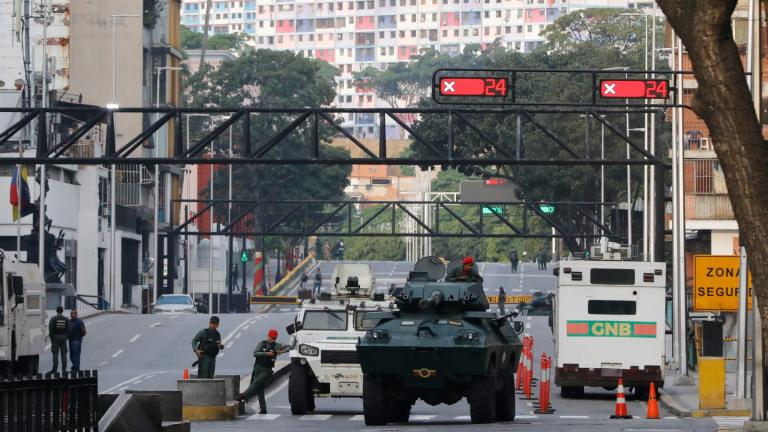
WASHINGTON (AP) — President Donald Trump on Monday did not rule out military action against Venezuela despite bringing up a potential diplomatic opening with leader Nicolás Maduro, who has insisted that a U.S. military buildup and strikes on alleged drug boats near his South American country are designed to push him out of office.
Trump reiterated that he “probably would talk to” Maduro, but underscored that he is not taking off the table the possibility of military action on Venezuelan territory.
“I don’t rule out that. I don’t rule out anything,” Trump told reporters in the Oval Office a day after he first floated the possibility of having “discussions” with Maduro. Trump, however, sidestepped questions about whether Maduro could say anything to him that would lead to the U.S. backing off its military show of force.
“He’s done tremendous damage to our country,” said Trump, tying Maduro to drugs and migrants coming into the U.S. from Venezuela. “He has not been good to the United States, so we’ll see what happens.”
The comments deepened the uncertainty about the Trump administration’s next steps toward Maduro’s government. The U.S. has ratcheted up the pressure in recent days, saying it was expecting to designate as a terrorist organization a cartel it says is led by Maduro and other high-level Venezuelan government officials.
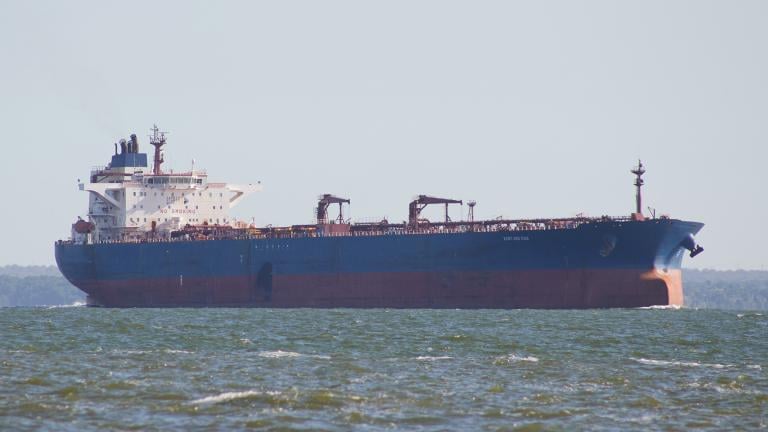
The USS Gerald R. Ford and accompanying warships arrived in the Caribbean this weekend just as the U.S. military announced its latest in a series of strikes against vessels suspected of transporting drugs.
‘Can Turn Policy on a Dime’
The administration says its actions are a counterdrug operation meant to stop narcotics from flowing to American cities, but some analysts, Venezuelans and the country’s political opposition see them as an escalating pressure tactic against Maduro.
The Trump administration has shown it “can turn policy on a dime,” said Geoff Ramsey, an expert on U.S. policy toward Venezuela who is a nonresident senior fellow at the Atlantic Council. He pointed to the diplomatic talks the administration held with Iran “right up until the point” that the U.S. military targeted Iran’s nuclear facilities in June.
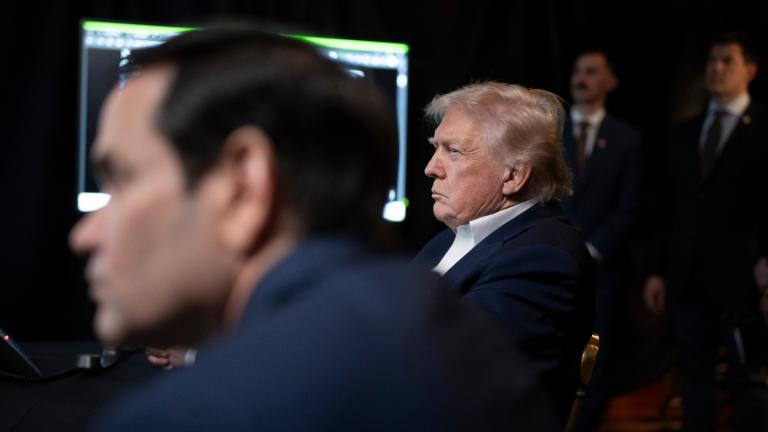
But, Ramsey added, the timing of Trump’s remarks — after Secretary of State Marco Rubio’s announcement of the impending terrorist designation of the Cartel de los Soles — underscores that the administration does not want to repeat failed attempts at dialogue.
“They really want to negotiate from a place of strength, and I think the White House is laying out an ultimatum for Maduro,” Ramsey said. “Either he engages in credible talks about a transition, or the U.S. will have no choice but to escalate.”
Maduro has negotiated with the U.S. and Venezuela’s political opposition for several years, most notably in the two years before the July 2024 presidential election. Those negotiations resulted in agreements meant to pave the way for a free and democratic election, but Maduro repeatedly tested their limits, ultimately claiming victory despite credible evidence that he lost the contest by a 2-to-1 margin.
Among the concessions the U.S. made to Maduro during negotiations was approval for oil giant Chevron Corp. to resume pumping and exporting Venezuelan oil. The corporation’s activities in the South American country resulted in a financial lifeline for Maduro’s government.
Neither Maduro nor his chief negotiator, National Assembly president Jorge Rodriguez, commented Monday on Trump’s remarks. A spokesperson for Venezuelan opposition leader and Nobel Peace Prize winner María Corina Machado told reporters Monday that she would not comment on Trump’s remarks.
Trump Also Talks About Mexico
Trump didn’t even rule out possible military action against close allies in the region.
“Would I want strikes in Mexico to stop drugs? OK with me, whatever we have to do to stop drugs,” Trump said, adding that he’s “not happy with Mexico.”
Trump said the U.S. government has drug corridors from Mexico “under major surveillance” and said he would also like to target Colombia’s “cocaine factories.”
“Would I knock out those factories? I would be proud to do it personally. I didn’t say I’m doing it — but I would be proud to do it,” he said.
Skepticism and Hope in Venezuela About Possible Talks
Trump’s goal on Venezuela remains unclear, but above all, Ramsey said, the president “is looking for a win.”
“And he may be flexible on exactly what that looks like,” Ramsey said. “I could envision the U.S. pushing for greater control over Venezuela’s natural resources, including oil, as well as greater cooperation with the president’s migration and security goals.”
In Venezuela’s capital, Caracas, people responded with skepticism and hope to the possibility of a new dialogue between the U.S. and Maduro, whose government has fueled rumors of a ground invasion despite the Trump administration giving little clear indication of such a plan.
“If (the dialogue) actually happens, I hope the government will actually follow through this time,“ shopkeeper Gustavo García, 38, said as he left church. ”We have to be serious. They’ve gotten us used to them talking, but they don’t honor the agreements. You don’t mess with Trump.”
Stay-at-home mother Mery Martínez, 41, said, “Talking is always better.”
“Anything that helps prevent a tragedy is good," Martínez said. “Venezuelans don’t deserve this. A war benefits no one.”
Historical Perspective
Lina Britto is an associate professor of history at Northwestern University and affiliated faculty in the school’s department of Spanish and Portuguese. She teaches about modern Latin America and shared her initial reactions to the ongoing escalation in the Caribbean.
“I don’t think it’s really just about Venezuela,” Britto said. “I think we really need a transnational lens that goes beyond Venezuela.”
She said the situation has been presented as if it were just a conflict between the two countries. Instead, Britto believes the situation extends to a conflict with the region as a whole.
Much of Britto’s focus is on the war on drugs on a transnational level. She believes the war, started by the United States, is “not really about drugs. It’s a toolkit for state violence in moments of crisis.”
She said the war on drugs presents itself in a pattern throughout history, but there are important changes in the current iteration — in particular, the use of new technology and a rapid escalation.
The war on drugs typically happens through “bilateral agreements” between countries where enforcement is a joint effort between the United States and another country, Britto said. However, she believes what we are seeing now, for the first time, is the U.S. government “unilaterally using the war on drugs — weaponizing the war on drugs against other governments in the region — instead of using it as a tunnel of negotiation with them to administer state violence in a transnational way.”
Britto said the only way to understand what is happening in Venezuela is to understand what is happening in the broader Caribbean. There is a long history, she said, of the United States using the Caribbean as its backyard to “experiment as a laboratory of violence in different moments of political crisis whether it is in the U.S. or in another country.”
She said it appears the Republican Party is split in its goals, seemingly between two ways to move forward in foreign policy with Venezuela. The first is full-scale U.S. intervention including a ground invasion and occupation to enact a regime change. The second is finding a path toward acquiring Venezuela’s oil and allowing companies to export oil from Venezuela.
Britto referenced the limited U.S. license Chevron was given earlier this year to operate in Venezuela. That was not possible a few years ago due to strict sanctions placed on the country.
“What we really have here,” Britto said, “is a split within the Trump administration.”