Crime & Law
Where Major Lawsuits Over Broadview ICE Conditions, Use of Force Stand After Big Week in Court
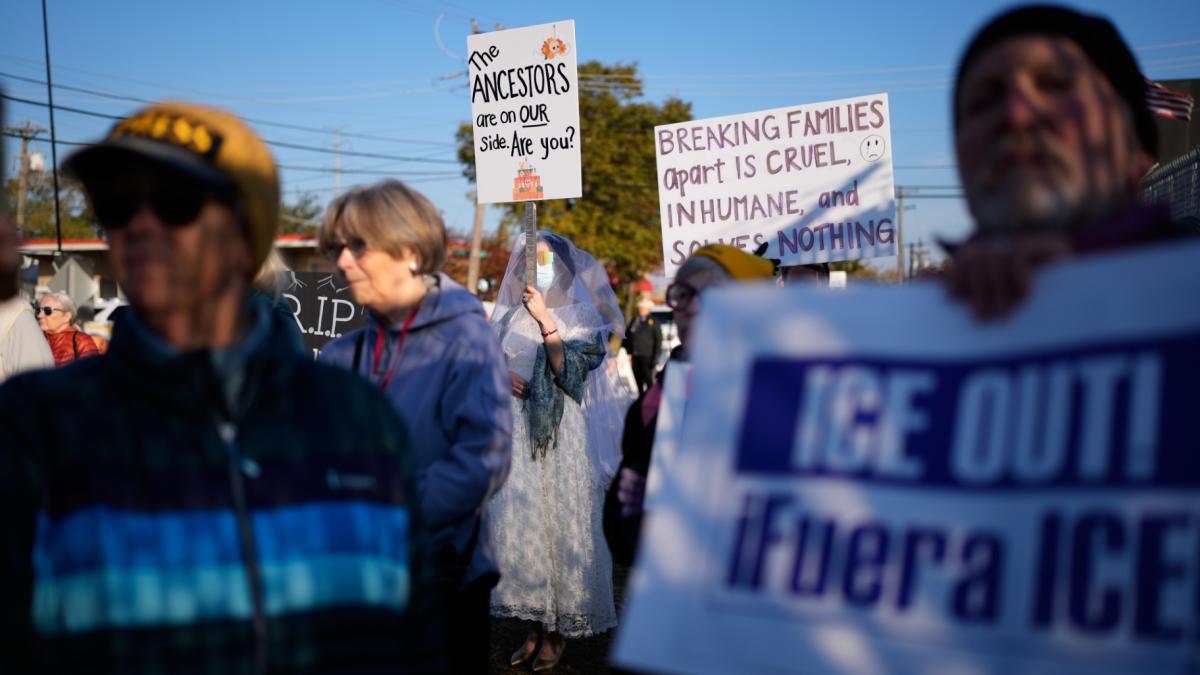 Protesters gather outside an ICE processing facility in the Chicago suburb of Broadview, Ill., Friday, Oct. 31, 2025. (AP Photo / Nam Y. Huh)
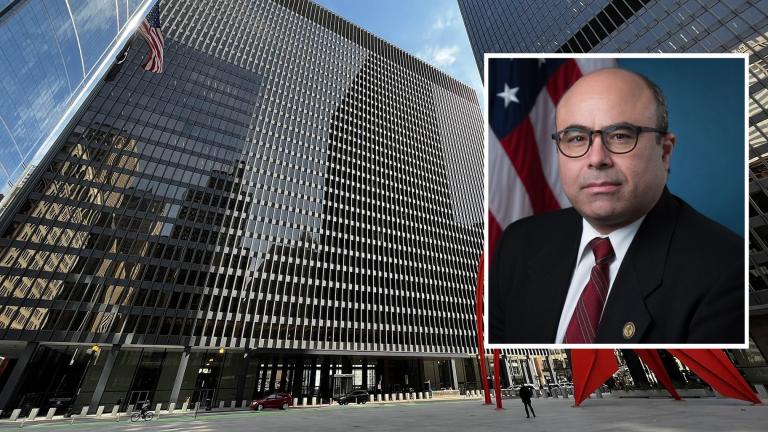
After daylong hearings, hours of witness testimony and high-profile rulings, Chicago’s Dirksen Federal Building has served as the battleground over the Trump administration’s wildly expanded immigration enforcement efforts throughout northern Illinois.
Federal judges this week have filed sweeping orders reining in federal immigration agents’ use of force and requiring Immigrations and Customs Enforcement to immediately improve “inhumane” living conditions at its suburban processing facility.
One judge found a top Border Patrol official lied about threats he faced before deploying tear gas, and called the Trump administration’s versions of events in multiple use-of-force incidents not credible.
While immigration enforcement continues at a drastically increased pace under the ongoing “Midway Blitz” operation, legal battles in the Dirksen continue shaping how those efforts can be carried out.
After a big week in court, here’s where several prominent cases in Chicago currently stand.
Use of Force by Immigration Agents
What the case is about: The lawsuit was brought by a group of local journalists, protesters and clergy members in early October. In it they alleged they had been subjected to a “pattern of extreme brutality” by immigration agents who had repeatedly used unjustified force against them without cause.
The lawsuit (Chicago Headline Club et al. v. Noem et al.) accused ICE and Border Patrol agents of deploying tear gas, pepper balls and other “less lethal” weapons against demonstrators and reporters gathered outside the federal immigration processing center in suburban Broadview.
What’s happened so far: Days after the suit was filed, U.S. District Judge Sara Ellis granted a temporary restraining order that barred federal agents from using those “riot control” weapons against anyone who didn’t pose an immediate threat to them and required them to issue multiple warnings before any such weapon was used.
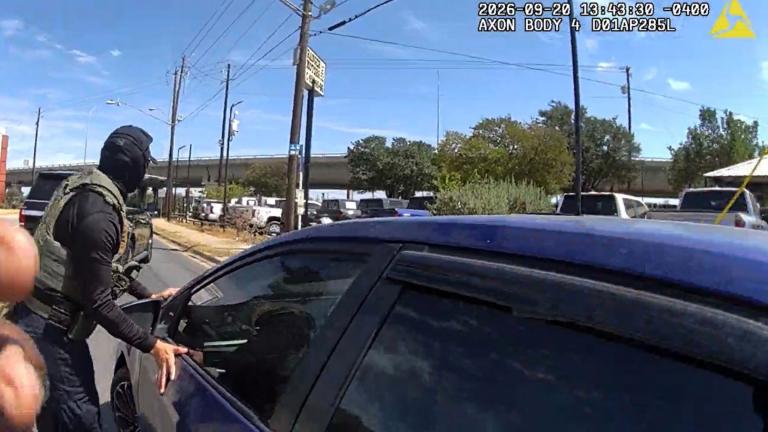
Despite that order, immigration agents continued to use similar force throughout October, not only in Broadview, but in a series of high-profile incidents across Chicago. Since Oct. 3, federal agents have fired tear gas at Chicagoans seven times, along with pepper balls and other crowd control measures.
In one incident on Oct. 24, body-worn camera footage recorded one agent mocking a crowd in Lakeview as tear gas was deployed, saying twice, “have fun!” and laughing as they fled.
Border Patrol chief Greg Bovino — the commander of the Trump administration’s ongoing “Midway Blitz” immigration operation and the public face of Trump’s mass deportation push — was ordered to sit for questioning by Ellis herself and later by the plaintiffs’ attorneys during a dayslong deposition.
Bovino fired at least two canisters of tear gas at a crowd in Little Village on Oct. 23 during a confrontation sparked by agents’ decision to detain a man at a bus stop near 26th and Whipple streets, prompting a crowd of angry residents to flock to the scene.
Bovino testified under oath that he’d been hit in the head with a rock before deploying the tear gas, but later admitted that story was not true.
Where the case is now: The plaintiffs’ attorneys claimed federal agents had repeatedly flouted Ellis’ temporary order and asked the judge to instead issue a preliminary injunction to more permanently rein in agents’ use of tear gas, pepper balls and other crowd control measures.
Following a marathon hearing Wednesday that featured testimony from several people who were directly impacted by tear gas, pepper balls or other violence from federal agents, Ellis granted that injunction, finding that agents used force that “shocks the conscience” and then lied about their actions.
Ellis on Thursday said that federal agents, including Bovino himself, lied about the threat posed by protesters and their conduct on the streets of Chicago. Federal agents “indiscriminately” fired tear gas at Chicagoans, tackled them, beat them, struck them with pepper balls and pointed weapons at them, the judge said.
“I find the government’s evidence to be simply not credible,” Ellis said.
Ellis’ order took effect Thursday morning, though the Trump administration intends to appeal that injunction.
National Guard Deployment
What the case is about: U.S. District Judge April Perry issued a temporary order barring the deployment of some 700 National Guard troops into Chicago and Illinois. While that case (Donald J. Trump ed al. v. Illinois et al.) continues playing out in her own courtroom, the Trump administration has appealed to the U.S. Supreme Court.
That appeal, filed Oct. 17, asked the high court to overturn Perry’s order and allow for the immediate deployment over the objections of Gov. JB Pritzker and other local leaders.
What’s happened so far: While Perry’s order was a temporary measure, the Trump administration and attorneys for the state of Illinois agreed to extend that throughout the remainder of that case.
However, that case could be rendered moot if the Supreme Court decides to overturn Perry’s ruling.
In their appeal, attorneys for the Trump administration argued the president’s decision to federalize National Guards troops is “unreviewable.”
They also claimed the Department of Homeland Security and other federal law enforcement agencies have been forced to operate “under the constant threat of mob violence” in Chicago and at ICE’s Broadview facility amid their escalated enforcement efforts across the state during “Operation Midway Blitz.”
Attorneys representing Illinois called on the Supreme Court to deny the administration’s “dramatic step” of deploying National Guard troops over the state’s objection, claiming the Trump administration “cannot show that such extraordinary relief is warranted.”
Where the case is now: The case is in a holding pattern, for now. There are no hearings currently scheduled before Perry, and the Supreme Court last week requested Illinois and the Trump administration to supply additional briefing on issues in the case.
Those briefs are due before Nov. 10, with reply briefs due by Nov. 17, meaning the Supreme Court is not likely to rule until after that date.
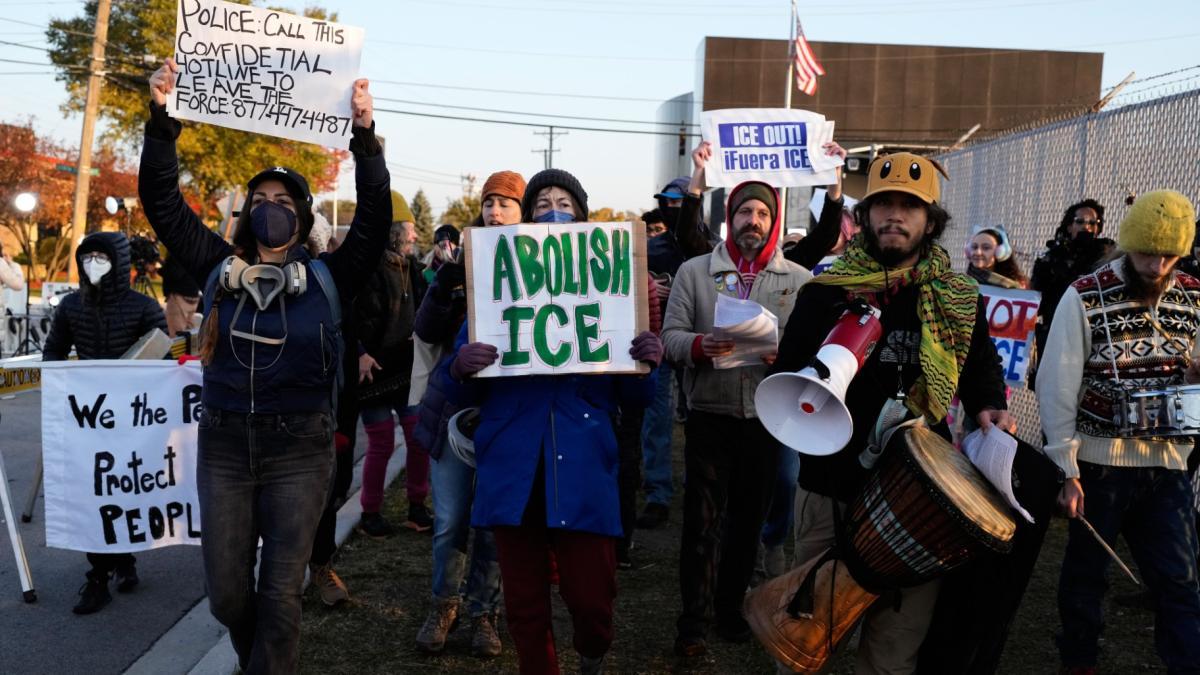 Protesters gather outside an ICE processing facility in the Chicago suburb of Broadview, Ill., Friday, Oct. 31, 2025. (AP Photo / Nam Y. Huh)
Conditions at Broadview
What the case is about: The lawsuit, filed Oct. 30, alleged that detainees housed at ICE’s Broadview facility were forced to endure “inhumane” conditions that included overcrowding and inadequate food and water supplies.
Plaintiffs’ attorneys claimed detainees were also prevented from contacting legal counsel as they were essentially cut off from contact with the outside world.
“By blocking access to detainees inside Broadview, Defendants have created a black box in which to disappear people from the U.S. justice and immigration systems,” the lawsuit states.
While the site operates as a processing center — not a detention center where detainees are held for longer periods — the lawsuit (Moreno Gonzalez et al. v. Noem et al.) alleged that people processed there have been kept in Broadview for “up to a week or more.”
What’s happened so far: Plaintiffs’ attorneys asked U.S. District Judge Robert Gettleman for a temporary restraining order requiring ICE and the Department of Homeland Security to immediately address the conditions at Broadview and remedy what they alleged to be a “vicious abuse of power and gross violation of basic human rights.”
During a hearing in Gettleman’s courtroom Tuesday, several former Broadview detainees detailed what life was like inside the facility during their time there — overcrowding, a lack of beds, no hygiene or medical supplies, no working showers, a lack of toilets and insufficient food and water access.
Some were kept in a holding cell with more than 100 others, forced to sleep on chairs or the floor in a room where lights were kept on 24 hours a day. The site had no working showers, they said, and only a single working toilet per room that offered no privacy.
They also testified that agents would deliberately mislead detainees about paperwork they asked them to sign, in some instances coercing them into signing voluntary deportation forms written in English — a language many detainees couldn’t understand.
The Trump administration has maintained any statements about “subprime conditions” at the Broadview ICE facility are false and that detainees are provided regular phone access.
But Gettleman found that the witness testimony repeatedly contradicted those claims.
“It’s just unacceptable,” Gettleman said.
Where the case is now: Gettleman on Wednesday granted a temporary restraining order requiring ICE and the Department of Homeland Security to provide clean bedding mats, toiletries and at least three full meals per day to detainees.
The order also requires that detainees be granted phone access to contact their attorneys in privacy and that agents provide all documents to detainees in both English and Spanish. Agents are also barred from misrepresenting the contents of those documents.
In a status report filed Friday, attorneys for the government said ICE is in compliance, or taking significant steps toward getting in compliance, with items in the order. But attorneys representing those detainees said they’ve thus far seen no proof of any changes at the facility.
The temporary restraining order is set to remain in effect until Nov. 19.