Politics
Where Are The Most Haunted Places in Chicago? Here’s Where the Ghosts of Politicians Still Roam
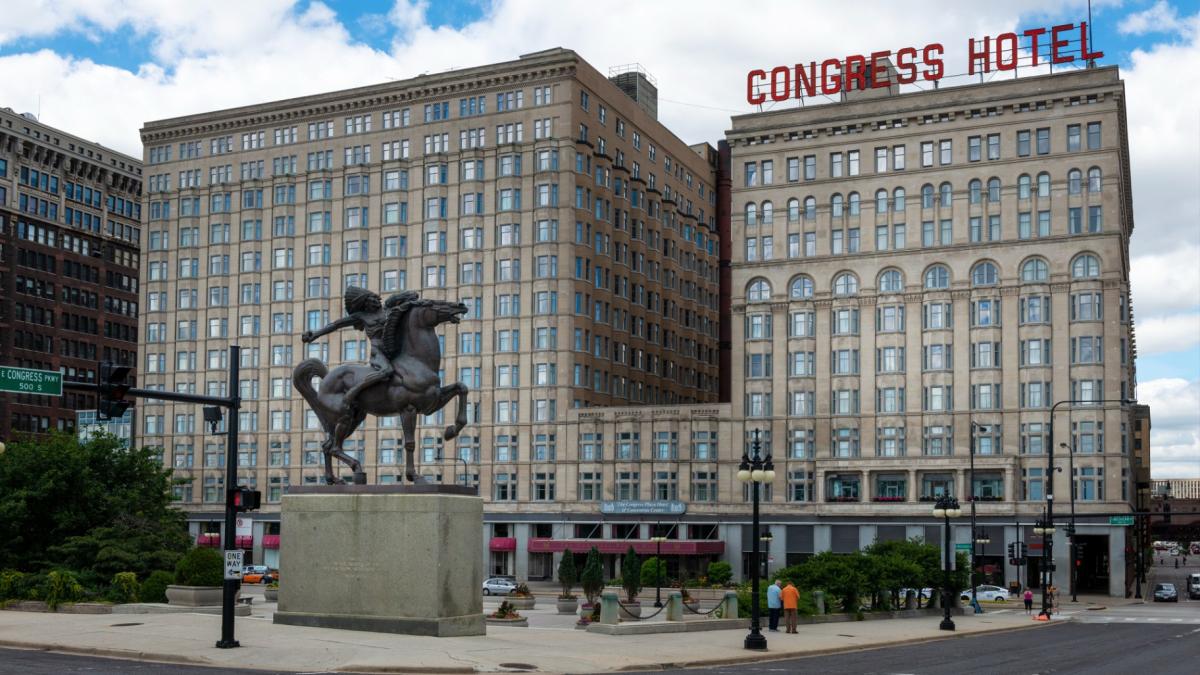 The Congress Hotel in Chicago is pictured in a file photo. (Tiago Fernandez / iStock)
This story was featured in the Daily Chicagoan newsletter. Sign up here.
Chicago is a six-sport city: baseball, basketball, hockey, soccer, football and politics. With the Cubs (all-too-short) playoff run over and spooky season in full effect, these are five of my favorite places in Chicago said to be haunted by the ghosts of politicians – and their scandals.
Congress Hotel: Presidents Grover Cleveland, William McKinley, Teddy Roosevelt, William Howard Taft, Woodrow Wilson, Warren Harding, Calvin Coolidge and Franklin Roosevelt all made the Congress Hotel at Michigan Avenue and Harrison Street their political headquarters while in town during their time in the White House.
For years, Al Capone played cards every Friday night in a meeting room overlooking Grant Park, ensuring that the ghosts of his victims mingled with those wronged by the eight presidents who called the hotel their home away from home.
The Iroquois Theatre: More than 600 people died and another 250 were injured when curtains caught fire during a December 1903 performance at the Iroquois Theatre, which touted the new structure along Randolph Street between State and Dearborn streets as totally fireproof. When it turned out to be anything but, officials overhauled building and fire codes and theaters closed all over the world for renovations. Mayor Carter Harrison IV was arrested and charged with looking the other way when theater owners bribed unqualified city inspectors with free tickets. Harrison was not convicted, but his ambitions for higher office were among the casualties of the fire.
Camp Douglas: Chicago’s South Side was home to one of the largest Union Army prisoner-of-war camps for Confederate soldiers taken prisoner during the American Civil War. From what is now Cottage Grove Avenue to the west and Martin Luther King Drive to the east, and between 31st and 33rd streets, 10 acres of land once owned by U.S. Sen. Stephen A. Douglas were used to house thousands of prisoners of war captured by the Union Army. Amid squalid conditions, the official death toll lists more than 4,400 people who died there. But it is likely more than 6,100 people actually died while imprisoned there, with many saying the clanging of their irons can still be heard amid the newly built condos.
Mount Henry: In the 1990s, the vacant lot at Roosevelt Road and Kostner Avenue became a community landmark for all the wrong reasons. Used as a dumping ground for construction waste by a man known as John Christopher, the 21-acre plot of land in the heart of North Lawndale became a six-story mountain of debris that threatened the health and safety of everyone who lived nearby. But complaints from residents to 24th Ward Ald. Bill Henry fell on deaf ears for years, resulting in the dump’s ironic nickname. Soon, everyone knew why the massive mountain of rubbish had been allowed to tower over the West Side: corruption. Christopher bribed Henry to allow the dump to remain, as part of a political corruption investigation dubbed Operation Silver Shovel by the FBI. Eighteen people were convicted, and eventually the dump was removed. But the lot would remain vacant until this year, when construction on a new industrial facility finally got under way, in the hopes that the ghosts of Chicagoans harmed by the dump can finally be put to rest.
City Hall: Since 1853, the full city block bounded by Randolph Street to the north, Washington Street to the south, Clark Street to the east and LaSalle Street to the west has been the center of political power in Chicago. But several buildings have called that land home, and all have been built at a steep price. Chicago’s first dedicated City Hall burned to the ground during the Great Chicago Fire of 1871.
In 1885, a new building replaced the one lost to the blaze. But just 20 years later, it was demolished and replaced with the current home of the mayor and all 50 alderpeople. There’s no doubt that if those walls could talk, they could tell some bone-chilling tales.
Contact Heather Cherone: @HeatherCherone | (773) 569-1863 | [email protected]