Politics
Federal Officials Defend Aggressive Immigration Enforcement Raids to Judge, Say No Agents Have Been Disciplined
Two federal officials Monday defended a series of increasingly aggressive raids across Chicago and the suburbs to a federal judge, saying agents were forced to deploy tear gas and pepper balls in the face of intense opposition from residents.
U.S. District Judge Sara Ellis did not rule on whether federal agents violated her order not to use tear gas and other weapons against journalists, protesters and anyone not posing an immediate threat to immigration enforcement agents.
As she ended the five-hour hearing, Ellis told lawyers for the Trump administration that federal agents “should simply follow the law.”
Saying she needed more information to evaluate the conduct of federal agents, Ellis ordered Gregory Bovino, commander-at-large of the U.S. Border Patrol, Deputy Chief Patrol Agent Daniel Parra and Russell Hott, the former field director for ICE operations in Chicago, to answer questions about their agencies’ operations in Chicago, saying some of the answers she got during the five-hour hearing on Monday were unsatisfactory.
Ellis also asked for detailed records about the policies governing the use of force by ICE and Border Patrol agents and how they are trained to follow those rules. Ellis also ordered ICE officials to preserve any video of the clashes between protestors and federal agents.
Ellis scheduled a hearing on whether to make her still-temporary order permanent for Nov. 5.
In the past 17 days, Department of Homeland Security agents have deployed tear gas against Chicagoans who gathered to protest their efforts to detain people they believe to be in the country illegally four times: in Logan Square on Oct. 3; in Brighton Park on Oct. 4; in Albany Park Oct. 12 and in East Side Oct. 14
Two of those incidents came after Ellis ordered agents to issue two warnings before using tear gas and other types of chemical sprays in a case brought by the Chicago Headline Club, Chicago Newspaper Guild Local 34071, Block Club Chicago and other media organizations.
The order also restricts agents from using force against members of the public — such as tackling — unless the person represents an immediate threat.
Ellis clarified her order on Friday to require all federal agents who are conducting immigration enforcement actions and who have body cameras to have them on while interacting with members of the public.
In court Monday, Ellis questioned Kyle Harvick, a Customs and Border Protection deputy incident commander, and Shawn Byers, deputy field office director of Immigration and Customs Enforcement, for nearly two hours each about several incidents across the Chicago area and agents’ response.
“I have a few concerns that the (temporary restraining order) was not being followed,“ Ellis said.
However, Harvick assured Ellis that Border Patrol leaders ordered agents to follow her order, which required agents to issue two warnings before using tear gas and other types of chemical sprays and restricted agents from using force unless the person represented an immediate threat.
“We take these (temporary restraining orders) very seriously, your honor,” Harvick said.
Harvick said tear gas was deployed to protect agents from an increasingly angry crowd, which included people who pelted agents with eggs and rocks.
“The situation gets more and more dangerous the longer we are there,” Harvick said. “It’s a dynamic situation, and speaking to my supervisor, the subjects that were blocking our egress had linked their arms together, which is active resistance. They were given lawful orders to get out of our way so we could depart and continue with our duties.”
No warnings were captured in any of the videos of the incidents, and witnesses said they did not have any chance to flee before the chemical agents were deployed.
Harvick said there are 201 Border Patrol agents assigned to Chicago — though there had been 231 working in the area until recently — and that all of them are now equipped with a body-worn camera.
Harvick assured Ellis that the agents had been trained on how to use the cameras, and would ensure that they record all interactions with members of the public as they conduct the immigration enforcement operation known as “Operation Midway Blitz.”
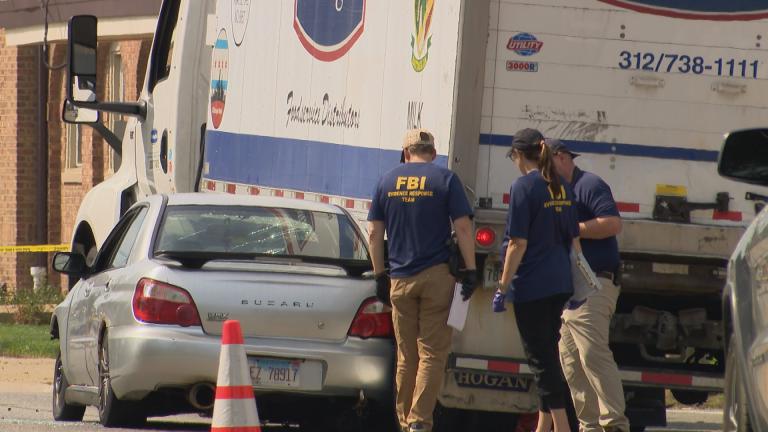
Harvick also said agents warned a crowd that gathered at the scene of a vehicle crash involving Border Patrol agents who detained two people on the East Side on Oct. 14 that tear gas would be deployed before the chemical agent was dispersed, affecting 13 Chicago Police Department officers.
However, Harvick said he had not personally spoken with the agents involved in both incidents, nor had he reviewed any body-worn camera footage or official reports, relying instead on information given to him by other border patrol agents.
During the Oct. 14 incident, border patrol agents deployed tear gas three times, Harvick testified. Twelve minutes elapsed between the first and second deployment of tear gas, Harvick said, adding that he did not know how much time passed between the second and third time agents fired tear gas at a crowd.
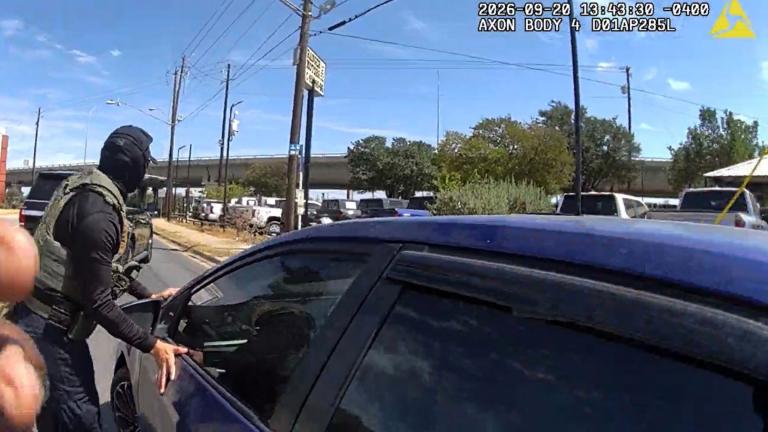
In a separate incident outside an ice cream shop in suburban Rolling Meadows, the Chicago Tribune reported that a video captured an agent pointing a weapon toward bystanders from the back seat of a truck with the window rolled down.
“You can see how I might be concerned that that might be a use of force that is not commensurate with any threat that the agents are getting from people passing by,” Ellis said.
Harvick agreed, saying he was also concerned by the incident.
Harvick testified he knew of no Border Patrol agents who have been disciplined in connection with their decisions to use force against members of the public.
Byers said no ICE agents had been disciplined for violating use-of-force policies outside the Broadview facility.
ICE agents have repeatedly deployed tear gas, pepper balls and rubber bullets against crowds of protesters outside the Broadview facility. Beyond affecting those protesters exercising their First Amendment rights, those munitions have also affected first responders, local police, members of the clergy and media who are in the area.
David Black, senior pastor of First Presbyterian Church of Chicago, who was repeatedly struck by chemical agents fired by ICE agents, was given multiple orders to leave the facility’s area, Byers said. Black disputes that and has said he posed no threat to ICE agents or anyone else.
Like Harvick, Byers told Ellis that he had not personally reviewed any of the required reports documenting agents’ use of force against protestors.
“I was, I guess, a little surprised that he had not seen any of the reports that were generated from the calculated uses of force at Broadview,” Ellis said.
Matt Masterson contributed to this story.
Contact Heather Cherone: @HeatherCherone | (773) 569-1863 | [email protected]