Politics
‘We’re in Limbo’: Chicago’s Federal Workers Talk Government Shutdown, Working Without Pay
The federal government entered its sixth day of a shutdown Tuesday, leaving hundreds of thousands of employees furloughed.
Thousands more essential workers — including air traffic controllers, TSA agents and Social Security administrators — are expected to work without pay if Congress fails to pass a bill funding the government.
The Congressional Budget Office released a report Sept. 30 detailing the potential effects of a shutdown.
“CBO estimates that under a lapse in discretionary funding for fiscal year 2026 about 750,000 employees could be furloughed each day; the total daily cost of their compensation would be roughly $400 million,” the report reads.
Jill Hornick, a Social Security administrator in Chicago Heights and member of the American Federation of Government Employees Local 1395, said many of her coworkers are facing tough financial decisions, adding that several manage single-income households.
“This week Social Security employees will receive a partial paycheck and that will be the last money they’ll have coming in until the shutdown is over,” Hornick said. “Employees are already worried about how they’re going to put food on the table, … how they’re going to pay for the day care, how they’re going to put gas in the car.”
Employees at Social Security offices have also been barred from providing several key services that help keep people eligible for benefits, according to Hornick.
She said that to qualify for certain unemployment and housing assistance programs, applicants must have their income and employment status verified by a Social Security office.
But those verifications have been halted due to funding uncertainties in Washington, D.C., leaving some people underpaid on benefits and others overpaid.
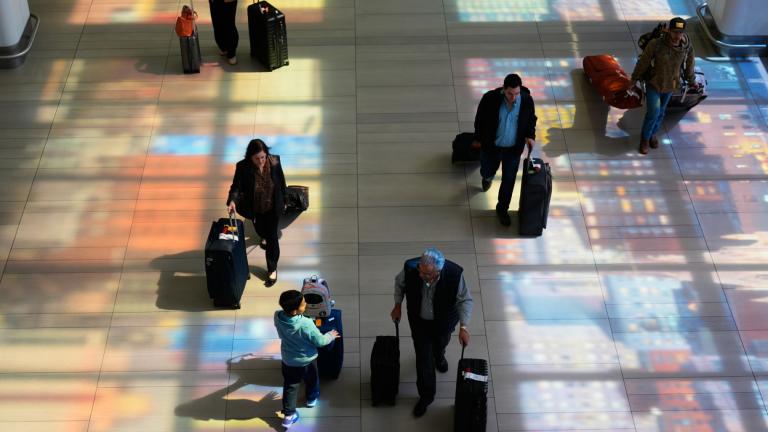
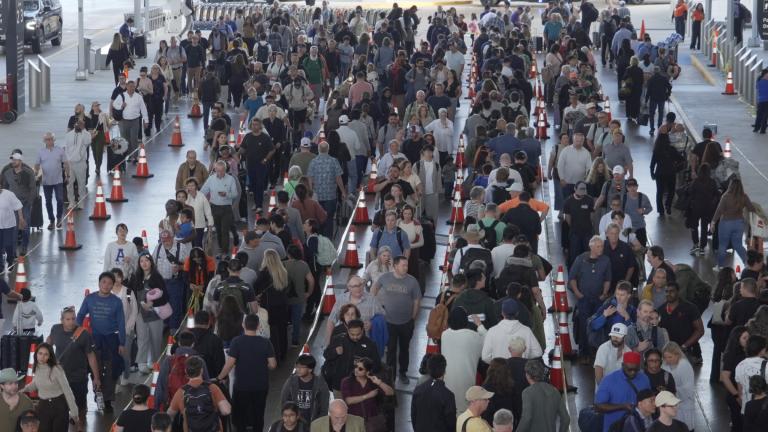
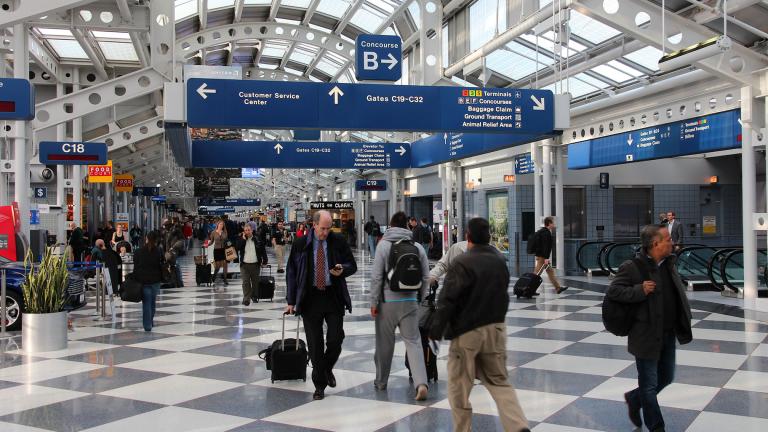
The effects of the shutdown are also being felt at Chicago’s airports, where Transportation Security Administration agents will soon begin working without pay.
Darrell English is a TSA officer at Chicago Midway International Airport and president of AFGE Local 777, which represents thousands of TSA workers across Illinois and Wisconsin. He said many TSA employees are young workers for whom the job is their first source of steady income.
“Some people that have been seasoned or been there longer, they had the ability to save up funds,” English said. “Those that are newer that just came — TSA may be their first real job — they’re not financially stable.”
English said some TSA employees may be forced to leave the agency if financial pressures grow, potentially worsening staffing shortages. As of Tuesday night, average wait times for flights at Chicago O’Hare International Airport had increased by about 41 minutes due to reduced staffing.
He added that AFGE Local 777 is working to identify TSA agents most affected by the shutdown’s financial strain and is helping them with transportation to and from work.
Federal agencies not facing furloughs or withheld paychecks are still feeling the effects of the shutdown.
The Department of Veterans Affairs said in July that it plans to reduce its workforce by up to 30,000 employees by the end of fiscal year 2025 and had already cut about 17,000 positions between Jan. 1 and June 1.
At a news conference Tuesday, President Donald Trump said cuts to federal programs and agencies could become permanent — a move that could significantly affect how medical services are delivered to veterans, according to Erica Bland, executive vice president of SEIU Healthcare Illinois, which represents Veterans Affairs workers.
“Since he’s (Trump) taken office they’ve instituted a hiring freeze,” Bland said. “What we’re seeing is that more vacancies are happening so delivery of services will be slower. If you have fewer people that are showing up to do the jobs because we simply aren’t filling the vacancies it makes it harder to deliver those services to the people that we promised to deliver them to like veterans and their families who deserve quality health care.”
Employees at the Environmental Protection Agency’s Chicago office received a letter last Tuesday notifying them of their exempt status, meaning they would keep their jobs and continue to be paid, according to Colin Kramer, an EPA worker and steward of AFGE Local 704.
Kramer said the agency has carryover funds, but it’s unclear when these funds might dry up.
“We’re in a situation where we’re in limbo and wondering every day whether we’re going to have to stop the work that we’re doing. At EPA that’s important because we’re dealing with projects and sites that are multiyear … and we might miss our window for remediation,” Kramer said.
Kramer added that since last Tuesday’s letter, Chicago EPA employees have received no further communication from their supervisors or from officials in Washington.
The U.S. Senate did not conduct any votes Tuesday to fund the government.