Science & Nature
There’s a Mother Lode of Fossils in Chicago’s Backyard, and It Could Hold Clues to the Evolution of Life on Earth
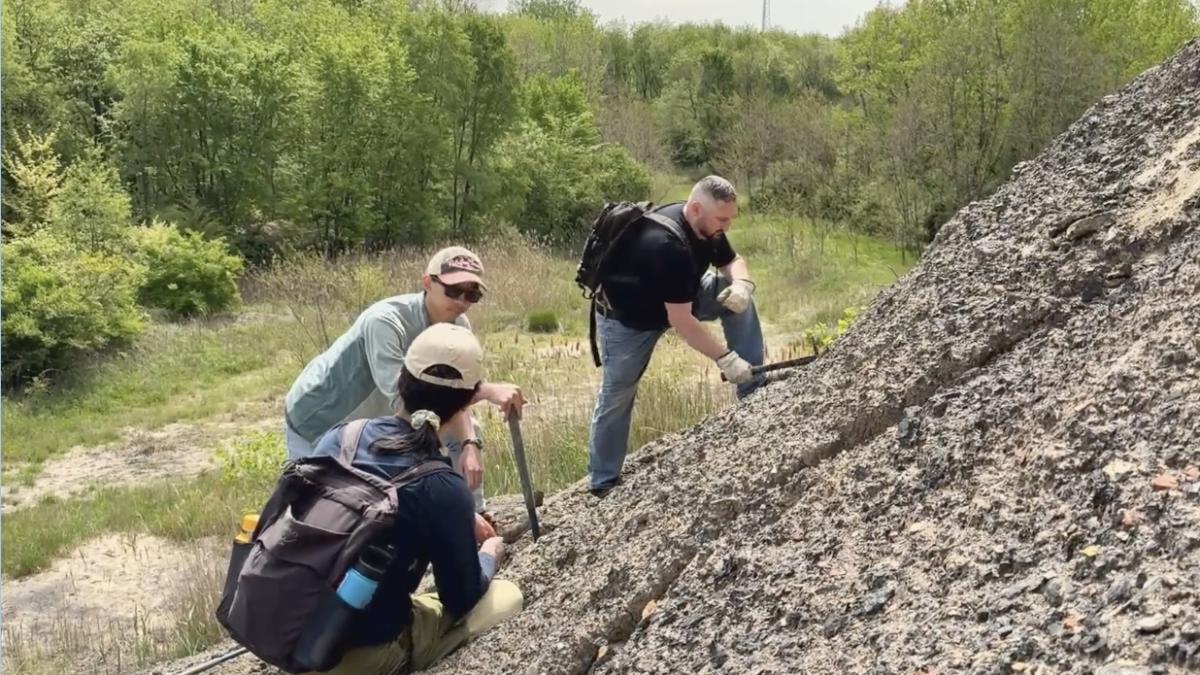 Jeremy Zimmerman (right) joined a Field Museum expedition to a Mazon Creek site in spring 2025. Fossils of 300-million-year-old plants and other organisms are buried in spoil piles left over from coal mining operations. (Courtesy of the Field Museum)
Three hundred million years ago, what’s now Illinois was covered by an inland sea teeming with aquatic life.
The sea is long gone, but the life is still there, roughly 60 miles southwest of Chicago.
An entire Paleozoic ecosystem is preserved at a site called Mazon Creek (“muh-ZAHN”), which sprawls across more than 250 individual locations in an area of northern Illinois that stretches roughly from the city of Morris to the village of Essex.
It’s one of the most important fossil deposits on the planet and in certain circles, also one of the most famous. Still, a lot of people who live within an hour’s drive of Mazon Creek have never heard of it.
“I had no idea that something like this was so close to Chicago, a world-class fossil location,” said Jeff Allen. “It just sort of blew my mind.”
In 2024, Allen had recently retired from a career as a computer scientist and was casting about for a new purpose. He found it at Mazon Creek, joining long-time fossil hunters from the Earth Science Club of Northern Illinois (ESCONI) on expeditions to the site.
“The first time I went out was before I met anybody, and I collected probably 50 pounds of rocks,” Allen recalled. “Then I started meeting people from ESCONI and started to tag along on some of the trips. I started realizing, ‘Oh my god, that first collection was mostly junk.’”
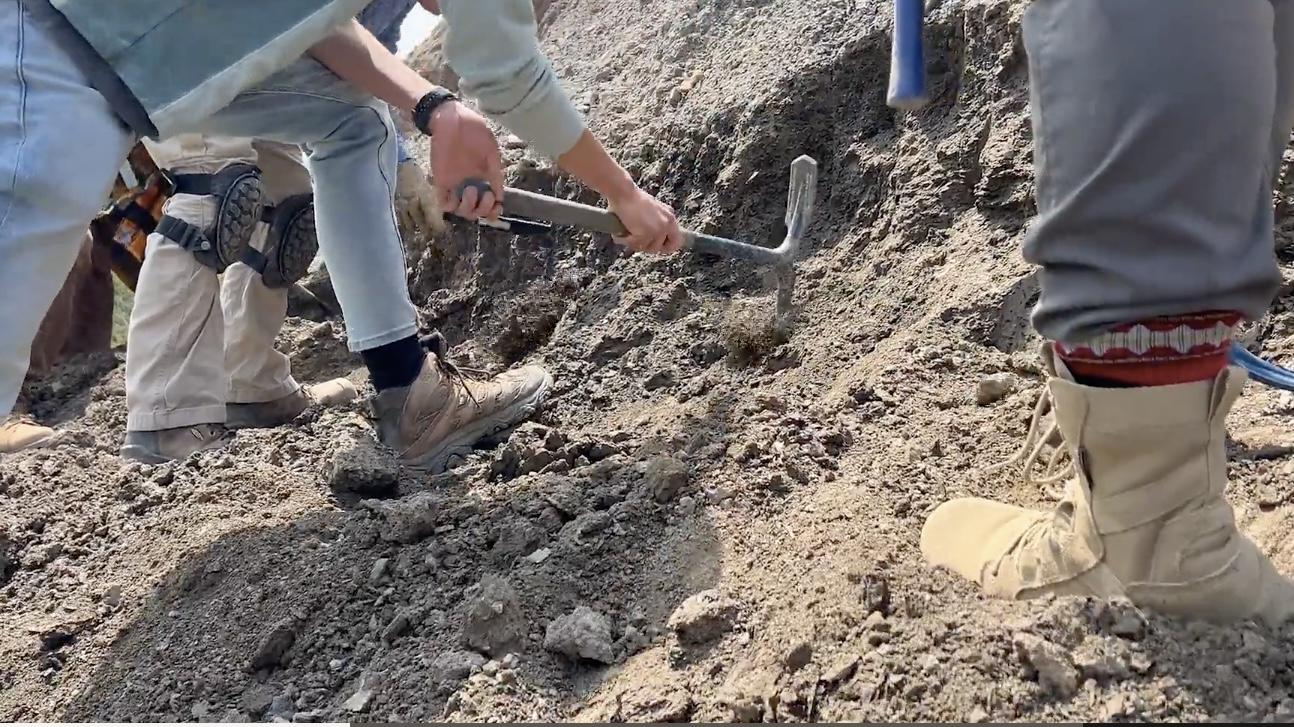 Digging for buried treasure, in this case fossils. (Courtesy of the Field Museum)
Jeremy Zimmerman, ESCONI’s assistant field trip chairman, helped show Allen the ropes.
Zimmerman has been collecting at Mazon Creek for 20 years. “As soon as I got my driver’s license, I was down there,” he said.
You can still find him at one Mazon Creek location or another almost every weekend, March through September, searching for what’s called a “concretion,” something that’s rock-like but is actually a cemented mass of mineral matter embedded within rock layers. (For reference, a pearl is a kind of concretion.)
To set the scene, throw out any images you might have in your head of “fossil site.”
Most Mazon Creek specimens are found in waste piles that are the byproduct of mining operations. Turns out the fossil-rich layer of shale harboring Paleozoic concretions was sitting on top of a seam of coal.
The shale was stripped away to get at the coal below, and it’s these spoil piles that fossil hunters comb through looking to strike pay dirt of their own.
It takes skill to identify concretions; after two decades of practice, Zimmerman has an experienced eye, zeroing in on certain shapes and colors. When he finds one, he excavates it, places it in a five-gallon bucket — the maximum amount for collecting, per Illinois law — and takes it home. There he’ll soak it in water for 24 to 48 hours, then pop it in the freezer for another two or three days, thaw it and let it completely dry.
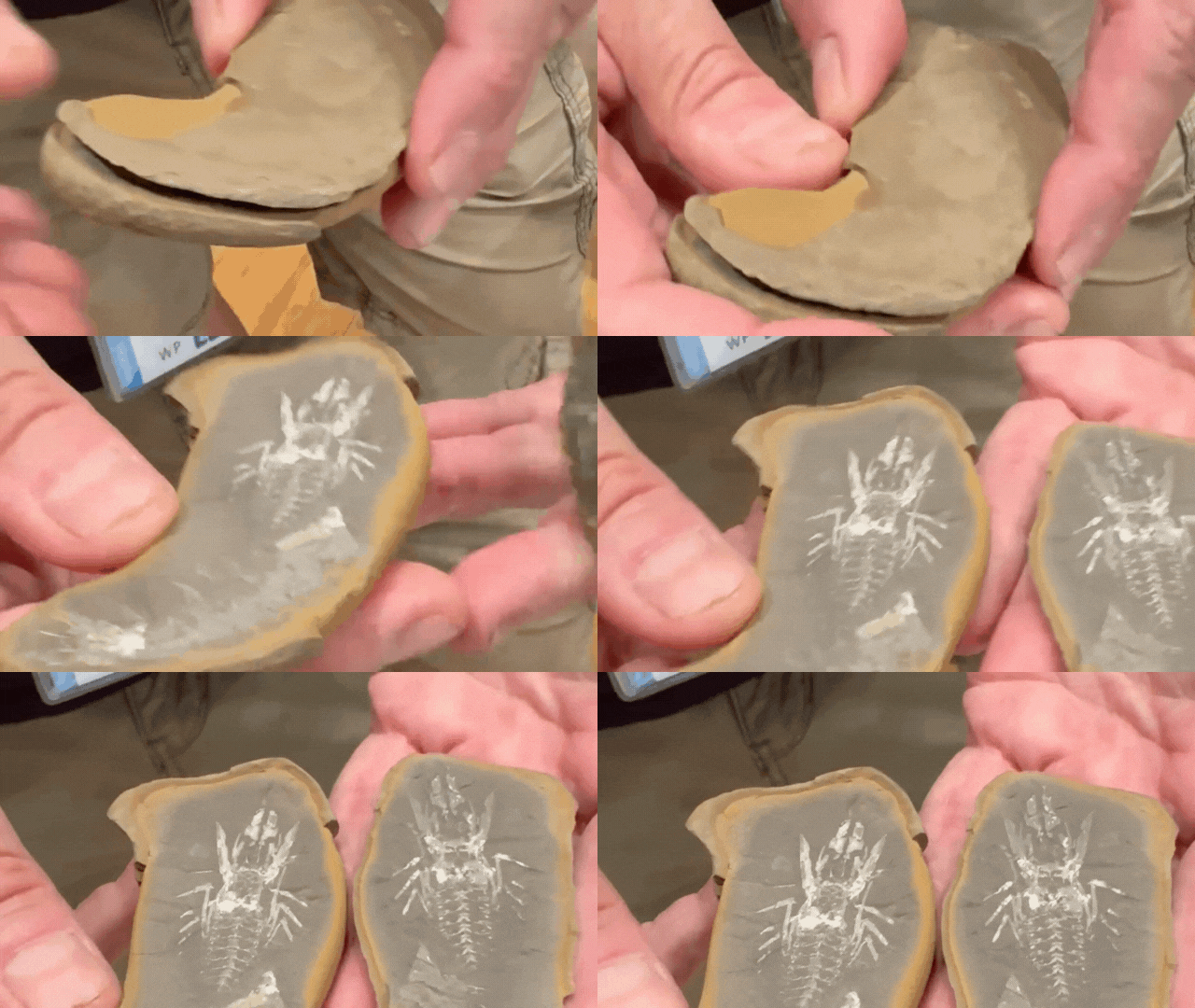 Rich Holm demonstrates how concretions open. (Patty Wetli / WTTW News)
If he’s lucky, the concretion will then split apart nicely along a weakened plane in the stone to reveal the mirrored impression of a 300-million-year-old plant or prehistoric organism.
To date, the Mazon Creek deposit has coughed up nearly 800 different species, any one of which, either in whole or in part, could be entombed inside a concretion. Maybe a leaf, an anemone, a spider or, quite often, nothing.
“It’s exciting because it’s pretty much a lottery ticket-slash-Easter egg hunt,” said Zimmerman. “You never know what’s inside.”
Rich Holm has been splitting concretions open for 20 years and said it never gets old.
“As they open, it is magical. You’re the first person who saw that (fossil), ever,” said Holm, who’s ESCONI’s historian. “It’s the first time it’s seen the light of day.”
Between Holm and Zimmerman, they’ve come across their share of rarities including a specimen of coprolite (fossilized feces), a plant with evidence of insect damage and a doubly-thrilling twofer — a spider grabbing a sea scorpion.
“I have a horseshoe crab hiding underneath a fern. That’s pretty cool,” said Zimmerman. “Horseshoe crabs are still in existence today and you see one from 300 million years ago.”
Even common specimens — picture the equivalent of a birder observing a cardinal — often exhibit an inherent artistic beauty and other times, an “ugly fossil” can contain a feature not previously seen before, said Holm.
“You have to go through a lot of tonnage to get to the nice stuff,” he said. “It’s kind of like a treasure hunt.”
Paleontologists used to share the same enthusiasm for Mazon Creek. There was a period in the mid-1900s when the site was a hub of activity as scientists worked side by side with amateurs, marveling at the beautifully preserved ferns, worms, jellyfish, amphibians and other assorted early tetrapods.
Museums across the globe added Mazon Creek fossils to their collections, many of them soft-bodied organisms seldom if ever preserved at other sites. One creature, the bizarre Tully Monster — described by at least one scientist as having the nose of an elephant, tail of a squid and the eyes of funny green alien — exists nowhere else in the fossil record other than Mazon Creek.
But not even the Tully Monster could compete with T. Rex. Interest in Mazon Creek waned as paleontologists turned their attention to the Jurassic’s giants.
For amateur collectors, though, Mazon Creek continued to enchant. And that dedication is paying off, as a new generation of paleontologists at the Field Museum aims to usher in a renaissance of discovery at the site, with the help of ESCONI’s loyal rockhounds.
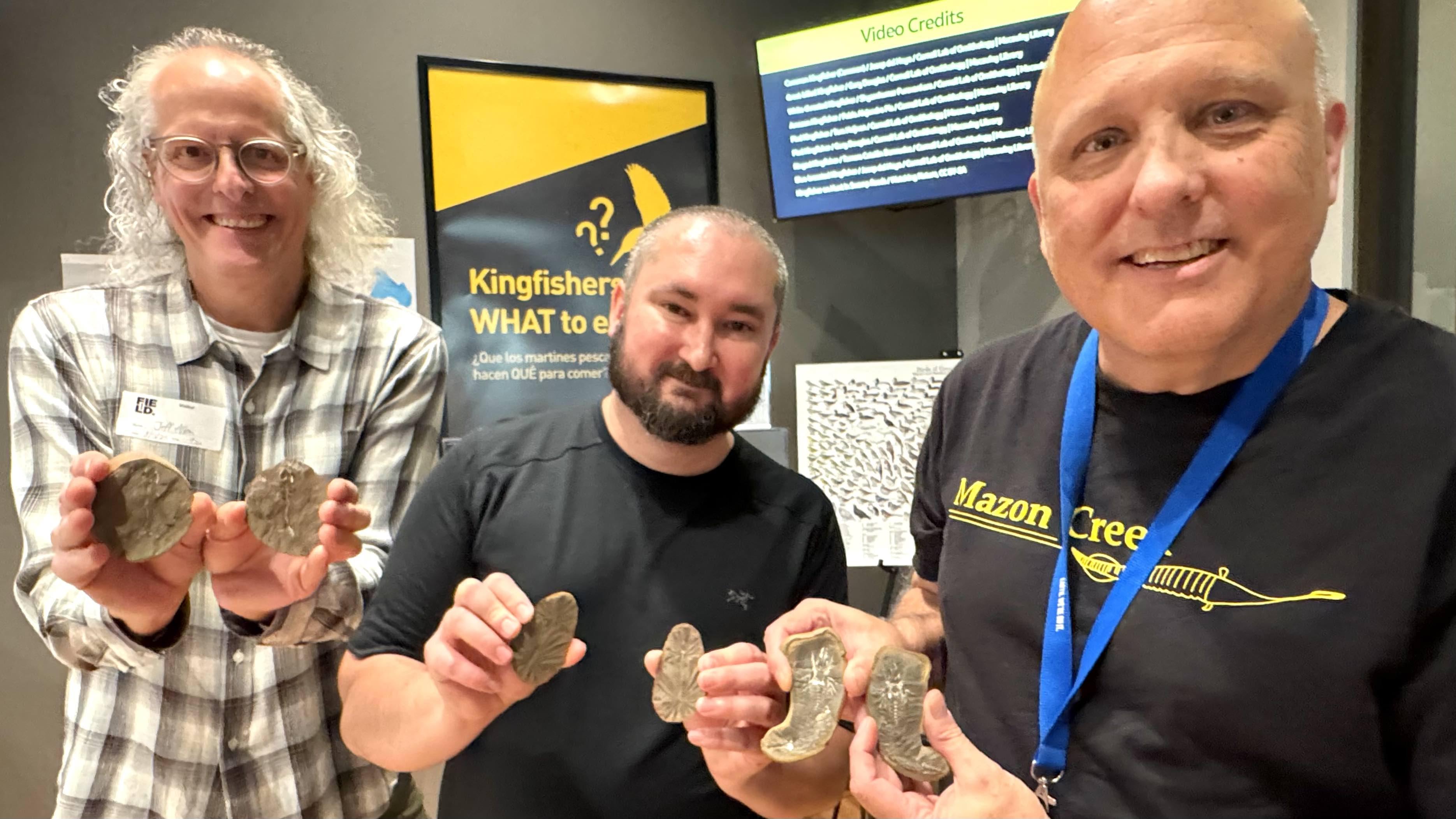 Jeff Allen, Jeremy Zimmerman and Rich Holm show off their Mazon Creek finds during an August 2025 event at the Field Museum. (Patty Wetli / WTTW News)
When Arjan Mann joined the Field Museum as assistant curator of early tetrapods, it was with the intention of turning the institution’s gaze back onto the trove of fossils in its backyard.
“I think that the mother lode still is in the ground,” said Mann. “And more concretions than have been collected still reside in these piles, still reside in the dirt, and they’re just waiting for the next person to come and uncover them and uncover the next evolutionary mystery or solution, too.”
There’s more vertebrate material at the site than previously thought, he said. And advances in imaging technology, including electron microscopy, have yet to be applied to Mazon Creek fossils on a large scale.
So might there be more to existing specimens than meets the eye?
“Absolutely,” Mann said. “They might be more complete.”
Rather than discount the knowledge of “avocational paleontologists” like Zimmerman, Holm and other members of ESCONI, Mann has actively sought out their expertise, calling them his “gateway” to Mazon Creek.
“We have benefited so much as a (paleontology) community and as a museum from people that have made this their life, their life goal, their hobby, their passion,” Mann said.
It was Holm, in fact, who showed Mann the prime fossil localities across Mazon Creek’s broad geography. Some are on private property, the owners of which allow access to ESCONI members, and others are on public land that’s open to all comers.
After familiarizing himself with the lay of the land, Mann struck out on field expeditions, most recently this past May. He was accompanied by members of his research team, interns and volunteers from ESCONI.
In August, some of the fossils collected during the spring trip were briefly on display at the Field. Turns out, Mann’s hunch about Mazon Creek was correct.
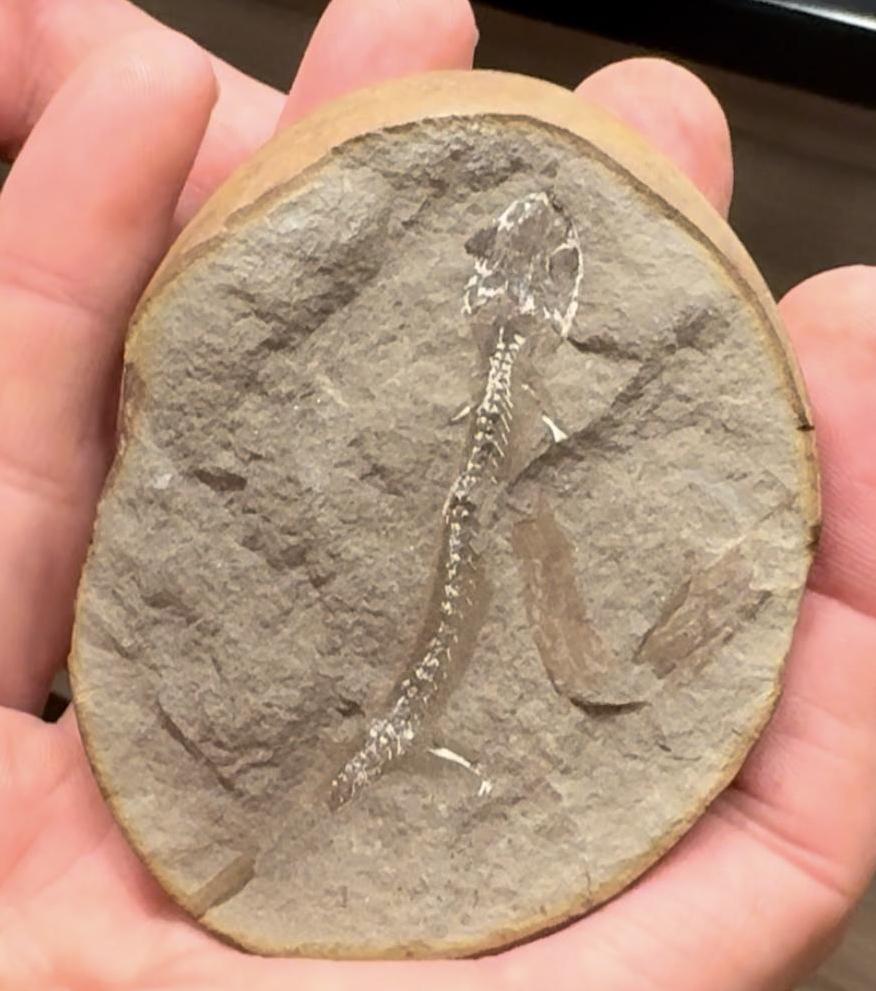 Mazon Creek is the gift that keeps on giving to paleontologists, with new species like the one pictured (as yet unnamed) still being discovered. (Patty Wetli / WTTW News)
It still has surprises up its sleeve.
“This is a new species,” said Allen, holding one of his finds in his hands. “We don’t know what it is yet. You’re seeing the first of an undescribed, new type of amphibian, a tetrapod actually, with legs.”
What is it related to? What role did it play in the broader ecosystem? Most importantly, what evolutionary secrets might it help unlock?
Surveying all of the fossils collected to date, Mazon Creek appears to represent a transition between terrestrial and marine environments, where that inland sea met land.
As such, the site “holds key anchor points” to when terrestrial lineages originated, Mann said.
“Everything we occupy today is the terrestrial realm,” he said. “Without understanding Mazon Creek and the ecological dynamics of that fauna, we have no idea how tetrapods, how our ancestors were able to flourish — how modern diversity colonized and conquered land.”
Each new fossil is another piece that helps fill gaps in the puzzle, whether it’s a newly discovered species or a specimen containing never-before-obtained soft tissues or original organic matter.
This is the work ahead of Mann and his lab at the Field, but it’s a job he readily acknowledges he can’t tackle on his own.
“I would actually encourage people to get out there and collect even more,” he said. “I can’t be up there seven days a week. I can’t be collecting thousands and thousands of concretions. … There’s way more to be found.”
Find out about upcoming fossil hunting field trips on ESCONI’s website.
Contact Patty Wetli: [email protected]