Politics
‘Partial Win for Customers’: ICC Approves $82 Million Rate Hike for Nicor Gas
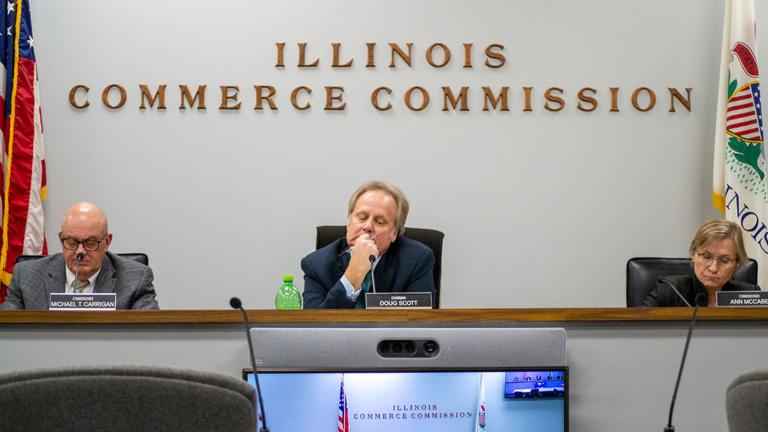
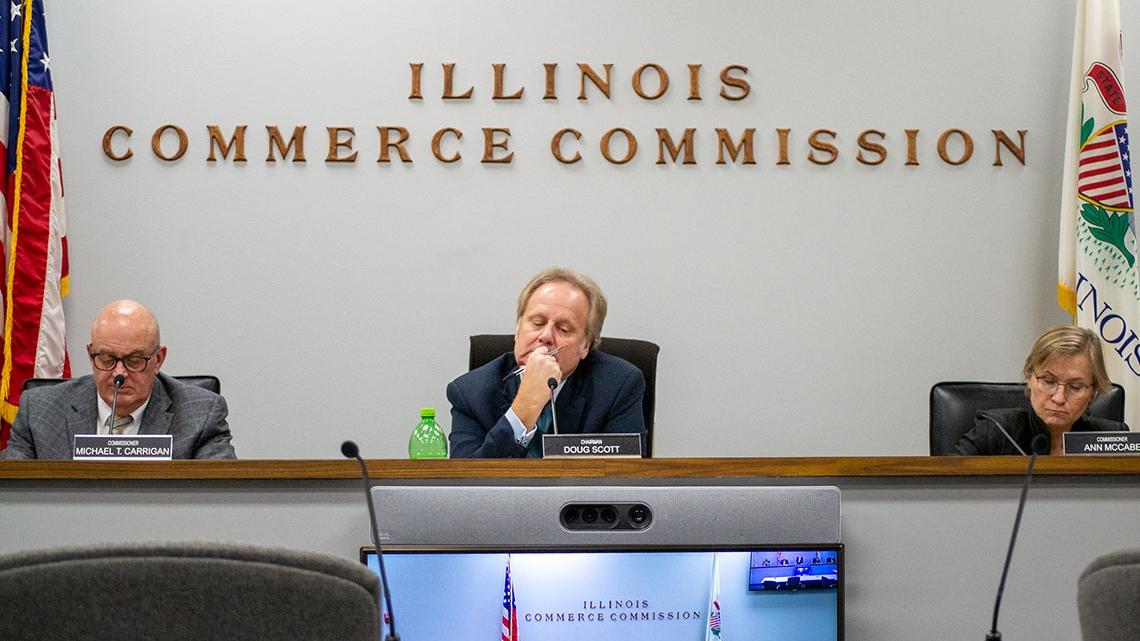 Illinois Commerce Commission Chair Doug Scott is pictured alongside commissioners Michael Carrigan, left, and Ann McCabe, right, at a November 2023 meeting in Springfield. (Jerry Nowicki / Capitol News Illinois)
CHICAGO — The Illinois Commerce Commission approved an $82 million rate hike on Thursday. The amount was negotiated between Nicor Gas and the attorney general’s office as part of a settlement that reduced the company’s original request by nearly two-thirds.
The rate increase is expected to add around $2 a month to residential customers’ bills beginning in November.
“A settlement is a compromise, so we’re not thrilled about every element, but we are pleased the Commission approved it,” Illinois PIRG Director Abe Scarr said in a statement. “We are excited that the settlement sets a lower, $15, monthly fixed charge. Lower fixed charges reward energy efficiency and conservation and give customers more control over their bill.”
The prior fixed fee was $21 per month, regardless of the volume of gas used.
The lower monthly charge gives consumers more control over their bills and protects low-income customers who often use less gas than high-income customers, according to Environmental Law and Policy Center senior attorney Rob Kelter.
“The larger users cause there to be more investment in the system,” Kelter said. “It’s fair to ask them to pay more.”
Kelter said he’d like to see that charge go down to $12 a month or lower. He thinks Nicor is moving in the right direction and has shown a willingness to do better.
But consumer advocates say the decision is only a “partial win for customers,” in that it still raises rates, building on other past rate hikes from the utility, and allows a higher profit rate than they hoped to see.
The settlement allows for a 9.48% return on equity for shareholders, which is between the 8.95% that Illinois PIRG and Legal Action Chicago had sought and the 10.35% rate that Nicor originally requested. Utility watchdog groups had characterized that request as “outrageous” and “exorbitant.”
Nicor serves a large swath of northern Illinois, excluding the city of Chicago.
Labor Agreement
The settlement negotiated by Illinois Attorney General Kwame Raoul’s office included a side deal on union labor that drew criticism from consumer advocates and was lambasted by the Chicago Tribune’s editorial board as a “nonsensical jobs deal.”
That deal committed Nicor to maintaining this year’s union staffing levels through the end of 2027 and continuing its capital investment levels.
But like at all public utilities, spending on infrastructure is how Nicor makes its profit. Consumer advocates fear that the agreement could give Nicor fuel for a future rate case, in that it could say the commission already blessed the spending by signing off on the labor side deal.
The consumer and environmental advocates who were party to the primary settlement declined to be party to the secondary labor deal.
While the commission accepted the agreement as “consistent” with its rate-making decisions, it also emphasized its own authority to scrutinize future rate cases without being held to conditions agreed to between Nicor and the attorney general’s office.
“The commission is not bound by any of the terms of this settlement in any future matter, and the commission retains the authority to make rate-making determinations regarding the prudence, justness, and reasonableness of any future expenditures and resulting rates,” Commission Chairman Doug Scott said of the labor agreement.
That is, if the company were to spend at a higher-than-justified level to meet the terms of its agreement with Raoul’s office, whether that spending can be passed on to ratepayers will still be subject to the commission’s scrutiny.
Scott added that it is outside the scope of the commission’s role to dictate who should perform any work for the utility.
“The commission’s role with respect to workforce commitments and who performs work is limited to determining whether any expense is reasonable,” Scott said.
Pattern of Rate Cases
Consumer advocates say Nicor has already indicated that it believes more investment is needed in its system, so they expect the company to file another rate case in January.
Nicor did not respond to questions about future rate case plans.
Scarr of Illinois PIRG described the rate hikes as part of a pattern of ‘excessive spending.’
“This is Nicor’s sixth rate hike in a decade,” Scarr said. “These rapid and significant rate hikes are driven by wasteful spending on unnecessary fossil fuel infrastructure, which threatens to lock northern Illinois into paying for polluting infrastructure for generations to come.”
But environmental law center attorney Kelter said it’s also a symptom of a regulatory body that’s doing its job.
“The Illinois Commerce Commission has shown that it is going to scrutinize every penny that utilities ask for in rate cases, and when you have a really strong commission that doesn’t rubber stamp rate hikes, you’re going to have utilities coming in more often for rate cases,” Kelter said.
“And so, while nobody likes to see utilities coming in for rate cases, that’s the product of having such a strong commission that’s protecting consumers in Illinois.”
Capitol News Illinois is a nonprofit, nonpartisan news service that distributes state government coverage to hundreds of news outlets statewide. It is funded primarily by the Illinois Press Foundation and the Robert R. McCormick Foundation.