Arts & Entertainment
New Book Examines the Tulsa Race Massacre and Legal Battle Over Reparations
It’s been nearly 105 years since the Tulsa Race Massacre claimed the lives of hundreds of Black Tulsans.
Over the course of two days in 1921, a mob of White people terrorized and burned down a thriving Black community known colloquially as Black Wall Street. Close to a century after what’s believed to be the worst incident of racial violence in American history, a lawsuit was filed on behalf of the last few remaining survivors.
The legal battle, the stories of the survivors and their descendants, and the case for reparations is outlined in an upcoming book called “Redeem a Nation: The Century-Long Battle to Restore the Soul of America.” It’s authored by Damario Solomon-Simmons, a civil rights lawyer who served as the case’s lead attorney.
He said he is a “son of Greenwood” who grew up hearing stories of how prosperous the community was, filled with Black businesses and professionals. It wasn’t until he was in college when he learned of the massacre.
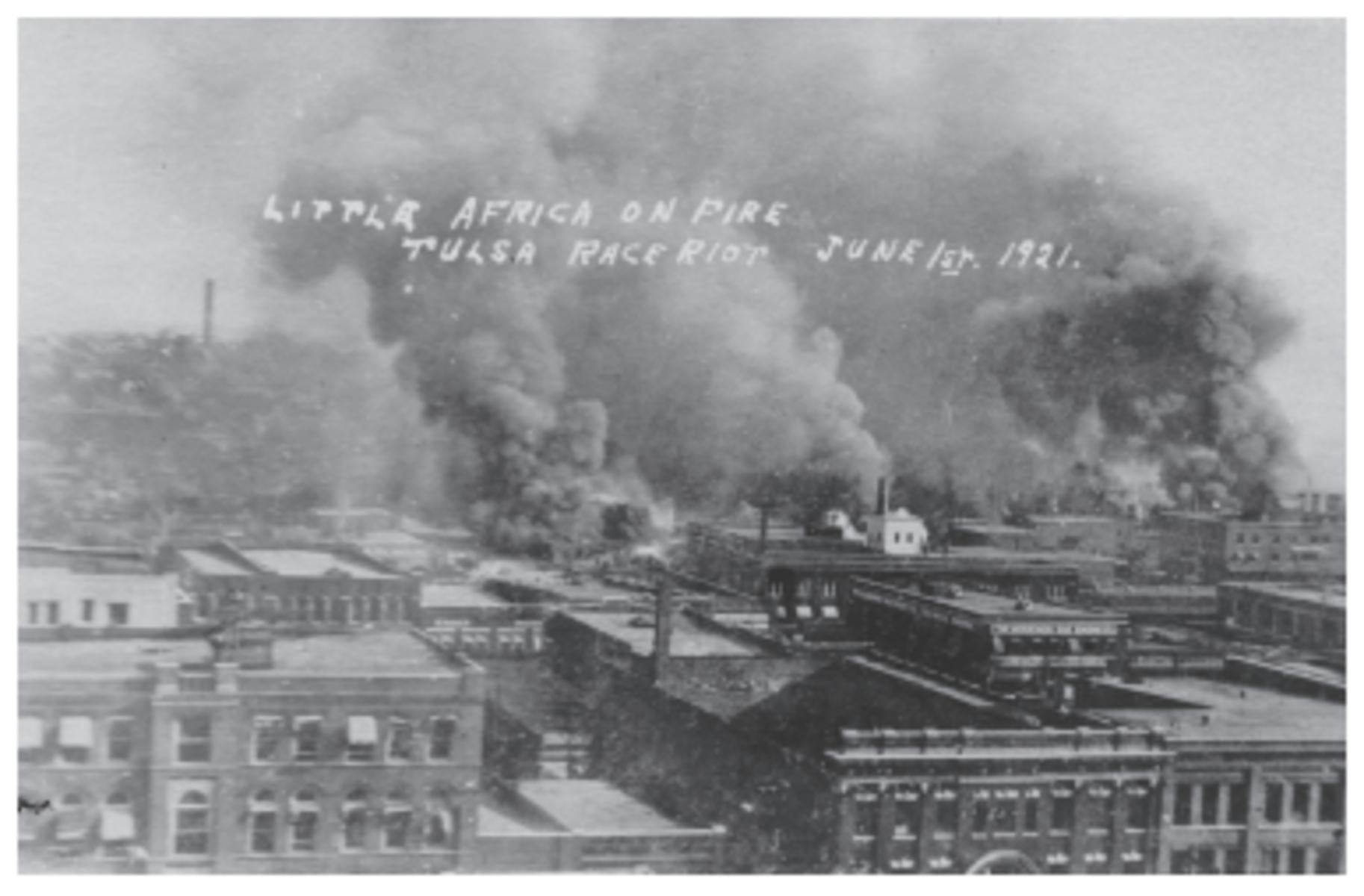 (Courtesy of the Department of Special Collections, McFarlin Library, the University of Tulsa)
Solomon-Simmons and his team filed the lawsuit in 2020. At the time, there were three living survivors of the massacre who were all over the age of 100. There is now one remaining survivor, Lessie Benningfield Randle, who is 111 years old and was about 5 years old at the time of the attack.
“We really thought this was a great opportunity with the so-called racial reckoning and everything that was going on that we wanted to try one more time to get justice and reparations for them,” Solomon-Simmons said.
The Oklahoma Supreme Court threw out the case in 2024, citing that while the grievances were legitimate they did not fall within the scope of the state’s public nuisance statute.
“Unfortunately, we were dismissed by the Oklahoma Supreme Court,” Solomon-Simmons said. “But we did get the United States Department of Justice for the first time in 2025 to issue a report about the massacre. We’ve continued to move forward to make sure that people understand what actually happened.”
In addition, Solomon-Simmons founded the Justice for Greenwood network that fights for justice, reparations and land reclamations among other projects for the community.
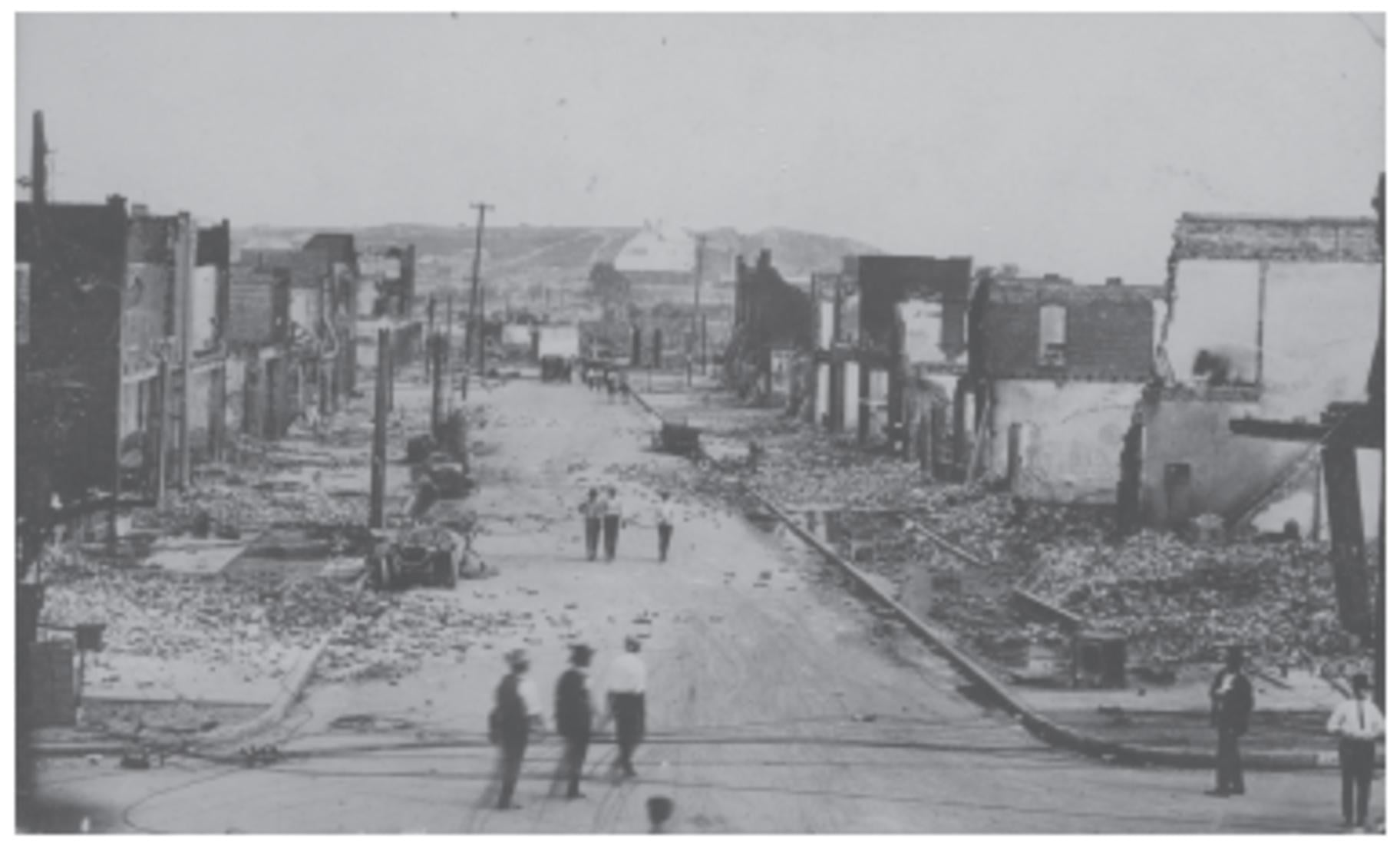 (Courtesy of the Oklahoma Historical Society)
For Chicago native John W. Rogers Jr., the destruction of Black Wall Street hits close to home as his great-grandfather, J.B. Stradford, was a survivor of the white supremacist attack that left his Greenwood hotel, the largest Black-run hotel at the time, destroyed and leveled.
The impact of stolen wealth has affected generations.
“My great-grandfather’s wealth would now be worth over $100 million,” Rogers said. “To think what we could do with that in our family — the amount of philanthropy, political empowerment that could come to our community if we were able to benefit from that wealth.”
Locally, the concept of reparations has been embraced in recent years. Evanston created a reparations program in 2021, and the city of Chicago and state of Illinois have reparations commissions designed to study what government-funded reparations could look like for the descendants of enslaved people and those harmed by Jim Crow.
At the moment, it seems unlikely that a federal program for reparations could come into fruition for the Black American community, Rogers said.
“As we know, diversity, equity and inclusion has been the thing people can’t even talk about in the corporate and university world,” Rogers said. “Even though I think it’s the right thing to do morally, it’s the right thing to create equal opportunity for us, to create wealth — it’s something that I think right now our federal government has no interest in.”
“Redeem a Nation: The Century-Long Battle to Restore the Soul of America” comes out May 12.
Read an excerpt from the book below:
It was late 2021, and I was spending most of my time on Zoom calls with my team discussing the speeches I would have to give, the presentations we would need to make, how to influence the press coverage of the lawsuit, fundraising, and how to rally the network of descendants. It was a busy time. But as we were working, I started to think about how we had gotten to this point.
There I was, working with a united, passionate team of people of all races, genders, and backgrounds, all committed to justice for Greenwood. Behind us stood a community of descendants and North Tulsans, like Dr. Tiffany Crutcher, Chief Amusan, and Terry Bradford, ready to raise money, take to the streets, and rally behind the cause. Behind them stood an army of national attorneys, journalists, politicians, academics, and activists like Bryan Stevenson, Joy Reid, Roland Martin, Tiffany Cross, Barbara Arnwine, and Angela Rye. Finally, behind everyone stood three centenarian survivors—people who could have easily said, “Leave me alone, I want to enjoy the final years of my life in peace;‘ but instead volunteered to go to court, travel to Washington, D.C., and go on television to be the faces of our cause.
That League of Extraordinary People did not come together in a vacuum.
As my extended team worked, an idea kept nagging at me. While the fight for reparations on a national level would go on, the outcomes in Tulsa, Palm Springs, and other locales suggested that the most promising avenue for obtaining reparations for traumatized populations might involve activism at the local level. But how could I teach Black leaders and communities to build what we had built in Greenwood?
The more I thought about it, the clearer the answer became. If you want to build something like what we have, you can’t start today. You have to go back to the Greenwood that existed before urban renewal. From there, you have to go back to Greenwood before the Massacre. But Greenwood didn’t spring from the dust, either. It was born because of ideas that had existed in the minds of Black people for hundreds of years. To understand that, you have to go back in time to the all-Black towns of Oklahoma, and from there to the Black Creeks, and other Black Indians of the Five Tribes. There’s a common thread, an enduring set of principles, linking our ancestors to the community that surrounds me today.
As I was building a presentation to tell the story behind our historic lawsuit, that idea kept creeping back into my mind. Finally, it hit me: The presentation had to be built around those fundamental ideas! If anyone outside Tulsa was going to understand what made Greenwood so special-and what makes our community so special today—we had to show them why Greenwood was special. That was the thought process that led to the five principles that I call ThinkGreenwood:
- Community Love. Loving ourselves, our neighbors, and our communities. Building spaces where everyone is valued, protected, and empowered. Honoring our elders, investing in our youth, and lifting one another as we climb.
- Freedom Mind State. Self-determination. We lead our lives, build our institutions, teach our history, grow and protect our wealth, and tell our stories on our own terms.
- Ownership. We own our lives, stories, businesses, land, and ideas. But this is not just about assets. It is about reclaiming our minds, bodies, and futures from white supremacy, racial capitalism, and Euro-American norms that elevate individualism over the collective good.
- Wealth Circulation. We pool our resources, invest in our own institutions, and practice cooperative economics rooted in intergenerational learning. We circulate both dollars and wisdom, understanding that real wealth includes money, health, time, knowledge, and the freedom to live without constant extraction.
- Willful Resilience. We don’t simply endure hardship. Each time we’re challenged, we emerge stronger, smarter, and more united.
ThinkGreenwood is a framework for Black power and reparatory justice that draws from the history and legacy of Greenwood, the historical events that made Greenwood possible, and most of all, the people who brought Greenwood to life. It combines legal advocacy, genealogy, history, community organizing, political and narrative advocacy, and economic justice to create sustainable pathways toward racial justice and collective prosperity. Through the devastation of the Massacre, the insult of ”urban removal;‘ decades of civic malice and racist public policy, and even the threats of MAGA, Greenwood’s principles of self-determination, collective economics, and mutual support remain just as strong as the day O. W. Gurley broke ground on Greenwood’s first buildings back in 1906.
ThinkGreenwood is my gift to every Black town, neighborhood, and community in this country where people seek to repair past harms and give themselves and their children a fair chance at a better life. It’s a blueprint for Black Power in the modern era that any group can use to build the same indomitable foundation that’s enabled Tulsa’s community to stay strong and united through decades of setbacks and disappointments.
Let’s break those principles down.
Excerpted from the book Redeem a Nation: The Century-Long Battle to Restore the Soul of America by Damario Solomon-Simmons. Copyright © 2026 by Damario Solomon-Simmons. Reprinted with permission of Storehouse Voices. All rights reserved.