Politics
Coach House Ordinance Aimed at Housing Affordability Crisis Takes Effect in Chicago
An ordinance allowing 34 of Chicago’s 50 wards to build additional dwelling units, or ADUs, took effect April 1.
Adopted last September, the ordinance permits Chicagoans to build small homes in their backyards, basements and attics and rent them out. Often called granny flats or coach houses, ADUs are the city’s latest effort to address rising housing costs in Chicago.
Ald. Bennett Lawson (44th Ward) was the ordinance’s main sponsor. He said that legalizing ADUs in Chicago has been a goal from the start of his time in City Council.
“I had been able to see in my neighborhood, which is very multi-unit, we have coach houses, we have attics and basements, how successful that could be,” Lawson said. “We wanted to make sure we were bringing those options in every neighborhood.”
The ordinance began as a 2021 pilot program to test legalizing ADUs. About 116,000 parcels were eligible under the pilot. City leaders deemed it a success and expanded it to more parts of Chicago. Now, more than 320,000 parcels are eligible.
“I wanted to take what had been a successful pilot we had seen in five different areas in the city and make it available citywide,” Lawson said. “We had a lot of interest from colleagues in different corners of the city to do that.”
The ordinance faced pushback from alderpeople representing parts of Chicago’s Northwest, Southwest and South sides. Led by Ald. Marty Quinn (13th Ward), they argued ADUs would detract from the suburban-style character of their wards and lead to overpopulation.
Proponents of the expansion were forced to compromise, allowing 14 alderpeople to keep their wards ADU-free.
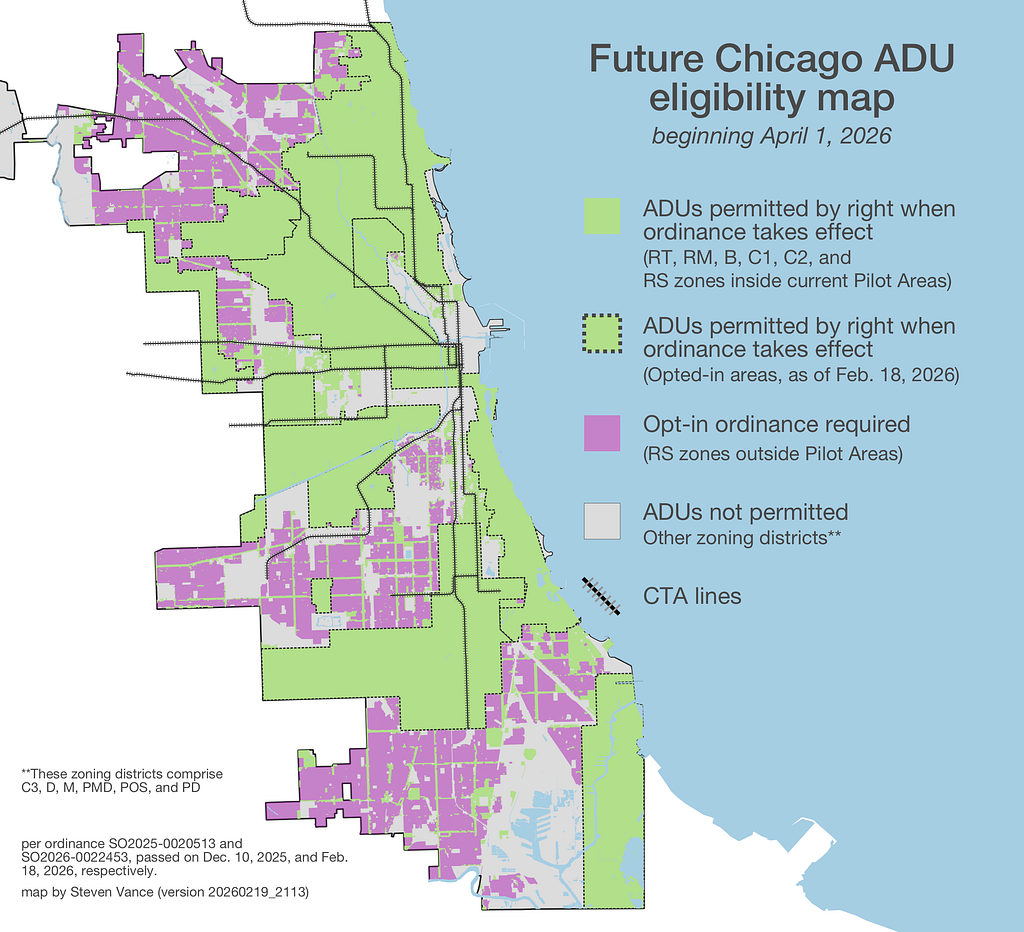 (Steven Vance / Cityscape Chicago)
But local affordable housing advocates like Steffany Bahamon, a co-leader volunteer at Abundant Housing Illinois, have been pushing back.
“This is not the allowance of 50 50-story buildings all at once,” Bahamon said of the notion that ADUs create congested neighborhoods. She added that ADUs could bring more people to Chicago.
“Chicago would benefit from having more people because we are the most in-debt city, in the most in-debt county, in the most in-debt state, and we need people here to pay those taxes,” Bahamon said.
City zoning rules adopted in 1957 banned secondary dwelling units. According to Bahamon, the ban was justified at the time by concerns about overcrowding and fire safety.
Looking back, though, housing advocates have connected a ban on ADUs to racially exclusive housing policies like redlining.
“I’m Colombian American. I live in a multigenerational household with my brother and soon my mom,” Bahamon said. “A lot of people back in 1957 didn’t want to see neighborhoods like that, especially around the time of more folks moving up from the South, the Great Migration. We’re undoing some of those racist policies.”
The push for ADUs comes at a time when Chicago is experiencing increasing rent and mortgage prices. According to a WBEZ analysis, someone making 50% of the city’s median income in 2000 could rent half the apartments in at least 12 of Chicago’s 77 neighborhoods. By 2022, that number shrank to just five neighborhoods.
In the last week, Lawson said the city received 126 applications from Chicagoans looking to build ADUs on their properties. That’s equal to the number of applications received in the last year of the pilot program.
Lawson and Mayor Brandon Johnson, also a backer of the ordinance, have described it as an effort to cut red tape and reduce regulation on property owners and developers.
ADUs are still regulated by the city, however. On a property with at least two ADUs, half must be rented to tenants earning at or below 60% of the area median income, and short-term rentals are prohibited.
“There are no short-term rentals allowed in ADUs, so no Airbnb or Vrbo, this is housing for Chicagoans,” Lawson said.
Those looking to build an ADU on their property can apply through the Chicago Department of Housing.