Science & Nature
UChicago Paleontologists Unveil Newly Discovered Spinosaurus Species: ‘A Kind of Hell Heron’
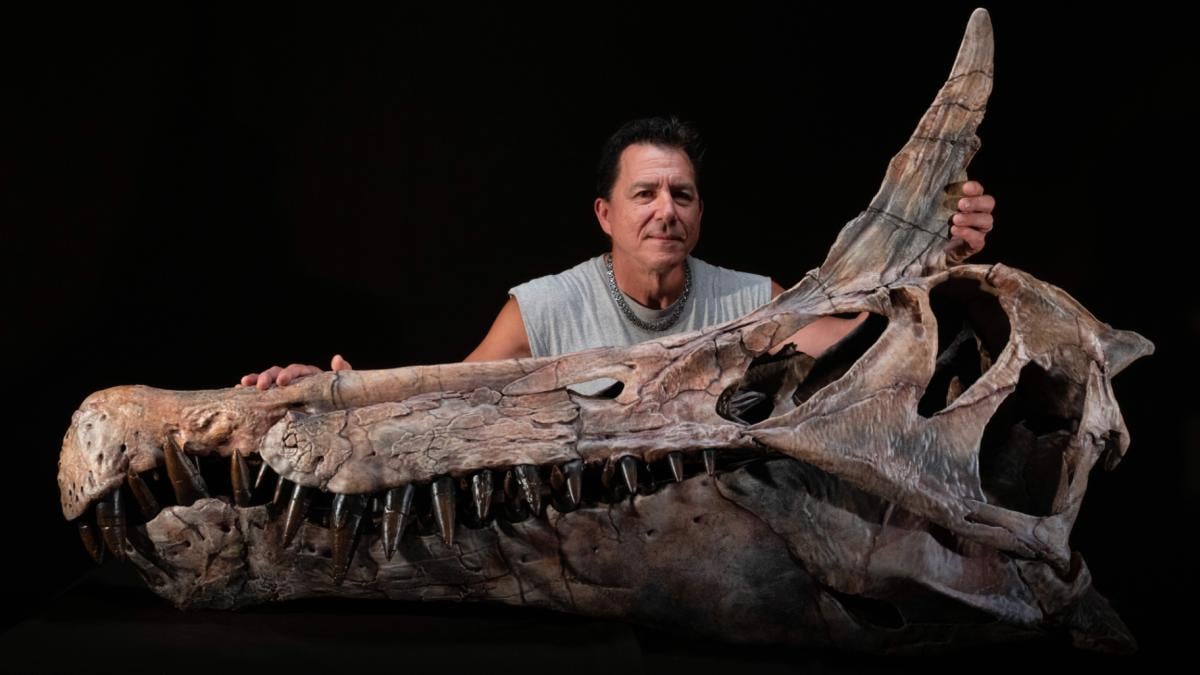 Paleontologist Paul Sereno marvels at the skull cast of the first dinosaur to be named from the Jenguebi fossil area in Niger, the spinosaurid Spinosaurus mirabilis. (Keith Ladzinski)
Posing with a replica skull from a previously unknown dinosaur species, the paleontologist Paul Sereno at the University of Chicago shows off what makes this one special.
One of Sereno’s arms extends only partway along the skull’s snout, while his other hand grabs a nearly 2-foot tall crest poking out from its top. His body is mostly hidden behind rows of interlocking teeth.
The unique size and shape of these bones from Spinosaurus mirabilis — the first Spinosaurus species discovered in over a century — gives important clues to the history of spinosaurids on Earth.
Like other spinosaurids, this new species stood tall on two legs and used muscular arms to grab prey. And, like another close Spinosaurus relative, teeth poked out of its mouth — interlocked like a crocodile. What sets this new species apart from other known spinosaurids is its crest, which rather than fanning out of its back, poked out of its head like a horn.
And from Niger’s Saharan to Chicago’s Fossil Lab and back again, the story of these ancient bones adds some perspective to our own brief stay on this planet.
This discovery “took grit, it took luck and it took a team,” said Sereno, whose team shared their findings on Thursday in the journal Science.
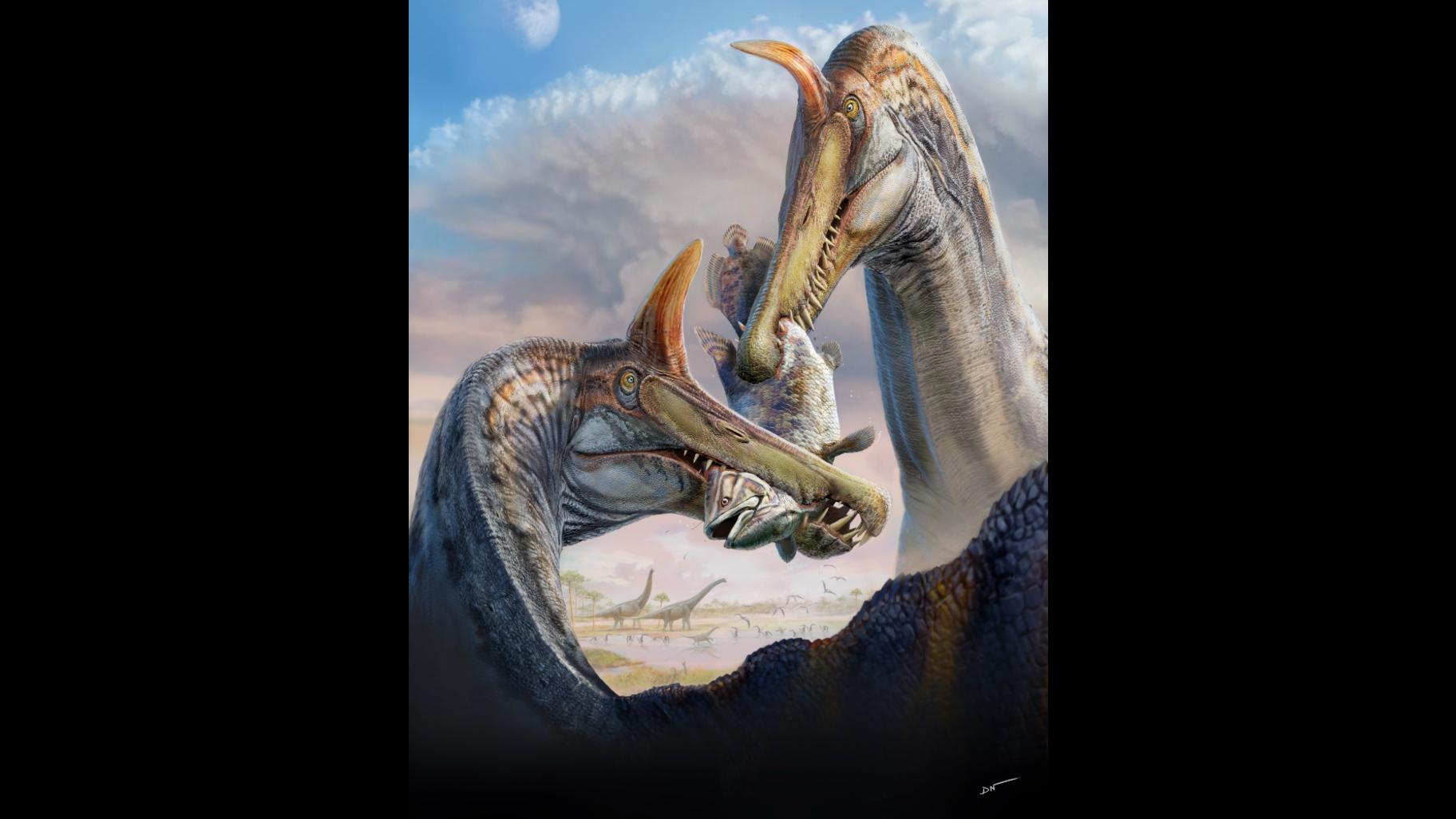 Two Spinosaurus mirabilis spar over a carcass on the forested bank of a river some 95 million years ago in what is now the Sahara Desert in Niger. A scimitar-shaped head crest and interdigitating teeth characterize this wading giant, one of the last-surviving species of a spinosaurid radiation some 50 million years in the making. (Artwork by Dani Navarro)
Putting the Puzzle Together
Daniel Vidal, a postdoctoral scholar who was one of the study’s co-authors, recounted the important moments leading up to the discovery.
On the last day of a Saharan expedition in 2019, Vidal noticed a bone sticking out of the sand with three holes — teeth sockets. He dropped a GPS pin where he found the jawbone, and planned to return as soon as possible.
After years of delays due to the COVID-19 pandemic, the team finally made it back in 2022. Within one hour, Vidal found the tip of a snout that fit the jawbone from three years earlier.
Then came the crest.
Vidal realized the horn-shaped crest was part of a skull. While other Spinosaurus species have crests that run down their heads like a ridge, this one was shaped unlike any other known Spinosarus crest.
“At that moment, the five of us that were there noticed right on the spot ‘Oh my God, we have a new species in our hands,’” said Vidal. “Without a shade of doubt, we’re completely sure.”
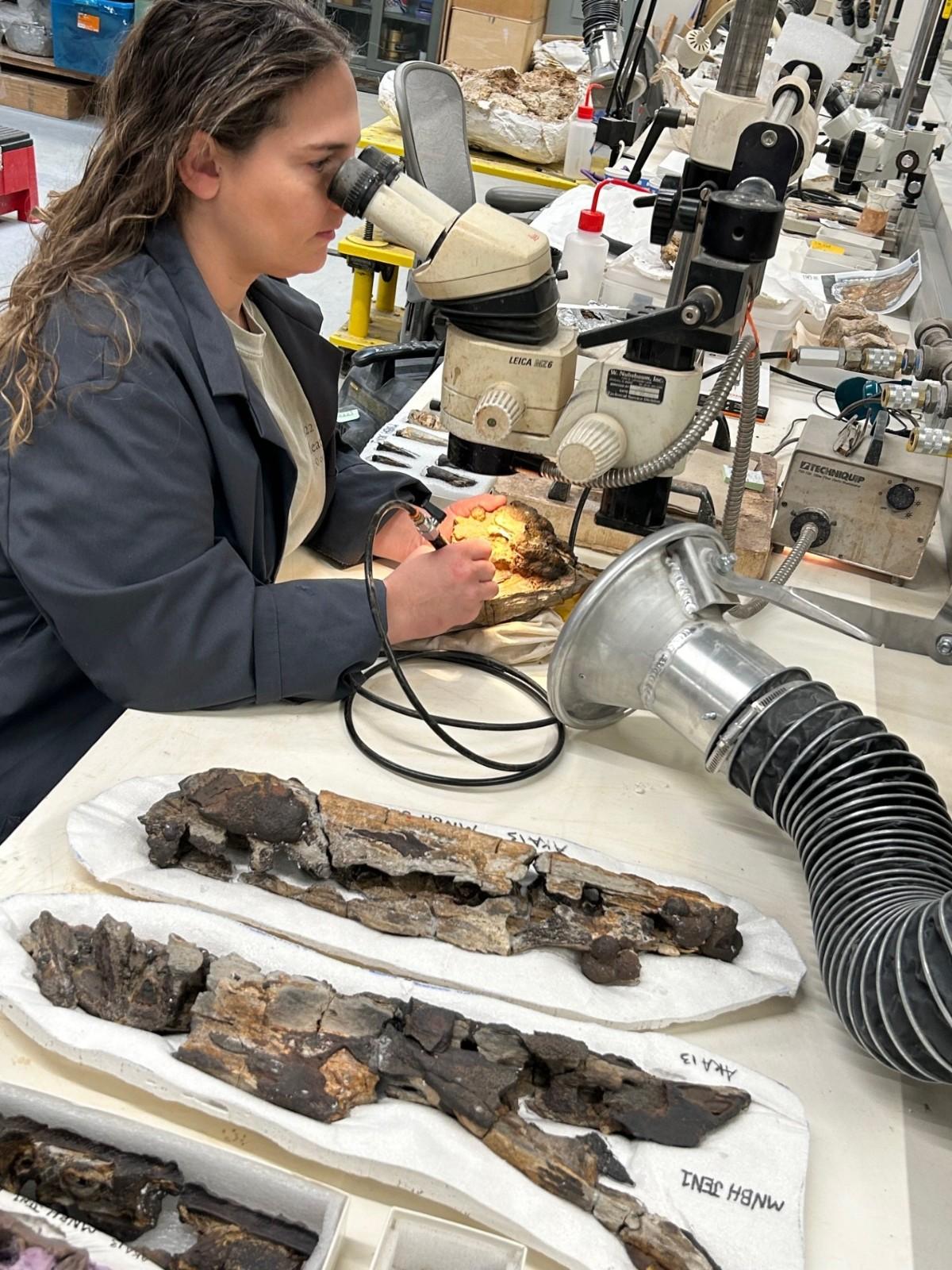 Under magnification at the University of Chicago Fossil Lab, fossil preparator Erin Fitzgerald cleans sediment from the fossilized snout tip of the new species Spinosaurus mirabilis, with other jaw pieces next in line. (Tyler Keillor)
Relying on solar power to juice their computers, Vidal and others in the field pieced together different scans into a three-dimensional picture of what the skull might look like.
After shipping 55 tons of rocks and sediment holding the bones back to the Fossil Lab, the paleontologists were able to prepare the bones and take them to the hospital to make CT scans. From there, they worked with animators to try to depict what the new dinosaur may have looked like and how it might have behaved.
The Aquatic Controversy
This discovery adds a new piece of evidence to a debate over the life history of spinosaurids.
Were they deep-diving aquatic animals, living only underwater? Or were they able to go back and forth between land and water?
Spinosaurus teeth seem well-suited for catching slippery fish. Plus, other spinosaurids had tails that resembled fish fins, and all were found near coasts, seemingly favoring the “aquatic hypothesis.”
These new bones, however, were located hundreds of miles away from the nearest coast. When this Spinosaurus roamed the Earth 95 million years ago, its habitat would have been near shallow rivers and forests.
Sereno’s conclusion is that this species was semi-aquatic, wading through shallow water and hunting fish “as a kind of hell heron.”
Still, the possibility remains that the dinosaur lived an aquatic lifestyle in a deep, ancient inland lake. But Sereno said its size makes that unlikely.
“The only [aquatic animal] living in freshwater that we know of, at this size, is the Loch Ness Monster,” joked Sereno.
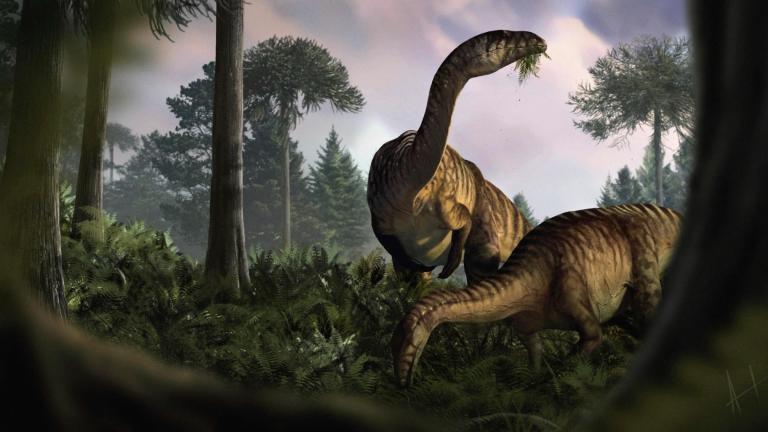
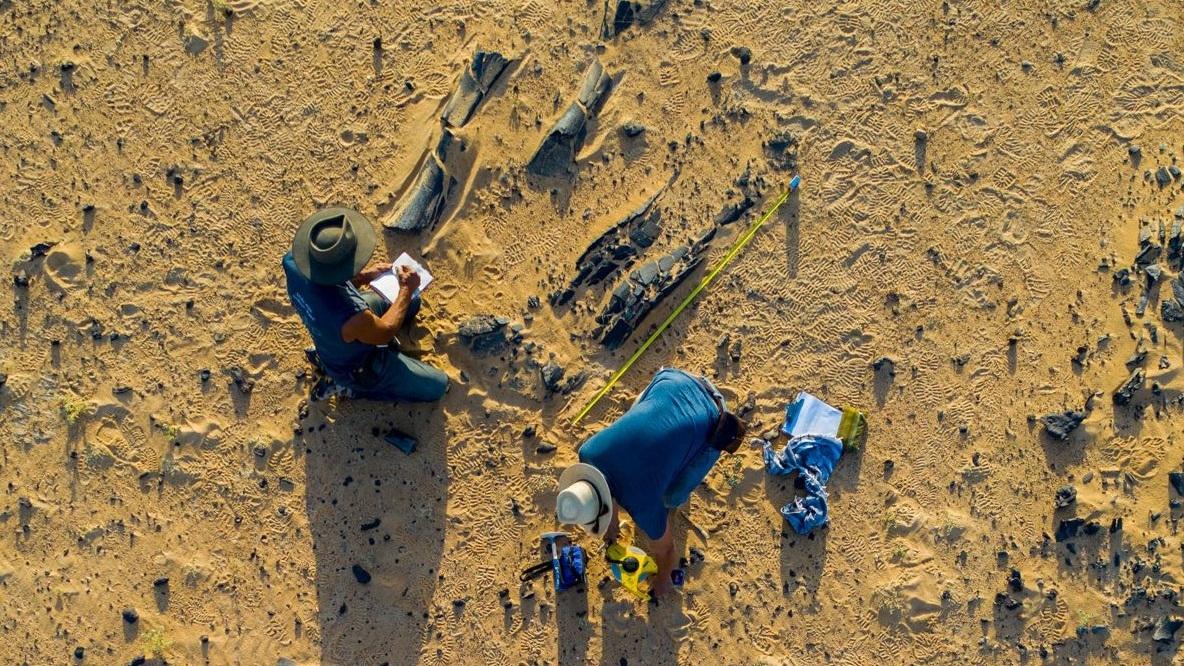 Moments after arriving at Jenguebi in November 2022, paleontologists Paul Sereno and Dan Vidal take notes on a massive hind limb of a new long-necked dinosaur, its femur measuring nearly 2 meters in length. (Matthew Irving / Fossil Lab)
From the Past to the Future
After more analysis in the Fossil Lab, the bones will be sent back to Niger, which Sereno said is their “rightful stage.” There they will add to the growing collection at the Museum of the River in the nation’s capital.
Meanwhile, replicas will be on display at the Chicago Children’s Museum at Navy Pier beginning in March. Sereno highlighted the remarkably quick turnaround from publishing research in a peer-reviewed journal to sharing the findings with children.
This outreach, he said, is a critical investment in our future.
“Children are fascinated by these animals that demand that they imagine,” said Sereno. “And that’s what science is ultimately about. It’s about imagining solutions to things… [the next generation] is going to be encountering problems that we can’t imagine yet.”