Crime & Law
Police Oversight Board Taps COPA’s Interim Head to Lead Police Misconduct Agency Permanently
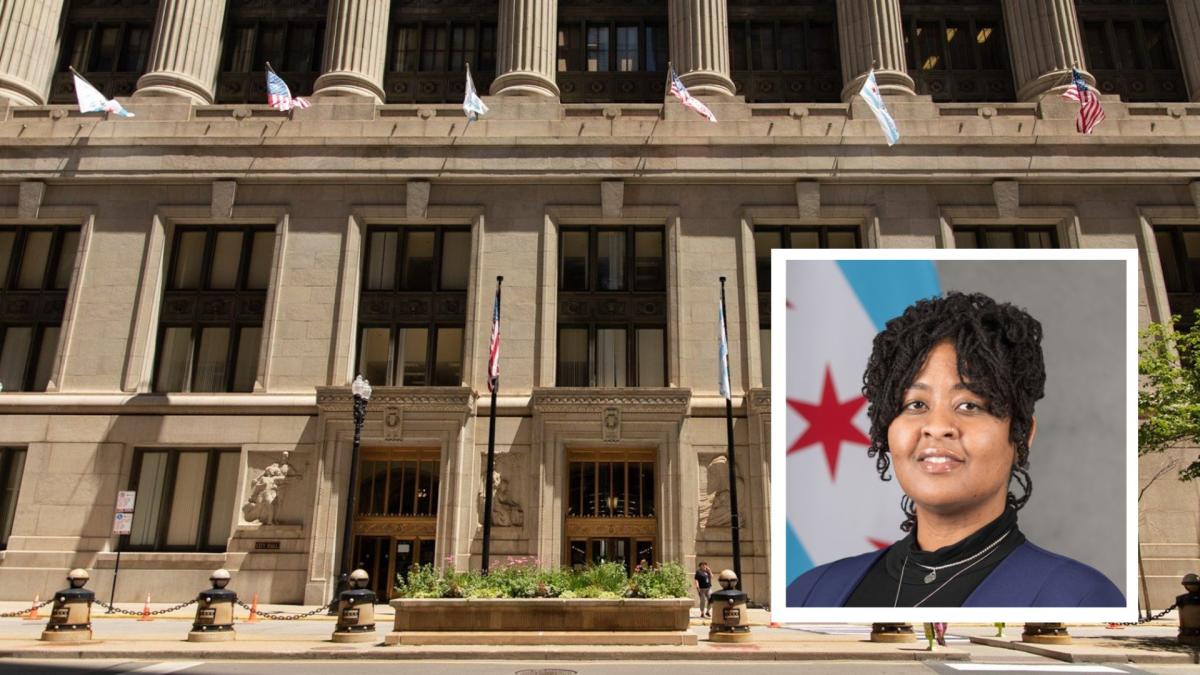 (Background: Michael Izquierdo / WTTW News. Inset: Provided)
Chicago’s police oversight board on Thursday tapped the interim head of the Civilian Office of Police Accountability to lead the city agency charged with investigating serious allegations of Chicago Police Department misconduct on a permanent basis.
The Community Commission for Public Safety and Accountability voted unanimously to select LaKenya White, a 26-year veteran of Chicago’s police accountability system, crediting her with improving “the quality, consistency and timeliness” of investigations conducted by the agency better known as COPA while improving the morale of the staff and “internal operations.”
“COPA’s work requires leadership that understands both the technical demands of complex investigations and the human impact those investigations have on families, officers and communities,” said Remel Terry, president of the police oversight board known as the CCPSA. “LaKenya has spent her career inside Chicago’s police accountability system, and she understands how this agency operates at every level.”
Twenty-seven people applied to lead COPA during the national search led by the CCPSA, officials said.
Mayor Brandon Johnson, who picked White to lead COPA on an interim basis after former Chief Administrator Andrea Kersten resigned under fire in February 2025, has 30 days to weigh in on the commission’s pick. He has no authority to veto the commission’s pick.
White said in a statement that working in Chicago’s police accountability system “is deeply personal.”
“I look forward to building on the progress we’ve made together to strengthen our integrity, transparency, and accountability, while standing alongside our community to continue building public trust,” White said.
White’s nomination now heads to the Chicago City Council’s Police and Fire Committee for a hearing. With the panel’s endorsement, it will be up to the full City Council to confirm her appointment.
The City Council could consider White’s appointment as they weigh whether to give COPA the explicit authority to investigate whether Chicago Police Department officers and leaders have violated city law by helping federal immigration agents.
White is the first COPA chief administrator to be selected by the CCPSA, which was created in July 2021.
White served as a director of investigations for COPA before taking the top job at the agency at a time when it was under fire from all sides.
If confirmed, White will take permanent control of an agency that received 976 complaints in 2025, an 11.8% decrease as compared with 2024, when the number of complaints set a new record, according to city data.
The agency has approximately 600 complaints under investigation, records show.
The number of complaints filed with COPA has been essentially flat since 2021, rising just 2%, according to city data.
In all of 2025, officers shot 22 people, killing nine, according to WTTW News’ analysis of COPA data. Since the start of 2026, officers have shot one person, records show.
COPA has not publicly released the results of any of its probes into those shootings, records show.
A Cook County judge ruled Jan. 21 that it did not violate state law for COPA to investigate fatal police shootings, rejecting a lawsuit filed by the city’s largest police union.
Union leaders have been harshly critical of COPA’s ability to probe officers’ conduct, a sentiment echoed by Chicago Police Supt. Larry Snelling, who said at a February 2024 Police Board meeting that COPA had treated CPD officers so unfairly that they are at risk of suicide. The agency’s probes also compromise public safety, the city’s top cop said.
By contrast, Snelling and White sat together during the CCPSA meeting and Snelling applauded after the unanimous vote.
“Congratulations and good luck,” Commissioner Angel Rubi Navarijo said, prompting laughter from the crowd of several dozen people.
Snelling praised White as “extremely hard working, extremely professional and prepared to this job.”
White has “always been fair” and has “always been firm on her decision making,” Snelling said.
“We don’t agree on everything,” Snelling said. “I can tell you that right now. That is absolutely healthy. We shouldn’t.”
White has testified in front of the City Council several times, receiving plaudits from alderpeople pleased with her low-profile approach to leading COPA during the past year. White has not given a single media interview since her appointment, a stark contrast to Kersten who frequently spoke to reporters.
White began her career with the city of Chicago in 2000 as an intake aide with the Office of Professional Standards, the agency then charged with probing police misconduct. After that agency was dissolved amid controversy and replaced with the Independent Police Review Authority, White served as an investigator with that agency for more than 10 years.
When the Independent Police Review Authority was replaced by COPA in 2017, White was promoted to major case specialist and then put in charge of COPA’s intake unit, where she reviewed all incoming complaints to determine which city agency should investigate the matter, records show.
Created in the wake of the outrage over the 2014 police murder of Laquan McDonald, COPA is charged with investigating claims of excessive force, bias-based verbal abuse, firearm discharges, deaths or serious injuries in custody, sexual misconduct, and improper searches or seizures, records show.
White would be the agency’s fourth leader.
COPA was supposed to usher in a new era of police accountability, with officials vowing to adequately fund the agency and staff it with professionals unafraid to bring disciplinary cases against officers found to have violated department rules.
Immediately after its 2017 launch, COPA found itself hamstrung by the massive backlog of nearly 1,000 cases it inherited. The agency also struggled to probe the more than 400 complaints alleging Chicago police officers committed a wide range of misconduct during the 2020 protests and unrest that were triggered by the police murder of George Floyd.
Kersten never enjoyed the support of City Council members who consider themselves to be pro-police, many of whom echoed criticism lobbed at the agency by John Catanzara, the president of the police union who often describes his officers as struggling to do their jobs amid unfair and biased treatment by COPA.
The breach between CPD and COPA widened after four officers shot and killed Dexter Reed shortly after he shot and wounded an officer during a traffic stop in March 2024.
Officers told COPA investigators at the scene of the fatal shooting they stopped Reed because they believed he was not wearing his seat belt, a violation, according to reports signed by the officers involved and released by COPA because they are public records.
In a letter to Snelling, Kersten suggested those reports contained false information.
In October 2024, WTTW News reported that COPA identified a troubling pattern of undocumented and aggressive stops on the city’s West Side at least a year before Reed’s death, but took no action.
The CCPSA had planned to take a no confidence vote in Kersten before she resigned, citing a number of failures they said had compromised Chicago’s police accountability system, eroding public confidence in policing and police oversight.
Kersten rejected those allegations, saying she was being targeted for attempting to hold police officers accountable for misconduct.
Contact Heather Cherone: @HeatherCherone | (773) 569-1863 | [email protected]
WTTW News coverage of policing and police reform is supported by The Joyce Foundation.