Crime & Law
For Some People With Criminal Records, Illinois’ Clean Slate Act Could Offer a New Beginning
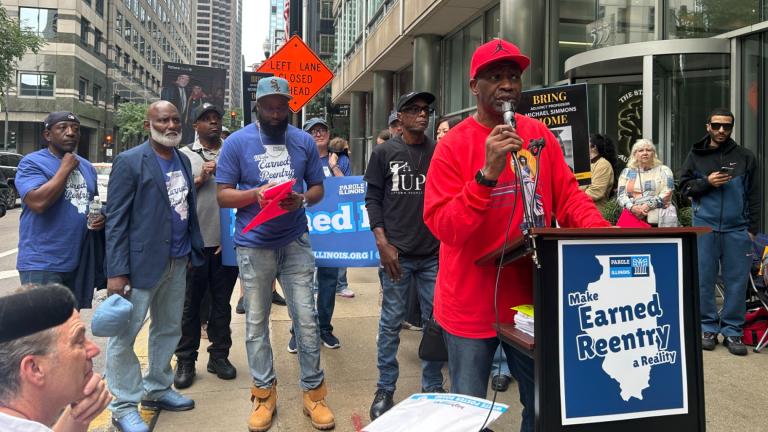
As he spoke to a room full of people impacted by the criminal justice system, and the activists who support them, 49-year old Marlon Chamberlain touted a recent victory.
“If you filled out a slip, jumped on a bus, made a phone call, sent an email — this is a win for us! We went to the Capitol saying ‘Clean Slate can’t wait! Clean Slate can’t wait!’” Chamberlain said to applause.
Chamberlain was celebrating the work of thousands of volunteers and activists who flooded the state Capitol in late October to lobby for legislation to help others like him. They finally notched the win during the General Assembly’s fall veto session with the passage of the Clean Slate Act, which is designed to automate the sealing of certain criminal offenses.
“It feels good,” Chamberlain said. “But the way I’m wired, my brain is instantly thinking about implementation. But this was a huge milestone.”
WTTW News first met Chamberlain two years ago, during our series on Permanent Punishment. Now, his work has led to the Clean Slate Act.
More than 2 million people in Illinois are eligible to have their records sealed but haven’t acted on what is currently a cumbersome, lengthy process.
“You can talk to one person who would say, ‘Hey, because I was well connected, supported in the nonprofit space, I had access to attorneys, and so for me it took six months,’” Chamberlain said. “But then there are some who we’ve spoken to where it’s been a three-year waiting period where it’s court dates that were rescheduled, canceled, or you didn’t have access to an attorney.”
“That’s not true justice,” said state Sen. Elgie Sims (D-Chicago), one of the bill’s chief sponsors. He said the process must be fair, equitable and open for everyone.
“Sealing allows for law enforcement, allows for certain governmental entities to still have access to the information — so it wouldn’t make the public any less safe,” Elgie Sims said. “But what it does, it would make that information not available to private entities so that individuals would have access to housing, access to employment, access to education.”
Julian Sims, 37, was released from prison three years ago after serving time on drug-related charges.
He said he earned degrees and certificates in culinary arts and electrical work while incarcerated, but he couldn’t get hired once he was released.
“What they told me was that I wasn’t allowed to go into people’s houses because I was a criminal, I have a background,” Julian Sims said.
As with the current sealing laws, the legislation only applies to misdemeanors, ordinance violations and Class 1-4 felony convictions, unless they involve violence.
That means no murder convictions, DUIs or Class X felonies such as armed robbery or sexual assault.
The new legislation also removes the drug testing requirement to seal felony drug convictions.
Chamberlain — a longtime advocate and someone who’s served time for federal drug charges — said passing the Clean Slate Act is just the beginning: Hundreds of state and local laws prevent people with criminal records from moving on.
“There’s restrictions around volunteering at your children’s schools. Certain professional licensing that folks can’t have with an arrest and conviction record,” Chamberlain said. “So there’s a list of over a thousand statutes that we have cataloged that still exist.”
“Our goal is to build a permanent institution so that we can continue long after Marlon decides to retire,” Chamberlain continued. “We want this fight continued until we have eliminated all of those statutes.”
For now, Julian Sims said a clean slate is at least a start.
“I wanna start a class so I could teach automotive so that I could put in my neighborhood to grow my neighborhood,” Julian Sims said. “Because I feel if they got more opportunities they got other better ways to grow.”
Only two Republican state senators voted with Democrats in favor of the law during the fall veto session. The bill passed the state Senate 39-17 after passing in the House in the spring.
State Sen. Steve McClure (R-Effingham), who voted against the bill, said in a statement: “This legislation eliminates provisions in current law that make sure people are rehabilitated before their criminal records are sealed and hidden from public view. One example is that this bill strips judges of the ability to unseal previous criminal convictions when the person whose records are sealed commits new and serious felonies demonstrating that they are not rehabilitated and are a danger to the public.”
He also noted concerns over the cost of implementing the bill, the decision to remove drug testing requirements and that crimes involving financial exploitation of the elderly will be sealed under the bill.
Advocates expect that Gov. JB Pritzker will sign the legislation.
It would go into effect next summer, when state police would start developing the process — overseen by a task force written into the law — before the first phase of records will be automatically sealed on Jan. 1, 2029.