Politics
As the Texas National Guard Leaves Illinois, Retired Major Generals Offer Insight Into Troops’ Role
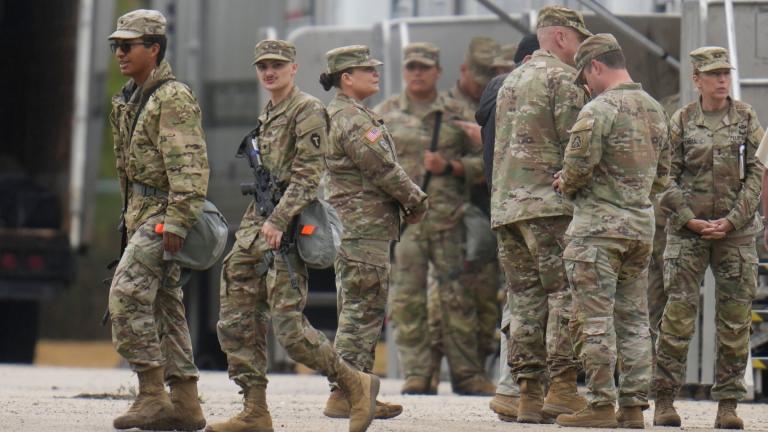
Hundreds of Texas National Guard members deployed to Illinois are being sent home, according to a defense official.
The move is said to be part of a broader change to deployments after President Donald Trump began his crackdown in Democratic-led cities like Chicago, Los Angeles and Portland, Oregon.
Meanwhile, the federal court order barring the deployment of the National Guard into Chicago expires next week, Nov. 24, as Trump awaits a U.S. Supreme Court ruling on whether he has the legal authority to deploy the National Guard to combat local crime.
“The people of Chicago and Texas deserve a full accounting on how much taxpayer dollars were actually wasted on this political stunt,” Mayor Brandon Johnson said Monday. “We promised to fight back against the militarization of our cities, using every tool at our disposal, and we were successful in that effort. As we said from the beginning, the Texas National Guard belongs in Texas.”
The Trump administration claims it’s necessary to bring in military presence as an aid to federal immigration agents who are under a “constant threat” of mob violence from protesters.
Border Patrol chief Gregory Bovino, along with his agents, recently left Chicago to lead a new operation in Charlotte, North Carolina.
In a post on social media platform X, Bovino credited his agency for bringing down crime in Chicago despite violent crime being on a downward trend since 2022.
“We already know the administration has been misrepresenting facts or making up their own facts about crime figures in every city,” said retired Maj. Gen. Randy Manner, who served as the acting vice chief of the National Guard Bureau. “The military is not the method we use for law enforcement. They are not trained for this, and we don’t want to put these young men and women in situations they are not trained for.”
Manner recently spoke to police chiefs from across the country at an event in Washington, D.C., where he urged department heads to prepare for collaboration with the National Guard in the event there’s a deployment in their jurisdiction.
“You have to develop the relationship (between the National Guard and police) in advance of there truly being a crisis because the Guard is there to help save the lives of American people — not to watch over them, not to intimidate them,” Manner said. “They are a partner with the police to back them up whenever needed. Particularly whenever there’s a storm, hurricane, forest fires or some significant calamity that might require local forces to be augmented to help either establish or restore order or to help save lives.”
In typical protocol, the National Guard is requested by local executives, such as the mayor, when a civil disturbance becomes too difficult or impossible for local law enforcement to handle by themselves.
The last time the National Guard was in Chicago was the summer of 2020, when the local government requested a National Guard presence. However, the troops weren’t participating in law enforcement operations like criminal investigations, traffic stops or conducting raids. They, instead, backed local forces and did crowd control.
“The federal district courts in Oregon and in Illinois have made it pretty clear that President Trump has vastly overstated any problems that have been taking place in Portland or in Chicago,” said retired Maj. Gen. William Enyart, former adjutant general of the Illinois National Guard. “It’s been a vast overreach on the part of the federal government to mobilize National Guard troops and bring them in from out of state against the expressed wishes of both the governors and local executive authority.”