Politics
Mayor Brandon Johnson Calls for $617M in New Taxes to Close Budget Gap, Avoid Layoffs
Mayor Brandon Johnson called Thursday for more than $617 million in new taxes on the wealthiest Chicagoans and largest firms in order to blunt cuts imposed by the Trump administration while avoiding drastic cuts in city services and thousands of layoffs.
The mayor’s spending plan does not include a property tax hike and would allow the state’s 1% tax on groceries to expire at the end of the year, according to the proposal presented Thursday to the Chicago City Council.
Instead, it would close the city’s massive shortfall in part by imposing a $21 per employee tax on large companies to generate $100 million to fund violence prevention and youth employment programs. Johnson also proposed a first-of-its-kind tax on social media companies to generate $31 million to fuel the city’s public mental health clinics and crisis response programs, according to the proposal.
“As I speak ... we have National Guard troops from Texas waiting on a court order to deploy to our streets; our federal government is in a shutdown with no end in sight; we have bands of armed, masked men with long guns and armored vehicles who have shot residents in the streets,” Johnson said, casting his proposed spending plan as the best way to protect Chicagoans from the president’s attacks.
Read the full budget overview.
Johnson’s $16.6 billion proposed spending plan for 2026 eliminates a $1.19 billion projected shortfall. Officials also closed a $146 million deficit the city was facing this year by declaring $1 billion in property taxes earmarked to fight blight to be “surplus,” sending more than $500 million to Chicago Public Schools. CPS will use those funds to make a required pension payment, easing the city’s financial crunch, officials said.
“This intense and growing wealth inequality is not sustainable for our city,” Johnson said. “We can not separate the immense wealth of the few from the poverty and insecurity of the many.”
The plan proposes just $80 million in cuts, with the bulk of those savings coming from a year-long hiring freeze to be imposed on every city department except for those focused on public safety or revenue collection, officials said.
The city will also borrow to cover the cost of “extraordinary and one-time” expenses, including the massive cost of resolving police misconduct lawsuits and paying Chicago firefighters and paramedics the retroactive pay they are owed after working without a contract for four years, officials said.
Chief Financial Officer Jill Jaworski said it was not immediately clear how much more the city would have to borrow, on top of its already massive amount of debt, to cover those costs.
Johnson said he would continue to ask state officials to allow Chicago to levy additional taxes on the wealthiest residents and biggest businesses. Most revenue-generating proposals, like imposing a sales tax on services, not just goods, would require a change in state law.
“Many of the proposals in our budget wouldn’t even be necessary if the progressive demands for a billionaire’s tax, a tax on services, or the elimination of corporate tax breaks were met at the state level,” Johnson said.
Johnson’s decision not to propose layoffs or furloughs avoids a fight with the city’s labor unions, which were likely to vehemently oppose any effort to balance the city’s budget by cutting their members’ pay or eliminating their jobs.
But the mayor’s decision to propose new taxes on large companies immediately triggered outrage in the city’s business community, which blasted those proposals as job killers. The proposal will fuel efforts to defeat Johnson and his allies on the City Council in the 2027 election.
“Rather than embracing shared sacrifice, this budget seeks to tax and borrow its way out of a deficit and, in the process, disincentivize job creation and hiring, deter relocation and expansion, and make Chicago less attractive at a time when national and global competition for jobs and investment is at an all-time high,” said Jack Lavin, the CEO of the Chicagoland Chamber of Commerce.
The proposal was also slammed by the Illinois Retail Merchants Association, the Illinois Manufacturers’ Association and the Civic Federation, a nonpartisan government research organization, led by former Inspector General Joseph Ferguson.
The proposal “repeats past mistakes and fails to provide progress toward sustainable, structural solutions,” according to a statement from the group.
While business groups panned the mayor’s budget proposal, progressive alderpeople said they were “heartened” by the mayor’s proposal.
“We have to come up with some innovative ways in order to fund government,” said Ald. Maria Hadden (49th Ward), the chair of the City Council’s Progressive Caucus.
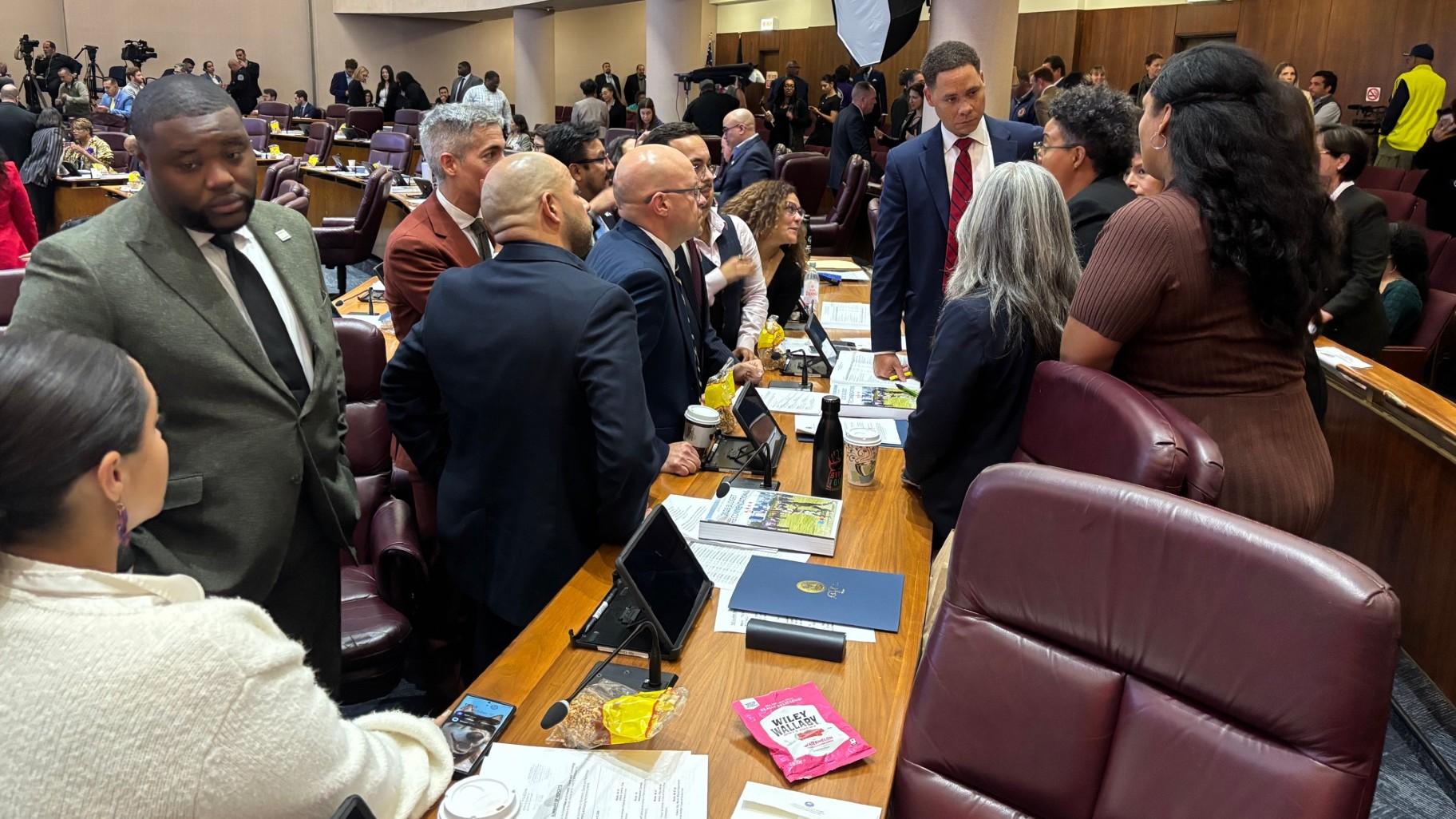 The Chicago City Council’s Progressive Caucus huddles after Mayor Brandon Johnson’s speech on Thursday, Oct. 16, 2025. Ald. Maria Hadden (49th Ward) called the speech “heartening.” (Heather Cherone / WTTW News)
A year ago, Johnson’s 2025 spending plan won only grudging support from his progressive allies, including Hadden, who blasted his handling of the budget negotiations. That meant the budget won the support of the City Council by the narrowest possible margin.
“Our budget proposal asks large corporations and the ultra-wealthy to chip in more so that working families are not burdened with higher property taxes or grocery taxes or garbage fees,” Johnson said. “These Big Tech corporations got hundreds of billions of dollars from the Trump tax cuts — we are proposing that they invest some of those profits into the people of Chicago.”
The city’s head tax, in place for four decades, was eliminated in 2011 by former Mayor Rahm Emanuel, who said lifting it helped spur millions of dollars of economic activity in the city and prompted dozens of companies to relocate to Chicago.
But Budget Director Annette Guzman said the impact of the head tax’s elimination on Chicago’s economy had been overstated.
The proposed head tax would apply to firms with more than 100 employees, which account for just 3% of all Chicago businesses, Johnson said. It would rise annually to keep pace with inflation, records show.
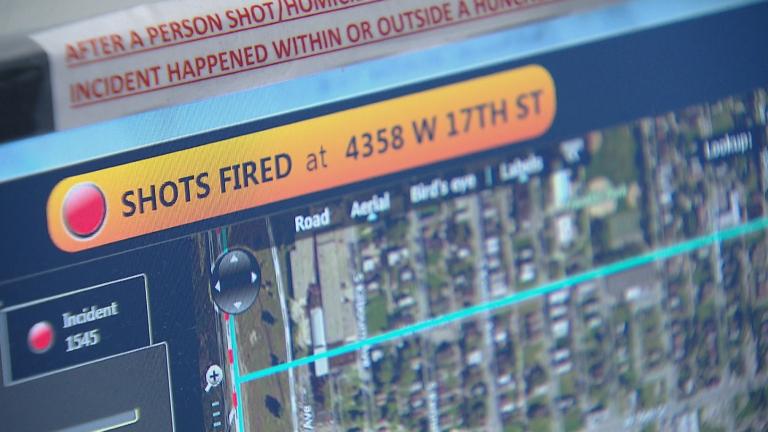
Johnson said not only would the new tax not be a “job killer” but it would serve as a “job creator” by ensuring that violent crime continues to decline across Chicago. Since the start of the year, homicides are down nearly 28%, while the number of people shot has dropped nearly 37%, according to city data.
“We cannot afford to go backward,” Johnson said, adding that while he was proud of the drop in crime and violence, he was not satisfied with it.
“I’m not going to sugar-coat it: If we fail to invest in community safety in this budget at historic levels, the federal government will try to use that as a justification for a military occupation of our city,” Johnson said.
That new money will flow into a special fund that will be used to fund the violence prevention and youth employment programs that Johnson and his allies credit for the sustained drop in violent crime since he took office.
Since business leaders have repeatedly said local government’s highest priority should be ensuring the safety of Chicago residents and business, the mayor said it only makes sense for Chicago’s largest companies to “put more skin in the game” in order to allow the city to “double down” on efforts that are working, Johnson said.
There can be no doubt that the companies can afford to pay more in taxes to the city, since the Trump administration slashed taxes on the wealthiest people and firms, Johnson said.
The largest tax hike included in the mayor’s proposal would boost the tax levied on software licenses, cloud services and other digital goods to generate $333.2 million, according to the proposal. The mayor touted that as a tax hike on “big tech.”
The city’s 2025 budget hiked that tax, which is largely paid by large corporations, like Google, Amazon and Salesforce, rather than individual Chicagoans, by $128.1 million, records show. If approved, the tax on those services would rise from 9% in 2024 to 14% 2026.
The proposed spending plan would also hike the congestion surcharge for all rides to and from an expanded area downtown to generate $65.4 million; impose a local tax on online wagers to generate $26.2 million and tax the sale of intoxicating hemp products starting July 1 to raise $10 million.
The budget would also generate an additional $47.3 million by expanding a program to use cameras mounted on city vehicles and CTA buses to fine owners of cars parked in bicycle and bus lanes, according to the proposal.
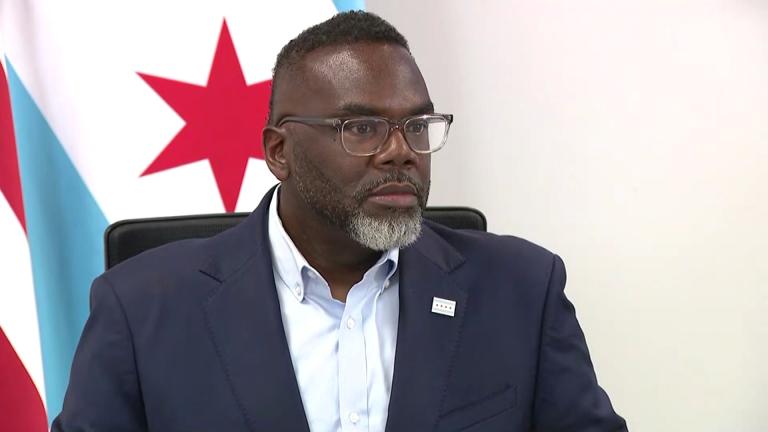
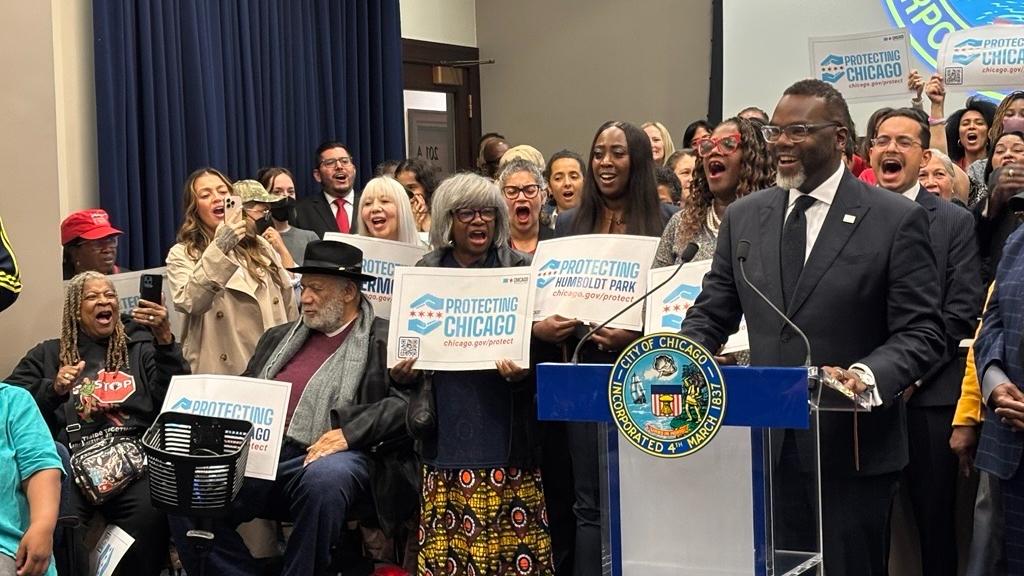 Mayor Brandon Johnson speaks before his budget address on Oct. 16, 2025. (Heather Cherone / WTTW News)
Focus on Mental Health Clinics
While Johnson touted the 2024 budget as a “down payment” on the promises he made during the campaign to invest in working-class Chicagoans by strengthening the city’s social safety net, the 2025 spending plan did little to fund those priorities.
After reopening three of the six mental health clinics closed in 2011 by Emanuel in 2024, no additional mental health clinics opened in 2025. This year’s budget included just $2 million to create a dedicated unit to dispatch 911 calls from those experiencing mental health crises and to staff the city’s existing clinics.
Efforts to expand those programs have faltered because there has never been a dedicated funding source for clinics and a program that sends counselors and social workers to those who call 911 while experiencing a mental health crisis.
“We are not afraid of taking on Big Tech giants to fund free mental health care for Chicago,” Johnson said.
Johnson proposes to solve that problem by forcing social media companies to pay a tax of 50 cents per month for every active user after the first 100,000 users, under the city’s amusement tax authority, officials said.
“A growing body of research shows that social media has a negative impact on mental health, particularly for young people” and the firms should “contribute fair share to fund additional public health and mental health services for Chicagoans,” according to the budget proposal.
That could raise $31 million, if the first-of-its-kind tax withstands a certain legal challenge, officials said.
Johnson acknowledged that several of his proposals pushed the envelope on the city’s taxing authority, saying those proposals were designed to shift the tax burden from those who could least afford to pay more to those who have benefited from growing economic inequality.
“I clearly don’t mind going first,” Johnson said. “Whether that’s, you know, investing in the West and South sides of the city, stand up for our immigrant communities, and in this case, challenging those with means to put more skin in the game. I’ve said this repeatedly, you know, as Democrats, we stand up for working people. It’s a really good time to be a billionaire right now.”
Structurally Unbalanced Budget
Chicago’s finances remain structurally unbalanced, pinched by soaring pension costs, spiraling personnel costs and a massive amount of debt. Officials are staring into a financial abyss after hitting the so-called “fiscal cliff,” with Chicago’s federal COVID-19 relief funds exhausted and tax revenues lagging after a period of high inflation.
Chicago’s financial condition is also threatened by a looming economic slowdown, rising inflation and efforts by the Trump administration to scale back funding for Chicago as the president continues to target his political opponents, officials said.
Johnson’s spending plan calls for the city to make an additional payment of $120.8 million to the city’s four underfunded pension funds. That additional payment is more than 55% smaller than the additional payment made in 2025, records show.
In August, the city had planned to make an additional payment to the city’s four pension funds of $219.4 million, records show.
The city faces a nearly $2.85 billion pension bill in 2026 in order to comply with a state law that requires two of Chicago’s pension funds be funded at a 90% level by 2055 and the other two by 2058, ensuring they can pay benefits to employees as they retire, according to the forecast released Friday.
The city faces a deadline of Dec. 31 to approve a spending plan for 2026, with City Council hearings scheduled to start on Tuesday.
Contact Heather Cherone: @HeatherCherone | (773) 569-1863 | [email protected]