Arts & Entertainment
After Trump’s Columbus Day Proclamation, Chicago Celebrates Both Italian American Pride and Indigenous Peoples Day
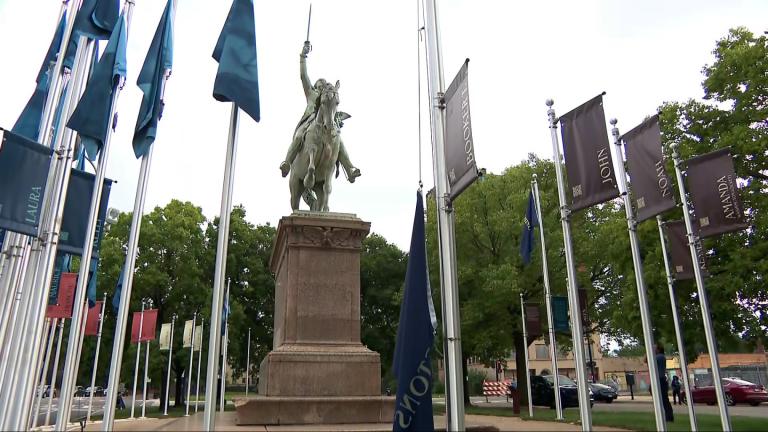
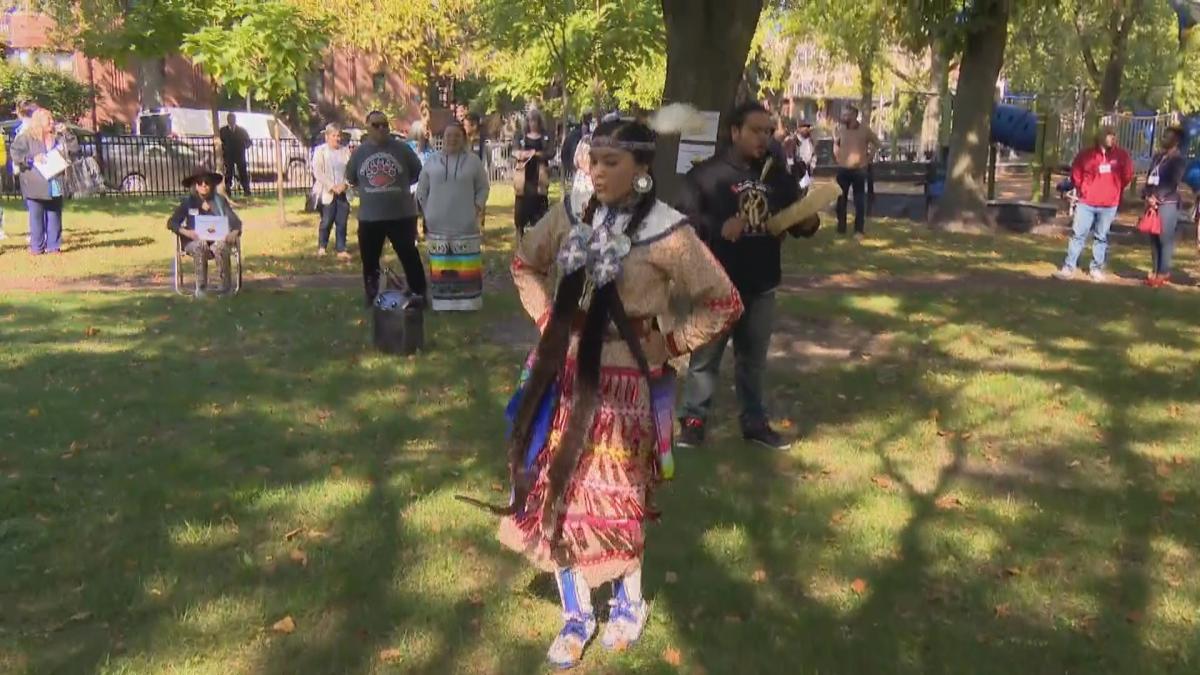 Indigenous Peoples Day is celebrated in Chicago in 2022. (WTTW News)
Monday’s Columbus Day parade kicked off for the 73rd time in Chicago amid renewed attention on the legacy the day celebrates.
Days before, President Donald Trump proclaimed Oct. 13 to be Columbus Day, citing Christopher Columbus as “the original American hero” and urging Americans to celebrate his legacy while directing all public buildings to display the American flag.
“This Columbus Day, we honor his life with reverence, perseverance, and virtue from the left-wing arsonists who have sought to destroy his name and dishonor his memory,” the proclamation reads.
The proclamation also acknowledges the contributions of Italian Americans who have contributed to “our culture and our way of life.”
The proclamation does correctly state that Columbus made several other trips throughout the Caribbean, Central and South America. However, he never actually explored any region in the continental United States.
The pointed words came after years of debate around the best way to mark the October holiday. Native activists have sought to recognize Indigenous Peoples Day as well, noting the historical legacy of Columbus and his treatment of Indigenous peoples across the Caribbean, Central America and South America.
In 2021, President Joe Biden became the first U.S. president to officially recognize Indigenous Peoples Day at the same time as Columbus Day, after years of organizing campaigns.
Despite that recognition, the day itself is not federally recognized as a holiday. Instead, only 17 states and Washington, D.C., recognize the day as opposed to the 30 states and three U.S. territories that recognize Columbus Day.
The Genoa-born Columbus’ legacy was first commemorated in 1892 by President Benjamin Harrison amid growing tension against Italian immigrants.
A year prior, 11 Italian immigrants were murdered in New Orleans, an event that strained the United States’ relationship with Italy.
In 1934, Columbus Day was proclaimed an official federal holiday by President Franklin Roosevelt.
In Chicago, the city’s parade is hosted by the Joint Civic Committee of Italian Americans.
“Since 1952, the Columbus Day celebration has been a generations-old honoring the Chicagoland Italian American Community,” a statement from the committee reads. “The JCCIA welcomes everyone to join us in celebration for the 2025 Columbus Day Parade.”
The organization describes itself as dedicated to “heritage and promoting the Italian American community.” They also provide scholarships to assist Italian Americans and serve as a congress for more than 60 Chicago-area Italian American organizations, “representing the community on a local, state, and international level.”
A Look at the History
Columbus’ legacy is often mythologized yet rarely put into historical context.
Hayley Negrin, an assistant professor at University of Illinois Chicago, specializes in Native American and Indigenous studies and hopes to bring a historical understanding to Columbus.
She said that Columbus in his lifetime was often criticized by his peers for his enslavement of and cruelty toward Native people.
After being appointed the governor of Hispaniola by the Spanish Crown, Columbus was imprisoned in 1500 for his mismanagement of the colony. A contributing factor to his imprisonment was his mistreatment and cruelty of Indigenous people, which led to civil unrest among settlers. Following his arrest, he was stripped of his titles and brought back to Spain.
“A lot of our holidays, you know, these sorts of legacies are created over time for different political and cultural reasons.” Negrin said. “I think, from the Indigenous perspective, this is a story about celebrating a colonizer and, you know, that’s a choice that a society can make or not make.”
For example, Thanksgiving was constructed over the national pride that Pilgrims held for people wanting to stake their claim as descendants of foundational Americans during a time when there was increased Catholic immigration, she said.
However, she believes Italian Americans hold on to Columbus Day as a celebration of their community that came from a very real and challenging immigrant experience full of struggle and bigotry.
“Multiple things can be true. That’s kind of how American history works,” Negrin said. “Italians go through a tremendous amount, in terms of figuring out their place in the United States. Nobody’s negating that history. ... I think there’s a lot of discussion around ‘Hey, you know, could there be a better Italian American that you could use?’”
When reading Columbus’ early writing, Negrin said she found his use of dehumanizing language to be shocking.
“He’d frame Indigenous people in his writings as either they’re kind of like innocent and very honest and kind, but not smart enough to possess sovereignty over their land, or he has a whole discourse about them being cannibals, which actually is a really, really important legal justification of slavery during that time period,” Negrin said.
Those two claims in his writings, in Negrin’s academic perspective, are “incredibly overexaggerated” if not entirely false.
Columbus’ legacy is one she encourages people to explore for themselves, recommending those who are interested to read the letters that he wrote to the Spanish Crown.
Locally, Indigenous Peoples Day is also recognized in conjunction with Columbus Day.
“Today on Indigenous Peoples’ Day, we honor the First Peoples of this land,” a post from the American Indian Center in Chicago reads. “The Bodéwadmi, Ojibwe, and Odawa Nations, known together as the Council of Three Fires, along with the Ho-Chunk, Menominee, Miami, Peoria, and many other Indigenous Nations who have called this region home. We also honor the countless Indigenous people who call Chicago home today.”
The post notes that Indigenous Peoples Day is not a holiday, but in their words, “a reminder that the same systems that tried to erase us are still here, only wearing new names.”
It later goes on to draw comparisons between the inhumane treatment of Indigenous people to the recent arrests, detainments and deportations under ICE.
“From the Trail of Death to boarding schools to ICE detention centers, this country has renamed the same violence for generations. Yet here we stand, still rising from the same soil they tried to bury us under,” the post reads.