Politics
Key Panel of Illinois Lawmakers Objects to Department of Corrections’ Move to Scan Mail in Prisons
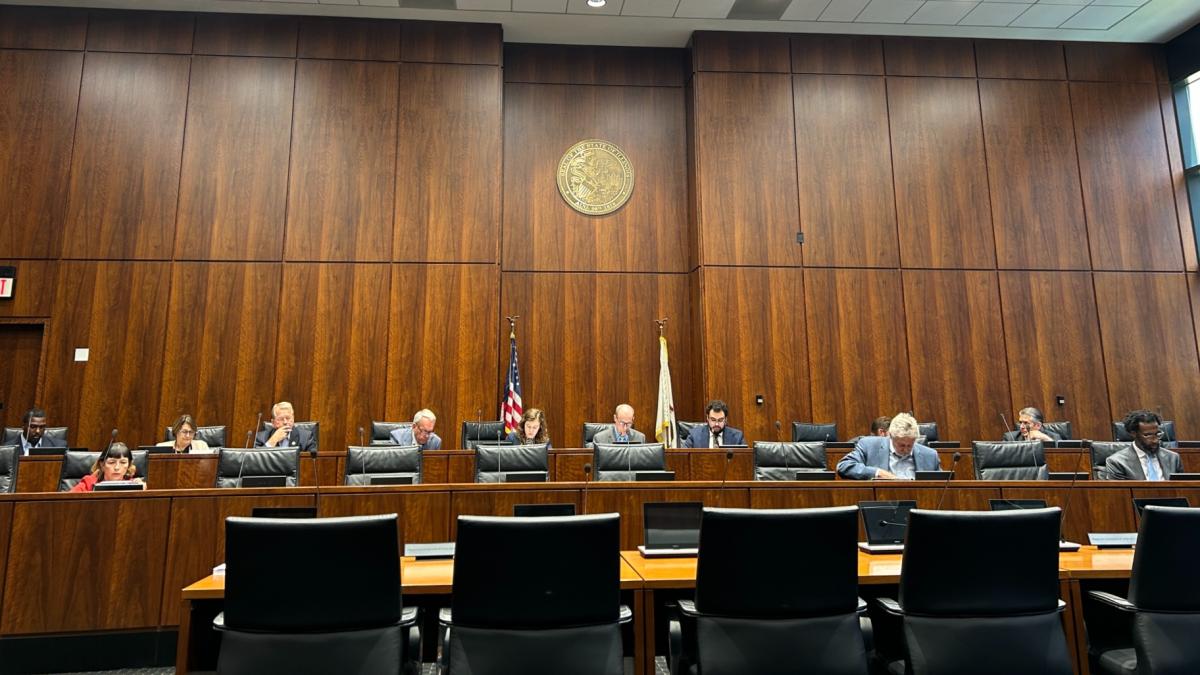 The Joint Committee on Administrative Rules holds a hearing Tuesday, Sept. 16, 2025. (Blair Paddock / WTTW News)
Amid an ongoing debate over whether physical mail is a major entryway for illicit substances in Illinois prisons, the Department of Corrections issued an emergency rule to instead scan mail. But a key legislative committee on Tuesday determined it doesn’t warrant an emergency.
The Joint Committee on Administrative Rules objected to the Illinois Department of Corrections’ emergency rule allowing facilities to electronically scan mail. The objection does not stop the department’s emergency rule, which paves the way for IDOC facilities to transition to scanning incarcerated peoples’ mail, instead of giving them physical mail.
Members of the bipartisan committee of state legislators made it clear they did not approve of IDOC using the emergency rule process to advance mail scanning: “I just don’t think that this is an emergency,” said state Rep. Eva-Dina Delgado (D-Chicago).
The hearing adjourned with lawmakers suggesting that IDOC go through the regular rule-making process, which requires public comment. Per the emergency rule process, Tuesday’s hearing allowed only IDOC officials to testify; public comment could only be sent in writing.
“There are other stakeholders involved that have not been part of this process,” said state Sen. Bill Cunningham (D-Chicago). “I just really encourage you to go back to the drawing board.”
In response to the JCAR objection, IDOC spokesperson Naomi Puzzello said the department “will continue to engage with our labor partners, advocacy groups, staff, and other stakeholders” as they “move towards implementation.”
“As we take steps to transition to scanned mail, IDOC is committed to striking a balance between enhancing security and supporting those vital personal relationships,” Puzzello said.
AFSCME Council 31, which represents most correctional workers in the state, did not reply to a request for comment on the objection.
Under the emergency rule, IDOC amended procedures for processing incoming mail and the reception of publications. The rule authorizes the department to process incoming mail by electronically scanning the contents, making digital copies and then providing those to recipients in print or electronically.
The rule also prohibits relatives or friends from soliciting or purchasing publications on behalf of a person in custody. Visitors can no longer bring approved publications to a prison — previously, they could bring up to five publications per visit that were not packaged or contained.
The emergency rule is effective Aug. 14 for a maximum of 150 days.
IDOC officials stated during the hearing that the department has not yet transitioned to scanning mail.
Last legislative session, some lawmakers proposed enshrining the right to physical mail into law, while others proposed to ban it outright. In an effort to better understand this issue, Gov. JB Pritzker signed legislation in August that requires IDOC to collect and publish data concerning contraband found in its facilities.
Advocates who oppose the rule emphasize the importance of physical mail as a connection to outside support. AFSCME Council 31 supports the rule for the “security of state facilities and the well-being of AFSCME members.”
“We are fully committed to using the scanning process and two factor authentication as core security measures for the department,” said Robert Fanning, chief legal counsel for IDOC.
On Tuesday, lawmakers pressed IDOC for evidence of the need to scan mail, such as data from other states that have made the switch. Justin Hammers, chief of operations at IDOC, said they have been in contact with Ohio officials, who scan physical mail coming into facilities, but did not have data from the state. Ohio’s implementation has not gone without issue, as lawyers alleged state employees are opening confidential mail.
States that have switched to scanned mail haven’t necessarily solved their drug issues. In Pennsylvania, for example, the rate of random positive drug tests among incarcerated people more than doubled since the mail scanning system went into effect.
As for Illinois’ data, the department said that since January 2024, there have been 669 nonfatal overdoses of incarcerated people, and 409 staff exposed to drugs. There have been no staff deaths and no confirmed drug-related deaths of incarcerated people, the department said.
But it’s unclear how many drugs enter IDOC facilities through the mail, according to data obtained by WTTW News in February. From January to mid-December of 2024, 779 synthetic cannabinoids were discovered across all facilities, according to data. The “point of discovery” for that drug type was 188 by mail, while 410 were discovered “in cell” and 156 were discovered “on person.”
If tainted mail is found in a cell, it is considered an in-cell discovery, IDOC spokesperson Naomi Puzzello said at the time. There are many scenarios in which a substance might not be detected initially, like the mail not appearing abnormal during initial inspection, or a substance could have been introduced through another method and later stored in someone’s cell, she added.
Lawmakers also took issue with tablet implementation and the emergency rule. In October, IDOC signed a contract with communications company ICSolutions, which provides tablets to incarcerated people, and gave the agency the ability to scan and digitally deliver mail.
Tablets are in use by all of the population, Hammers said, but when they were first provided, “pretty much just had entertainment content on them.” Hammers acknowledged “bumps” in moving forward with the tablets.
“Why was the priority from the vendor entertainment if this is about communication,” asked state Rep. Curtis Tarver (D-Chicago).
The contract with the tablet provider is a “zero cost contract,” Fanning said. The vendor makes their money back through the selling of content, through phone calls, messages and entertainment, he added.
“Frankly speaking, if this is a safety issue, I don’t know why you are allowing them to make money on ancillary things that have nothing to do with both the safety of both your employees and the people who are incarcerated,” said state Rep. Steve Reick (R-Woodstock).
After the committee’s objection, IDOC can modify their emergency rule. The rule will be discussed again at the committee’s next meeting on Oct. 14.
Contact Blair Paddock: @blairpaddock.bsky.social | [email protected]