Arts & Entertainment
Find Echoes of the Civil War and the Battle of Gettysburg at Chicago’s Rosehill Cemetery
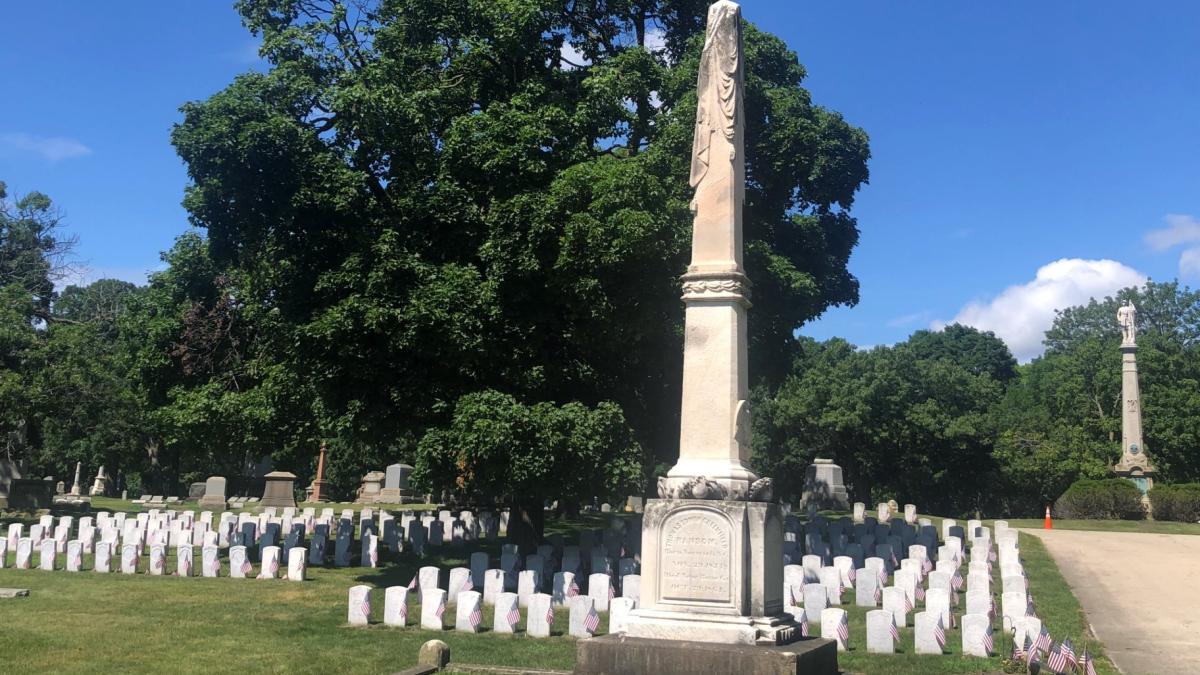 The grave of Gen. Thomas Ransom at Rosehill Cemetery. (Marc Vitali / WTTW News)
This month 162 years ago, the 8th Illinois Cavalry Regiment engaged in the first action of the Battle of Gettysburg, defending Union positions and delaying the advance of waves of Confederate infantry.
A soldier from DuPage County, Lt. Marcellus Jones, fired the first shot of the millions fired between July 1-3, 1863.
Two years earlier, these volunteers from the St. Charles area had mustered into service and joined the Army of the Potomac. Now they were on the front line at the start of the biggest and bloodiest battle of the Civil War.
Incredibly, the fighting that first day killed only one soldier from the 8th Illinois Cavalry; Pvt. David Diffenbaugh of Freeport is buried at Gettysburg National Cemetery in Pennsylvania.
Other veterans of the 8th Illinois Cavalry are buried in Rosehill Cemetery’s Civil War memorial area, a stone’s throw from the entrance to the city’s largest cemetery at 5800 N. Ravenswood Ave.
It’s the final resting place for generals, drummer boys and unknown soldiers.
But first, a correction.
The American Battlefield Trust website www.battlefields.org says this about Rosehill: “A portion of the administrative building is devoted to a Civil War museum, emphasizing the roles of those buried there.”
Upon returning from a recent trip to Gettysburg National Military Park, I was eager to see the museum.
But the Trust — which preserves battlegrounds across the country and educates the public — gets one thing wrong about Rosehill.
There is no Civil War museum at Rosehill.
At the administration building, I was told that the question frequently comes up.
Michael Weidman is director of family services at Rosehill Cemetery, and he’s their unofficial historian.
“That museum has been out of existence for about 25 years,” Weidman said. “It was a project of one of the administrators, and when he left our company it left with him.”
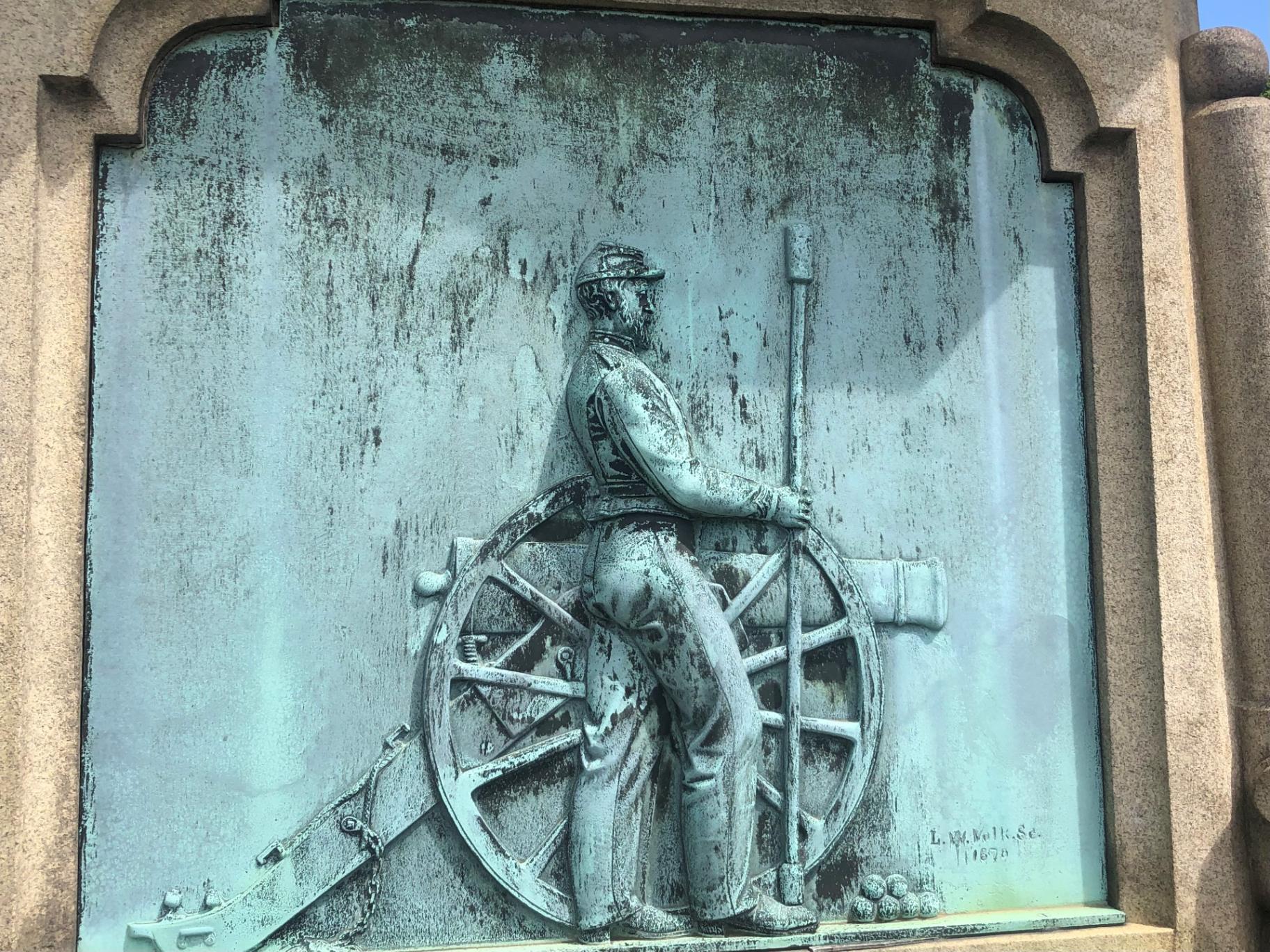 “Our Heroes” was erected in 1870 by sculptor Leonard Volk and includes a 30-foot limestone structure. (Marc Vitali / WTTW News)
I told him that the museum is also mentioned on www.findagrave.com
“It’s still on Wikipedia, too,” he said. “We don’t have any artifacts, but we’ve got close to 300 Civil War soldiers who are interred at Rosehill Cemetery.”
The grave of Gen. Thomas Ransom has a prominent location near the cemetery entrance. Ransom was a favorite of Ulysses S. Grant and William Tecumseh Sherman.
“Ransom was an Illinois guy. He was a surveyor in LaSalle County before he joined up,” Weidman said. “He was called the Ghost General because he should’ve been killed – he was wounded in battle four different times, and what finally got him in the end was dysentery.”
Ransom’s monument rises above the plots of more than 100 soldiers, whose deteriorated headstones were replaced in 1993 by the Sons of Union Veterans of the Civil War.
“The older stones were made out of marble,” Weidman said. “Marble doesn’t stand up well to the weather and the rain and over time it kind of melts away.”
One memorial that won’t melt away is the Rock of Chickamauga. The 16-ton boulder was hauled to Chicago from Georgia in 1894 and named after Gen. George Thomas, a hero of the battle who was nicknamed the Rock of Chickamauga.
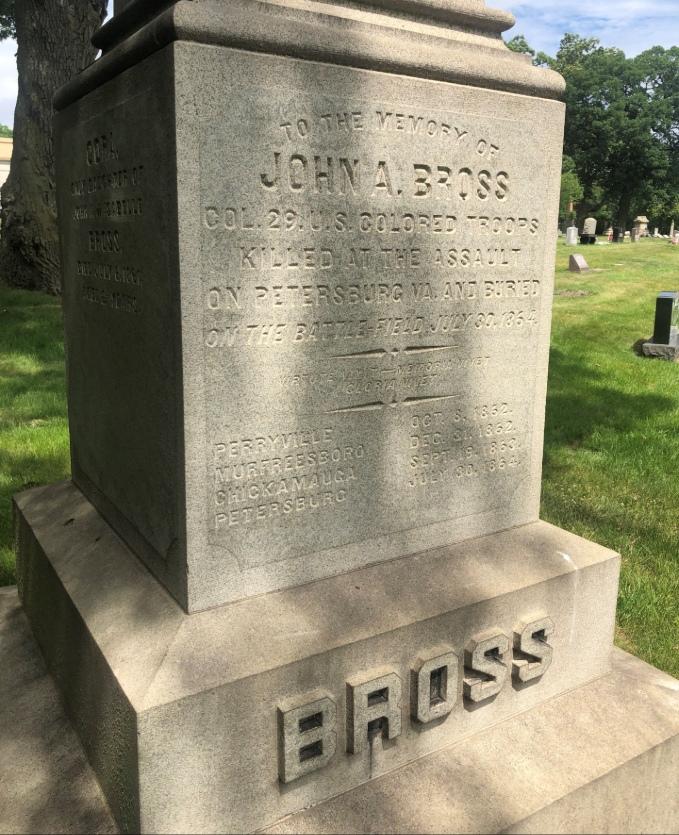 Col. John Bross led a regiment of African American soldiers, the 29th U.S. Colored Infantry. (Marc Vitali / WTTW News)
There’s also a monument to Col. John Bross, who led a regiment of African American soldiers from Illinois, the 29th U.S. Colored Infantry. Bross died in trench warfare near Petersburg, Virginia, and his body was never recovered.
Col. John Beveridge is buried here. An officer at Gettysburg, Beveridge later became 16th governor of Illinois.
One of the more impressive memorials is titled “Our Heroes.”
“The Our Heroes monument was put up in 1870 by sculptor Leonard Volk [who had also made a life mask of Abraham Lincoln]. It represents the cavalry, the infantry, the artillery and the naval units, and it has a 30-foot limestone statue,” Weidman said.
Another memorable gravesite is encircled by 10 captured Confederate cannon, partially buried and pointing to the sky.
“We were founded in February 1859. When the civil war broke out in 1861, the directors of the cemetery set aside a few beautiful spots right for Union soldiers of the war,” Weidman said. “They donated plots of land to the U.S. government for that purpose. We have the largest amount of Civil War soldiers buried in the Midwest.”
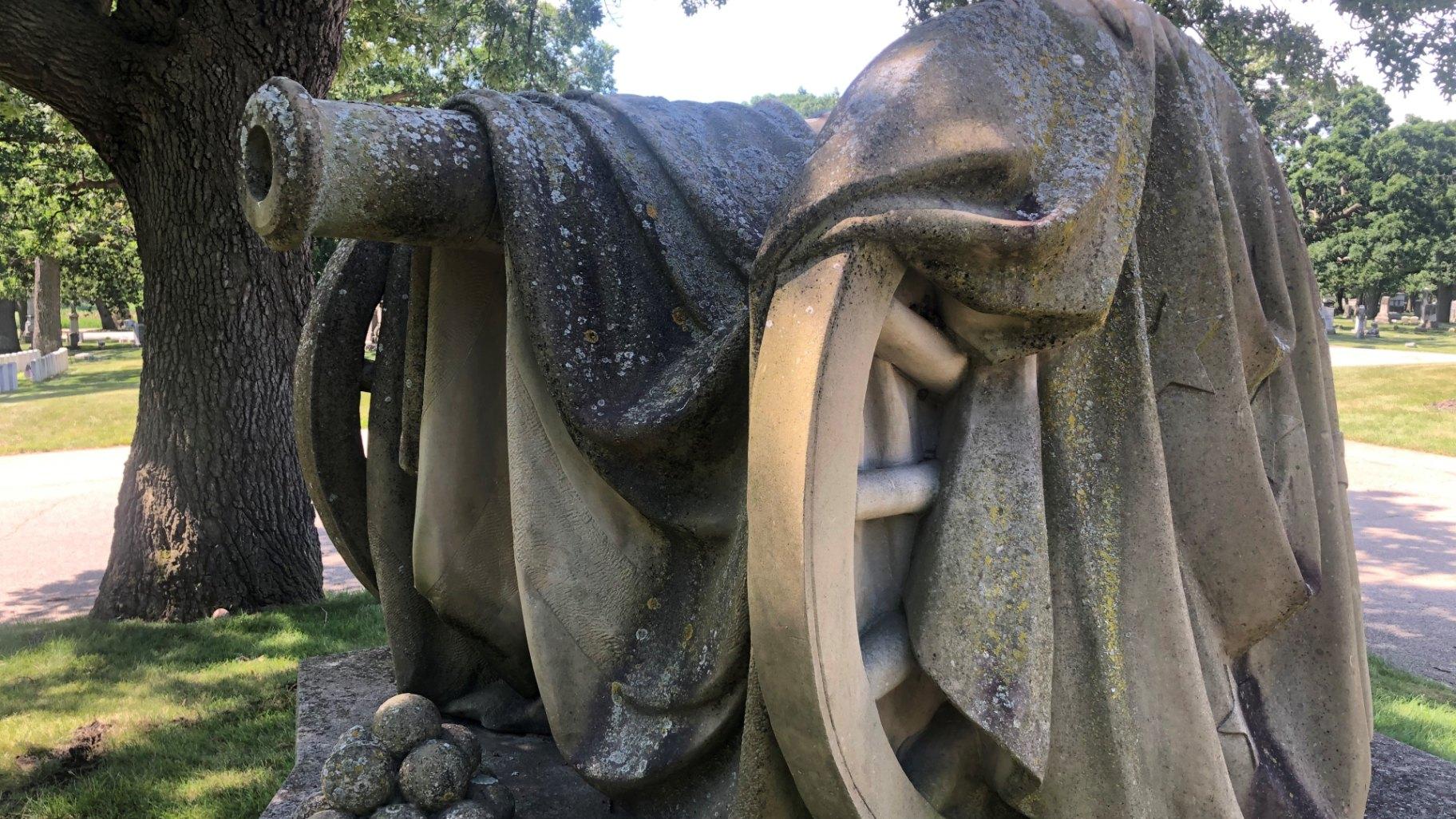 A stone cannon at Rosehill Cemetery. (Marc Vitali / WTTW News)
Some gravesites of contemporaries are only tangentially related but still interesting — Mary Todd Lincoln’s female attorney, for example, and the sister-in-law of John Wilkes Booth.
The aforementioned Marcellus Jones, who man who fired the first shot at Gettysburg, isn’t buried here. He’s not too far though — Jones’ final resting place is in Wheaton Cemetery.
Rosehill’s Civil War monuments and memorials are hallowed ground and a beautiful setting to reflect on the sacrifice these men made to preserve the Union.
There’s much to see and contemplate at Rosehill Cemetery – just not a museum.
Historic walking tours of Rosehill Cemetery are on the second Saturday of every month, April through November. It’s free and meets at the main gate at 10 a.m.
Marc Vitali is the JCS Fund of the DuPage Foundation Arts Correspondent.