Crime & Law
Ex-Ald. Carrie Austin Too Sick to Stand Trial on Corruption Charges, Federal Judge Rules
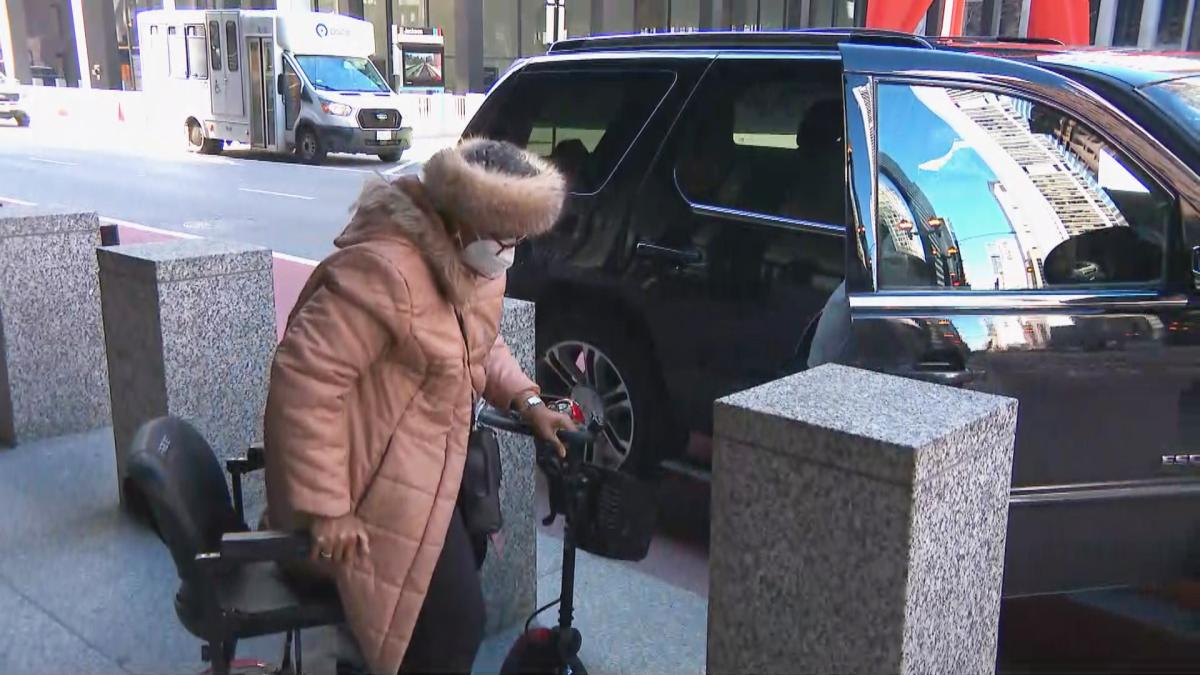 Former Ald. Carrie Austin (34th Ward) leaves the Dirksen Federal Courthouse on Thursday, Feb. 29, 2024. (WTTW News)
Former Chicago Ald. Carrie Austin is too sick to stand trial on charges that she took bribes in the form of home improvements including new kitchen cabinets and granite countertops from a developer and lied to federal agents, a federal judge ruled Wednesday.
Austin, 76, had been set to stand trial Nov. 3, nearly four and a half years after federal prosecutors first alleged that she leveraged her elected office for personal gain.
“Although the issue is close, requiring defendant to proceed to trial would present an unacceptable risk to her health,” U.S. District Court Judge John F. Kness wrote. “In addition, defendant’s present condition, which is unlikely to improve, is compromised such that her ability to participate in trial — not only in the courtroom, but also in necessary trial preparation and conferences with her counsel —would be materially impeded.”
Austin is “gratified by by Judge Kness’ thoughtful and well considered opinion,” said Thomas Durkin, Austin’s attorney.
A spokesperson for the U.S. Attorney's Office for the Northern District of Illinois declined to comment on the ruling.
Indicted four years and nine days ago while representing what was then the 34th Ward on the Far South Side on the Chicago City Council, Austin’s case was delayed by restrictions put in place to stop the spread of COVID-19 during the pandemic, her poor health and the voluminous amount of evidence in the case.
Austin appeared just once in court to face corruption charges.
Prosecutors fiercely argued that Austin was healthy enough to stand trial, and agreed to ensure that the former alderperson had access to additional supplies of oxygen, access to medication during the day and breaks when needed during a trial.
Austin’s attorneys argued that a trial could prove fatal for the former alderperson.
Dr. Susan Russell, a pulmonologist with the Northwestern Medicine Canning Thoracic Institute, determined that Austin was too ill with chronic obstructive pulmonary disorder to help craft a defense to the charges she took bribes from a developer and lied to FBI agents.
But under questioning by prosecutors during a May 13 hearing, Russell said that while Austin would face an “increased” risk of her disease worsening during a trial where she was provided with necessary medical care, it would not be “substantial,” the legal standard for calling off the trial.
But Russell said during that hearing that she stood by her conclusion that Austin was too ill to stand trial.
“Merely the act of showering or walking from room to room in her house is strenuous for defendant, so there is no doubt that traveling to and from the courthouse, sitting in trial all day, and traveling to meet with her attorneys at night, even with the aid of a scooter, will have an ‘adverse effect’ on her health compared to resting at home as she currently does most of the time,” Kness ruled.
Kness said his ruling that Austin is too ill to stand trial does not exonerate her of corruption. If her medical condition improves, prosecutors could seek to set a new trial date.
“In the end, this decision should not be taken as an implication concerning the merits of the case or as a suggestion that defendant is not deserving of having to face a jury of her peers,” Kness ruled. “Defendant is, of course, presumed innocent of the charges against her. But by the same token, she remains under the cloud of a criminal indictment returned by a grand jury. Granting defendant’s motion means that, barring a material improvement in her health, she may indeed never face the prospect of a guilty verdict; but then again, she may also never enjoy the restorative benefit of a not guilty verdict.”
Austin resigned from the City Council in March 2023, and did not seek reelection.
The ward map drawn after the 2020 census moved the 34th Ward, which saw a steep drop in population during the past decade, to the booming area south and west of the Loop. That newly created ward is represented by Ald. Bill Conway.
Austin earns pension payments of more than $9,500 per month, according to records obtained by WTTW News from the Municipal Employees’ Annuity and Benefit Fund of Chicago. Appointed in 1994 by Mayor Richard M. Daley, and elected six times by Far South Side voters, Austin served on the City Council for approximately 28 years and six months.
Kness’ ruling means those payments, which would have been halted by a conviction, will continue.
Austin has a “long history of heart problems,” including a heart attack and coronary artery disease that required heart bypass surgery in the early 2000s, according to records filed by her attorneys. In addition, Austin underwent a double mastectomy in February 2021 after being diagnosed with breast cancer in 2015.
In April 2021, Austin had another surgery connected to a long history of life-threatening gastrointestinal bleeding, according to her attorneys.
During the Dec. 15, 2021, City Council meeting, Austin collapsed and had to be revived by Ald. Anthony Napolitano (41st Ward), a former firefighter.
The Charges
The bulk of the charges Austin faced involve a firm that began building a $49.6 million redevelopment in her former Far South Side ward that includes Roseland in 2014.
That development was eligible for $10 million from the area’s tax increment financing district as well as money from the “aldermanic menu” fund controlled by Austin to be used for infrastructure projects in the ward, including road resurfacing, according to the indictment.
According to the indictment, Austin accepted new kitchen cabinets — worth $5,250 — in June 2017 from the developer. The next month, the firm gave Austin two “brand new” and “expensive” sump pumps and had a representative of the firm buy and install a new dehumidifier in her home, the indictment states.
Austin also asked the developer to install new “bathroom tiles in white or vein white,” in her home, according to the indictment.
Austin had been set to be tried alongside her former chief of staff Chester Wilson Jr., who is charged with bribery conspiracy and two counts of using interstate facilities to promote bribery.
Federal prosecutors plan to try Wilson separately on a charge alleging he stole government funds by orchestrating a scheme to buy Supplemental Nutrition Assistance Program benefits at a discount, officials said.
In October 2017, the firm agreed to pay for a portion of a new heating and air conditioning system at Wilson’s property because, as one unnamed individual told Wilson, “You help me a lot, and I’ll help you,” according to the indictment. Another unnamed individual said, “[If] I get what I want next week, it’s worth it” to pay for the upgrades to the property owned by Wilson, according to the indictment.
Wilson and Austin also had granite countertops installed at their properties as part of the scheme, according to the indictment.
The first indication that Austin was under investigation by federal officials came on June 19, 2019, when the FBI raided her ward office, hauling away boxes and files. After the raid, Austin denied wrongdoing.
Austin lied to the FBI that very day, according to the indictment. When agents told her that the developer had installed a dehumidifier at her house, Austin replied “not to me,” according to the indictment. Austin said she got nothing from the developer “other than a cake,” according to the indictment.
Thirty-eight members of the City Council have been convicted of a crime since 1969.
Contact Heather Cherone: @HeatherCherone | (773) 569-1863 | [email protected]