Politics
With Federal Funds Frozen, a 1,300-Acre Restoration Project Comes to an Abrupt Stop at Midewin — Chicago Region’s Largest Natural Area
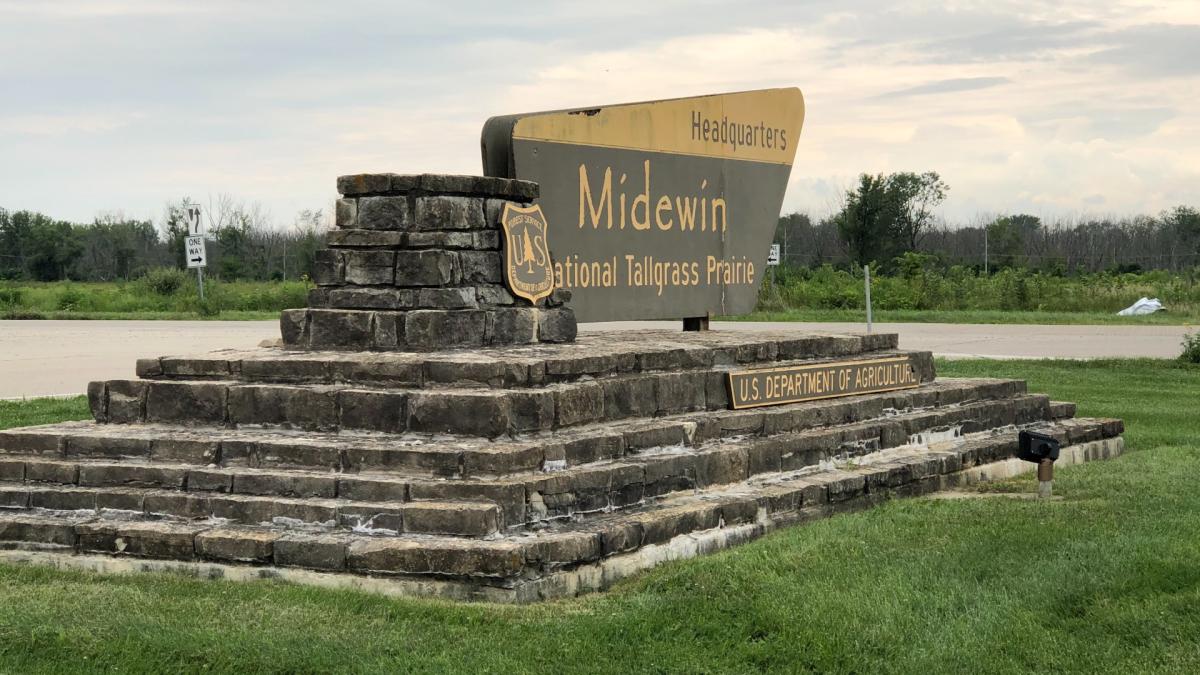 (Patty Wetli / WTTW News)
Growers and gardeners across Illinois are champing at the bit for spring thaw, eager to get their seeds and seedlings in the ground.
But for folks in the habitat restoration business, cold hard ground is often a godsend. And the longer it stays that way, the better for bringing in big, powerful equipment, which can make quick work of tasks too complicated or taxing to be done by hand.
This winter had been a favorable one — weather-wise — for Homer Tree Care, a contractor doing the heavy lifting at Midewin National Tallgrass Prairie in Will County, where an ambitious 1,300-acre restoration recently kicked off, a year after a $1.5 million grant was announced to fund the project’s first phase.
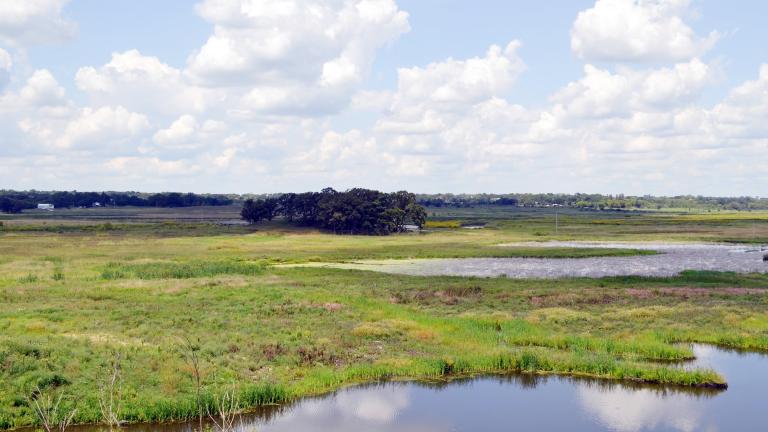
Midewin is the largest natural area in the Chicago region, encompassing 20,000 acres that provide needed habitat to numerous species amid surrounding urban and agricultural sprawl.
Last week, Homer had a dozen pieces of large machinery on site — machinery that in a warmer, wetter winter would be bogged down in mud. Operators were expertly maneuvering the rigs, ripping out and mulching invasive trees as they prepared the land for the future planting of native prairie and wetland species.
It’s perhaps the least glamorous aspect of restoration work, but clearing invasives is a crucial first step in bringing ecosystems back into balance.
“They (Homer) were really full steam ahead with the weather we’ve had. It was really great,” said Emily Reusswig, vice president of conservation and policy at Openlands, the lead grantee on the Midewin project.
Then it all abruptly came to a halt.
On Feb. 11, Reusswig received an email from the National Fish and Wildlife Foundation, which is administering the $1.5 million America the Beautiful Challenge grant on behalf of the U.S. Forest Service.
The funding account associated with the grant, the email stated, had been frozen at the federal level, part of a broader clamp down by the Trump Administration.
In short, bills would not be paid.
Openlands had attempted to push through invoices at the end of 2024, out of concerns about rumored pending funding freezes, Reusswig said, but those disbursements were never made.
She estimated there’s now a backlog of $475,000 in unpaid invoices owed to contractors on the project — mainly Homer, but also The Wetlands Initiative, a sub-grantee, which had a three-person team assigned to Midewin, tackling smaller invasive shrubs and following in Homer’s tracks with herbicide.
These reimbursements are for work that’s been completed, not anticipated, Reusswig said, and there’s no timeline for when vendors will be compensated.
“The email says, ‘At this time we have no information on when the federal accounts will be unlocked,’” she said.
In response to a query from WTTW News, a spokesperson for the U.S. Forest Service (itself a division of the Department of Agriculture) said via email: “The Trump Administration rightfully has asked for a comprehensive review of all contracts, work, and personnel across all federal agencies. Anything that violates the President’s executive orders will be subject for review.”
For her part, Reusswig is at a loss for what could be considered controversial, partisan or political about habitat restoration.
Last fall, voters across northern Illinois unanimously approved tax referenda proposed by various forest preserve and conservation districts, she noted.
“Caring for our land is a purple issue, it’s a green issue, not a red or a blue issue,” Reusswig said. “So I don’t know what this funding freeze is trying to say, because everyone cares about clean air, clean water and wildlife, and that’s what this grant is about.”
Paul Botts, president and executive director of The Wetlands Initiative, said politics and policy are beside the point.
“This is not a new administration coming in with their own policy goals saying, ‘We’re going to change the budget this way, we’re going to cut this, we’re going to drop that.’ That’s not what this is,” Botts said. “This is saying, ‘We’re going to renege on a whole bunch of contracts that the government of the United States entered into.’”
The contract for the Midewin grant is full of rules and regulations. Among the requirements: Work like that underway up until a week ago could only be done during certain months of the year, specifically October through April.
“We had to go through a compliance period to ensure that we weren’t impacting any endangered or threatened species,” Reusswig said. “So we didn’t actually sign the grant agreement and get started formally on the project until May or June (2024) and Homer didn’t start until November because there are certain restrictions on the site for endangered and threatened species.”
What the agreement doesn’t contain, Botts said, is a unilateral opt-out clause on the part of the government.
“That’s not part of the deal. And I’ve never seen it before. Nobody’s ever seen it before,” he said.
‘Nature Is Not on a Furlough’
The Wetlands Initiative has collaborated with the U.S. Forest Service on projects at Midewin for more than 25 years, helping to restore nearly 3,400 acres of prairie-wetland landscape.
“The ‘full faith and credit’ of the United States government is being flushed down the toilet as we speak. And it’s just ... I never thought I’d live to see the day, I’ve gotta be honest,” said Botts. “Deciding to renege on actual, literal contracts that the government of our country freely entered into — that is just astonishing.”
Reusswig is quick to point out that the funds are frozen, not withdrawn, but the entire process has been flung into chaos, and the path to resolution is unclear.
Per the Forest Service spokesperson: “The Department of Agriculture will be happy to provide a response to interested parties once Secretary Brooke Rollins has the opportunity to analyze these reviews.”
Time is not on the side of Openlands and The Wetlands Initiative as they attempt to improvise some sort of short-term solution at Midewin — and figure out how to pay for it.
Reusswig and Botts said if the federal funding spigot isn’t turned back on in a couple of weeks, progress at Midewin won’t just be stalled, it will be undone.
“If we get to restart in two weeks from now, it’s probably $15,000 extra dollars to get Homer back on site. It’s losing time, if it’s short,” Reusswig said.
Homer withdrew its crews and equipment. The company did not respond to multiple requests from WTTW News for an interview.
But a longer pause will be devastating, Botts said.
“Nature is not on furlough. And in a few weeks, the growing season is going to pop,” he said. “Invasives will come flying back in. It’s a reversal. It isn’t just a stopping of progress. It’s going to be an actual reversal.”
Bigger picture, Botts said he’s worried about the chilling effect the government’s actions will have on the restoration community.
“We get really wonderful, smart young people who want to come into this field and do this kind of work and make a decent living at it. I’m always saying, our hiring pools keep getting better and better,” he said. “But if we just collectively, because of this, end up letting a whole cohort of folks down, that could be just catastrophic. That could just be disastrous for our sector.”
On Thursday, USDA Secretary Rollins announced the release of $20 million in frozen funds, but only for contracts associated with specific programs targeting farmers and ranchers.
In a news release, the department said it continues to review funding “to ensure that programs are focused on supporting farmers and ranchers, not DEIA programs or far-left climate programs.”
Midewin: A ‘Down Payment’ Unfulfilled
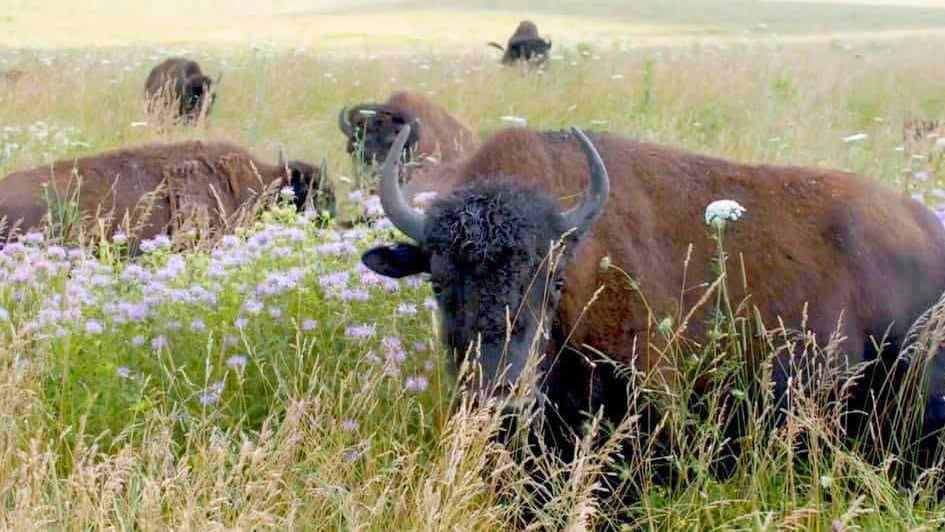
Established in 1996 on the site of the former Joliet Arsenal and administered by the U.S. Forest Service, Midewin National Tallgrass Prairie is the largest natural area in the Chicago region, its 20,000 acres providing the kind of room certain species — including grassland birds — need to survive amid urban and agricultural sprawl.
But that designation — National Tallgrass Prairie, the first in the U.S. — has been somewhat aspirational from the get-go, according to Paul Botts of The Wetlands Initiative.
“(Midewin) definitely had healthy remnants of tallgrass prairie and wetlands associated, but it also had many more acres — thousands and thousands of acres — that were going to have to be restored, that was not healthy prairie at all,” he said. “Everybody understood it was a restoration job.”
Multiple agencies and organizations have bitten off different chunks of that work, which has included, most notably, the introduction of a herd of bison on the property.
The project that’s currently on hold — the 1,300-acre Grant Creek watershed restoration — shares a mile-long border with the bison pasture.
The intent is to return Grant Creek — a stream that, headwaters-to-discharge, exists almost entirely within Midewin — to its natural hydrology.
“If you look at this site now, the creek is completely straight almost. So, it would be restoring it to its original function, so it can meander,” said Emily Reusswig of Openlands. “It will be a beautiful landscape. It would look like what the native prairie looked like before we got here.“
What Reusswig is describing is the end goal.
The $1.5 million grant for phase one — the removal of invasive species — was largely viewed as a “big down payment” on the broader restoration, which is yet unfunded, according to Botts.
He and Reusswig had been invited to a national Forest Service workshop in April, where partners in select projects gather to identify and outline next steps and funding sources.
“We were fired up,” Botts said. “Sadly, that workshop seems to have been canceled. They’ve simply taken it off the calendars.”
This article originally published on Feb. 19 and has been updated with new information.
Contact Patty Wetli: @pattywetli | (773) 509-5623 | [email protected]