Crime & Law
Ex-Ald. Ed Burke Hit with 2-Year Prison Sentence: ‘I Regret the Pain and Sorrow I Have Caused’
Former Ald. Ed Burke was sentenced Monday to two years in federal prison and fined $2 million, a lighter than expected punishment for the man a jury found ran City Hall like a mafia don for decades, shaking down those who needed or desired an official action from their elected leaders.
The sentence facing the 80-year-old Burke is significantly less than the eight years federal sentencing guidelines called for, and the 10 years prosecutors sought. Burke is set to spend significantly less time in prison than former Gov. Rod Blagojevich, who served eight years behind bars after being sentenced to 14 years in prison, and former Gov. George Ryan, who served more than five years in prison after being sentenced to 6 1/2 years in prison.
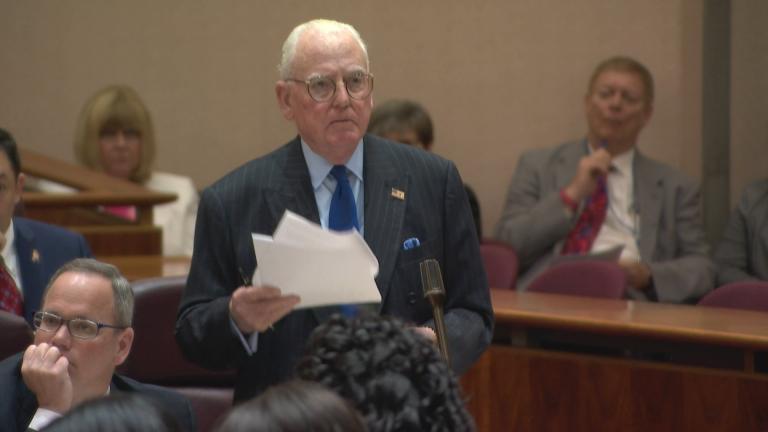
The former 14th Ward alderperson, the longest serving member of the Chicago City Council in city history, was sentenced after making a final plea to U.S. District Court Judge Virginia Kendall for mercy after noting that he had a great family and a great career.
“I’m sorry to see that career end like this,” Burke said, adding that the blame for that end “is mine and mine alone.”
“I regret the pain and sorrow I have caused my dear friends and family,” Burke said, as his wife, children and dozens of supporters looked on, holding back tears.
Burke’s conviction and prison sentence ensures he will be remembered not just for leading a group of white City Council members who worked to stymie Chicago’s first Black chief executive, Mayor Harold Washington, touching off what came to be known as Council Wars in the 1980s, but also as a brash criminal.
Burke is the 38th member of the Chicago City Council to be convicted of a crime since 1968. He is scheduled to report to prison Sept. 23.
Burke showed no emotion as Kendall handed down the sentence, but his wife, Anne Burke, the former chief justice of the Illinois Supreme Court, buried her face in her hands and cried. As soon as the judge left the courtroom, the Burkes embraced.
“At least this chapter is over,” he said, smiling broadly.
Kendall acknowledged that it is unusual for a judge to levy such a large fine in a public corruption case, but said it was warranted, given Burke’s conduct and his wealth of nearly $30 million, according to court records.
Burke has plenty of campaign cash left on hand to appeal the jury’s verdict and delay any prison sentence. His campaign account still has approximately $8 million in investments, the nest egg left over from decades spent amassing cash alongside political power.
Burke was convicted on 13 of 14 counts of racketeering, bribery and attempted extortion, after a landmark corruption trial late last year that delivered a searing indictment not just of his conduct but also of Chicago’s political system, which tolerated Burke’s conduct for decades.
Burke repeatedly — and brazenly — used his powerful position at City Hall to force those doing business with the city to hire his private law firm, formerly known as Klafter & Burke, according to the jury’s verdict.
Kendall said the crimes that Burke was convicted of are very serious and threaten the “fragility of our democracy.”
When elected officials enrich themselves, the public “lose their faith” in the system, Kendall said.
“That begins the whittling away of our rule of law,” Kendall said.
Prosecutors asked Kendall to sentence Burke to 10 years in prison, while Burke’s lawyers urged Kendall to sentence Burke to home confinement, calling a prison sentence of any length a “death sentence.”
Before sentencing Burke, Kendall said she read through the more than 200 letters from his family, friends, employees, priests and former constituents, all praising him as a man of deep Catholic faith who worked his entire career to help women and those with disabilities.
Speaking at some length and with obvious emotion, Kendall said she was overwhelmed by acts of “small altruistic acts of kindness,” as detailed by the letters. However, Kendall said she discounted the letters from high-profile people, noting they were likely politically motivated.
“I have never in all my career seen the letters I have received for Mr. Burke,” Kendall said. “I have never received the testimonials that I have received.”
Kendall said she was moved by Burke’s long history of “very personal acts that are not anything to do with authority or public office” that helped average Chicagoans, who could offer him nothing in return.
The judge also struck a despairing note about Chicago’s deeply entrenched culture of political corruption.
“I don’t know how to impress upon those who serve the public that what they are sacrificing might not simply be their own lives,” Kendall said. “They’re a part of this erosion. Part of this chipping away at our democracy.”
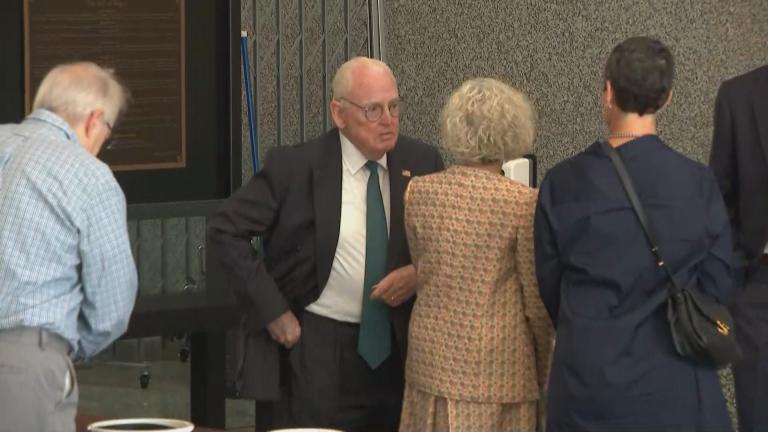
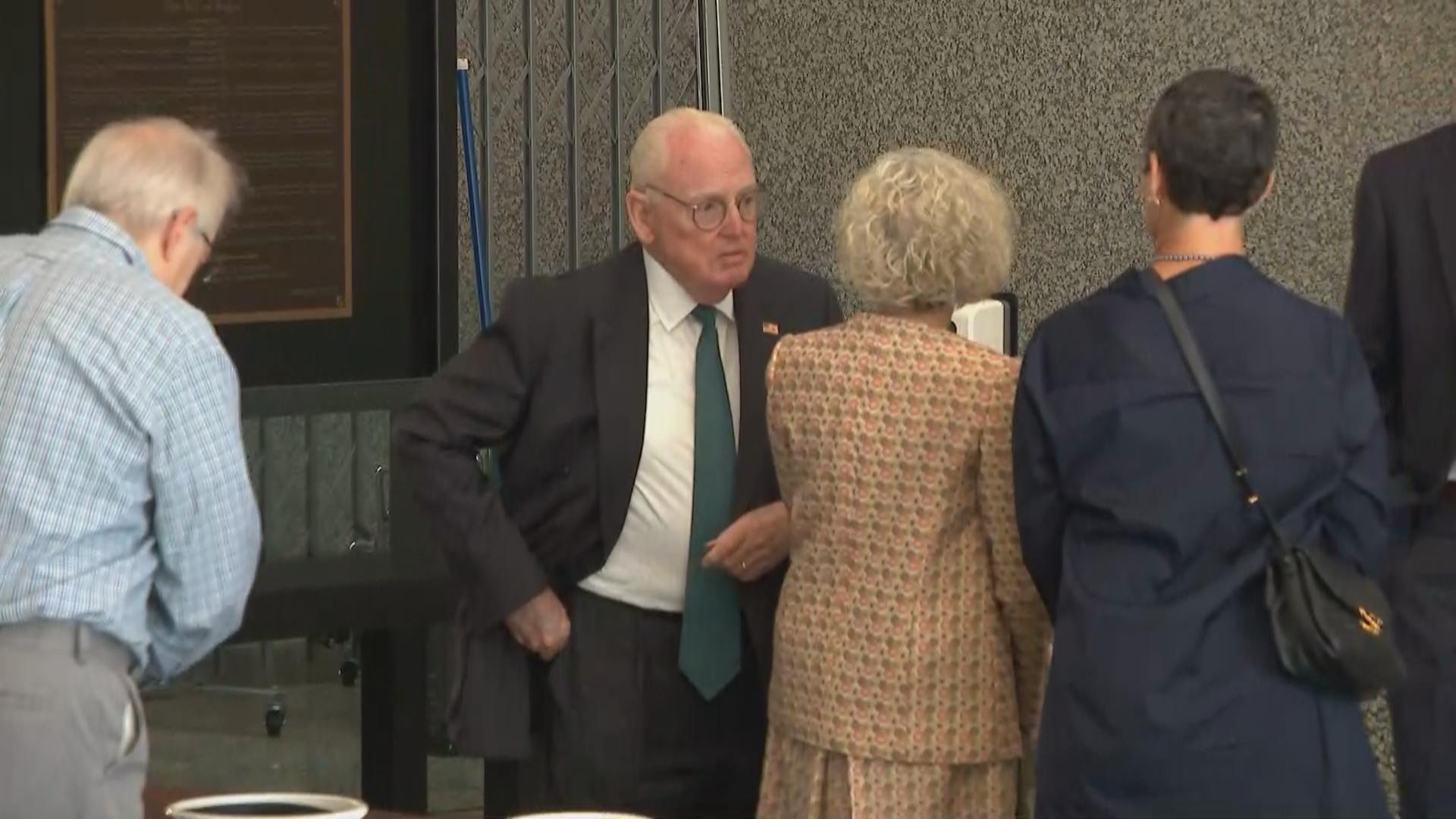 Former Chicago Ald. Ed Burke enters the Dirksen Federal Building ahead of his sentencing hearing on June 24, 2024. (WTTW News)
Burke was convicted of orchestrating four criminal schemes, three involving his side hustle as a property tax attorney, costing his victims $215,027, Kendall ruled after lengthy arguments before the sentencing.
Based on that ruling, federal sentencing guidelines called for Burke to get a prison sentence between six and a half years and eight years. Originally, prosecutors had asked Kendall to sentence Burke to 10 years in prison.
Prosecutors argued the actual cost of the crimes Burke was convicted of was $829,525, and asked Kendall to impose a significant prison sentence.
Before Kendall sentenced Burke, assistant U.S. Attorney Sarah Streicker urged her to send a message to other politicians tempted to commit crimes and exploit their offices for personal gain.
Burke’s conduct “reinforces Chicago's reputation nationwide for corruption and that business owners have to pay to play in Chicago,” Streicker said
That is “repugnant,” Streicker added.
At the pinnacle of his power at City Hall, Burke acted out of greed, Streicker said.
“He was the face of city government,” Streicker said “He chose to engage in criminal activity over and over again.”
After the sentencing, prosecutors did not take questions from reporters, as they did after Burke was convicted in December.
“Corruption in the Chicago City Council tears at the fabric of a vital body of local government,” Acting United States Attorney for the Northern District of Illinois Morris Pasqual said. “When an alderman fails to discharge his duties with honesty and integrity, he betrays not only the citizens of Chicago, but his fellow public officials who do their jobs the right way. Our office will continue to vigorously prosecute corruption and hold public officials accountable for violating the public trust.”
Burke’s attorneys urged Kendall to sentence Burke to home confinement for no more than 63 months, or approximately five years.
Arguing on behalf of Burke, attorney Charles Sklarsky highlighted some of the more than 200 letters from his family, friends, employees, priests and former constituents, all praising him as a man of deep Catholic faith who worked his entire career to help women and those with disabilities while serving the city he loves.
Those letters detail how Burke committed dozens of private acts of personal generosity, without seeking attention or money, Sklarsky said.
Sklarsky also spent a significant amount of time extolling Burke’s Catholic faith.
“Ed is really a priest without a collar,” Sklarsky said, saying that Burke has a “priestly nature.”
Sklarsky said there is no evidence that a lengthy sentence will dissuade other politicians from committing crime.
“We hear it in every case and yet there still are more cases so there’s gotta be something that’s not right about that,” Sklarsky said. “It’s not working.”
A prison sentence of more than six years could be a “death sentence,” Sklarsky said.
“No matter what he has done, he doesn’t deserve a death sentence,” Sklarsky said.
The six-week trial included testimony from three dozen witnesses and 100 recordings made as part of a court-authorized wiretap and undercover efforts by disgraced former Ald. Danny Solis (25th Ward).
Before sentencing Burke, Kendall said she was “uncomfortable” that Solis would spend no time in prison, after helping to convict Burke. Solis, who admitted taking a bribe as part of a deferred prosecution agreement, is expected to testify against former House Speaker Michael Madigan, who is set to stand trial in October.
Those wiretaps captured indelible turns of phrase by Burke that are now enshrined as part of Chicago’s long history of political corruption.
“So, did we, uh, land the tuna?” Burke asked Solis. “If we land the tuna there certainly will be a day of accounting, you can count on that.”
Burke wasn’t done.
“If we’re not signed up, we’re not going to do heavy lifting,” Burke said. “The cash register has not rung yet.”
The most elaborate scheme involved the Old Post Office, the massive building that straddles the Eisenhower Expressway at the edge of the Loop. Vacant for nearly 25 years after the departure of the U.S. Postal Service, the landmark’s fortunes began to reverse when the building was purchased by New York-based 601 West Companies, which planned to spend $800 million to renovate the massive structure into offices.
But to make that financially possible, the developers needed significant help from City Hall, which meant they needed the backing of Burke, the chair of the powerful Finance Committee, and Solis, the chair of the Zoning Committee.
Burke held up that assistance to force the Old Post Office developer to hire Burke’s private law firm, which specialized in getting companies breaks on their property taxes by appealing to county officials, the jury determined.
Burke pledged to kick back a portion of the spoils to Solis in return for his approval of an $18 million subsidy and a tax break worth $100 million, the jury found.
The very first charge levied against Burke in January 2019 — attempted extortion — involved a similar scheme, this one involving the owners of a Burger King in Burke’s 14th Ward.
In 2017, the owners of the fast-food joint needed city permits to renovate the eatery at 4060 S. Pulaski Road. Under the City Council’s decades-long tradition of aldermanic prerogative, they needed Burke’s sign-off — and prosecutors say Burke sought to explicitly withhold that permission until the owners hired his private law firm to appeal their property taxes.
Burke also urged the Burger King executives to donate campaign cash to Toni Preckwinkle, who was running for another term as president of the Cook County Board of Commissioners at the time. Preckwinkle’s connection to Burke was enough to torpedo her 2019 run for mayor, even as she won reelection as county board president in 2022.
A longtime aide to Burke, Pete Andrews was acquitted of participating in the attempted extortion of the Burger King restaurant.
Burke was convicted alongside businessman Charles Cui, who is scheduled to be sentenced July 25. After city officials denied Cui’s request for a large pole sign outside the former bank, Cui was convicted of bribing Burke by hiring his law firm to get a permit for the sign and then lied to FBI agents. The pole sign was never erected.
Burke was also convicted of threatening to block a fee increase at a museum in 2017 because officials didn’t agree to hire a friend’s daughter as an intern.
Burke intervened to help the daughter of former Ald. Terry Gabinski (32nd Ward) get a job at the Field Museum, the jury determined. Eventually the fee hike was approved, and Gabinski’s daughter never took a job at the museum.