Health
Illinois Grapples With Medical Debt, Care Access as Medicaid Work Requirements Loom
With Medicaid work requirements set to go into effect in the new year, local healthcare providers are bracing for a sharp increase in the number of uninsured patients.
Among the challenges that might lead to is the worsening impact of medical debt. Now, experts are taking a look at how some strategies — from relieving debt, to preventing it in the first place — might hold up under this new strain on the system.
“When someone has to take on medical debt for the care that they received yesterday, that actually impacts them wanting to seek care tomorrow,” said Steph Willding, the CEO of CommunityHealth, a volunteer-based health center that provides free care to uninsured patients in clinics around Chicago.
As a result, “cancers are found later, disease management is a challenge, and emergency department utilization tends to rise,” Willding said.
Over the course of a two-year Medical Debt Relief Program, the Illinois Department of Healthcare and Family Services (IDHFS) reported more than $1.4 billion in debt relief for nearly 700,000 residents. In Cook County alone, the debt relief stood at $689 million for 139,000 residents.
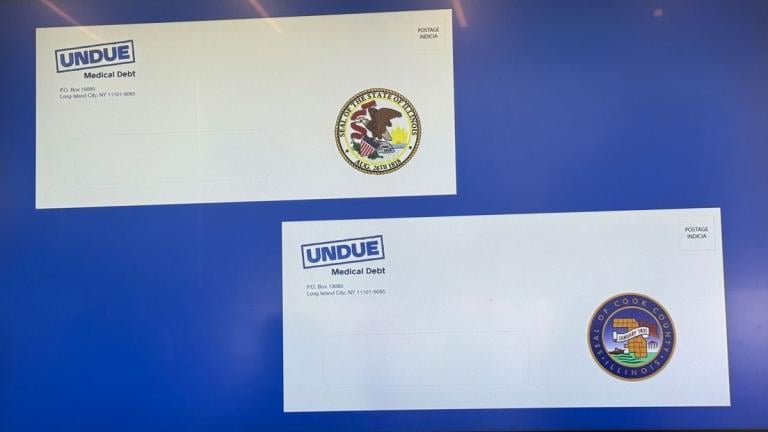
Courtney Werpy Story, the vice president of government initiatives for Undue Medical Debt, a nonprofit that contracts with the state of Illinois on the Medical Debt Relief Program, said these eye-popping numbers are possible because the organization purchases debt directly from hospitals and collection agencies for pennies on the dollar.
“At this point in the collections process, the hospitals have been unable to collect (the debt),” Story said. “It’s not that people don’t want to pay, it’s that they can’t.”
Recent studies show that assessing the impact of this program might be a bit more complicated than just looking at those numbers.
In 2023, a survey from Undue Medical Debt (then known as RIP Medical Debt) found a majority of medical debt holders experienced negative impacts on their credit score and mental health. But a 2024 study from the National Bureau of Economic Research (NBER) surprisingly found that debt relief did little to improve these measures.
The NBER researchers suggested this discrepancy may have to do with when debt relief programs intervene. If debt can be forgiven before it makes it from a hospital to a collection agency, it may still be possible to avoid the worst of its impacts.
“One of the most important ways that we can help folks is to get their debt earlier and earlier,” Story said. “That’s exactly why we work directly with hospitals and healthcare providers. Our model has significantly changed over the last several years.”
Another way to keep the worst impacts of debt from taking root is to prevent it from accruing in the first place.
Charity care through Cook County Health is one way to accomplish this locally. Still, patients can face access barriers, and the county-wide system is not immune to the effects of Medicaid cuts.
A 2025 investigation from Illinois Answers Project found that the majority of medical debt relief in Cook County went to patients who would have been eligible for free charity care to begin with.
Cook County Health CEO Dr. Erik Mikaitis previously told WTTW News the county health system is bracing for 400,000 Illinois residents to lose health insurance coverage in 2027, largely due to Medicaid work requirements that go into effect in the new year.
These Medicaid changes are expected to contribute to a $138 million drop in revenue and $100 million increase in charity care costs for Cook County Health.
As needs for free and reduced-cost healthcare mount, Willding said organizations serving uninsured populations like CommunityHealth are important to protect the whole healthcare system.
“This is our time to really step up and do all that we can,” Willding said. “We want to make sure that we’re able to be a key pillar in the safety net, but be able to support others in the safety net as well.”