Health
Advocates, Patients File Lawsuit to Block ‘Medical Aid in Dying’ Law in Illinois
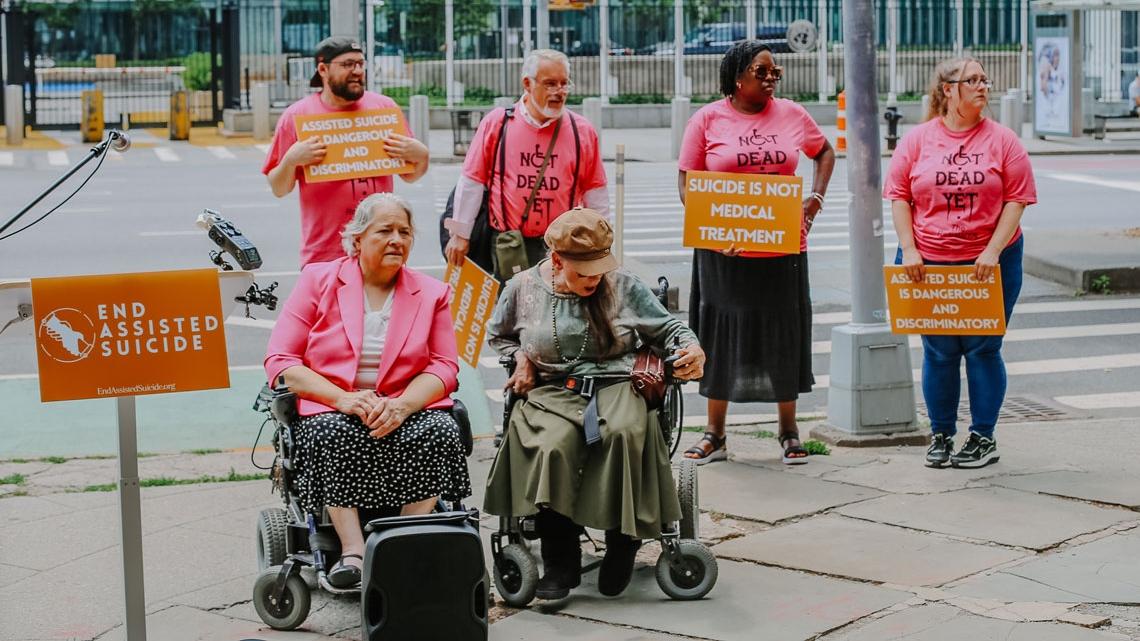 Advocates and patients announced lawsuits against “medical aid in dying” legislation at a news conference in New York. (Photo provided by the Patients Rights Action Fund)
A federal lawsuit filed last week seeks to block an Illinois law allowing doctors to help terminally ill patients end their own lives ahead of its Sept. 12 effective date.
The complaint, brought by medical advocacy groups, an Illinois-based physician and two disabled Illinoisans, claims the law discriminates against people with disabilities and lacks significant safeguards or oversight, violating due process and equal protection.
The End-of-Life Options for Terminally Ill Patients Act, or EOLA, will allow doctors to prescribe lethal medication to a terminal patient if they meet certain qualifications and make two oral requests at least five days apart. The law was passed in October 2025 and signed by the governor in December.
One of the plaintiffs is Ebony Payne, a Chicagoan who is quadriplegic. Payne was one of the opponents to the bill prior to its passage and has continued to advocate against it.
“For people with disabilities overall, I don’t think it’s a safe bet, because just like me, anybody could have an infection and fall prey to doctors who are not as scrupulous as others,” Payne said, referring to an infection she had that led her to tell her doctor she “didn’t want to live anymore.”
In that instance, her mother obtained power of attorney and could make medical decisions for Payne when she was unable to. Under the law, doctors are not required to notify family of the patient’s decision and there is no appeals process. But patients must be of sound mind and have a prognosis of less than six months to make an eligible request. Nobody else, even with power of attorney, would be able to make the decision for them.
“Many, many people who can’t or don’t have these opportunities to speak up for themselves … hopefully I do a well enough job to help their voice be heard, especially in situations like this,” Payne said.
Oral requests for aid in dying must be accompanied by a written report signed by two witnesses, at least one of which is not an employee of the health facility or a relative or estate beneficiary of the patient. But if a doctor believes the patient has less than five days to live, they can approve an emergency prescription.
A lawsuit was also filed in New York, joining three previous cases in California, Colorado and Delaware. Currently, 13 states and the District of Columbia have laws permitting aid in dying. Illinois is the first Midwestern state to legalize the practice.
Illinois’ law is similar to other states, with the basics being copied from Oregon, the first state to legalize the practice.
Discrimination Claims
The lawsuit is centered around the claim that EOLA discriminates against people with disabilities by singling out disabled people for aid in dying and not providing them with sufficient protections against abuse of the practice.
“The perception that Ebony is suffering every day, that she is better off dead, is discrimination,” attorney Michael Bien said. “The idea that we can categorize people and say certain people should be eligible for suicide and other people are not is discrimination.”
Doctors must weigh coercion and mental status before they prescribe the medication. And the law says no person is considered a qualified patient solely because of age, disability or mental health condition. But with federal healthcare cuts putting more people under pressure, Bien questioned if this is an environment in which the law should go into effect.
During debates last spring, advocates from other states, including Oregon, said there has been no evidence of discriminatory use of the procedure.
“Each law authorizing medical aid in dying states clearly and unequivocally that disability alone does not automatically qualify or disqualify someone for access to this healthcare option,” Veronica Darling, director of litigation with healthcare advocacy group Compassion & Choices, said in a statement. “These laws are not about discrimination, they are about compassion, dignity, and respecting the healthcare choices of terminally ill adults when it matters most.”
Oversight and Safeguards
In addition to singling out people with disabilities, the lawsuit claims that they are at extra risk because of “toothless” guidelines and lack of independent oversight, taking “the power of death from the sovereign state and (giving) it to private actors.”
After a request and before writing a prescription, the physician must evaluate the patient’s diagnosis, mental capacity and potential coercion and refer to a consulting physician for approval. A full mental health examination is only required if the attending doctor believes the patient isn’t stable.
Once written, the prescription can be filled and taken at any time the patient chooses.
“What if you become mentally unstable? … There’s nothing at all involved with the actual moment,” Bien said.
The doctor must provide the patient with sufficient information regarding “all appropriate end-of-life care options,” and the risks and benefits of each, so the patient can make a “voluntary and affirmative decision” regarding their end-of-life care.
The lawsuit also claims the law overrides the interests of doctors to govern the ethical practices of their own profession, though EOLA does give physicians the right to choose whether to participate in aid-in-dying without consequence. Doctors are also exempt from civil or criminal liability and professional consequences for prescribing medication or not doing so.
Capitol News Illinois is a nonprofit, nonpartisan news service that distributes state government coverage to hundreds of news outlets statewide. It is funded primarily by the Illinois Press Foundation and the Robert R. McCormick Foundation.