Politics
‘They Had a Clear Sense of Priorities’: Key Takeaways From Trump’s Beijing Summit
An exchange of niceties and kicking the can down the road.
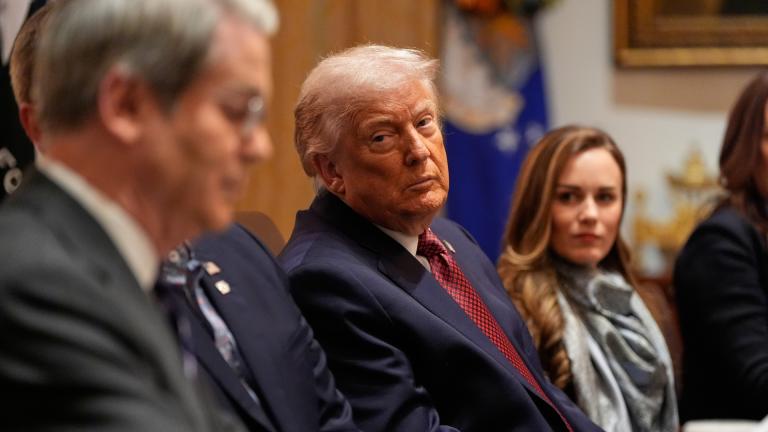
That’s how analysts are describing last week’s Beijing summit between President Donald Trump and Chinese President Xi Jinping.
While the two leaders reached some agreement on trade deals, questions still loom large over Taiwanese independence and which country will emerge as the dominant world power for decades to come.
Raymond Kuo, vice president of research for geostrategy and diplomacy at the Chicago Council on Global Affairs, joined “Chicago Tonight” to break down the key takeaways of Trump’s visit to China.
WTTW News: Which country accomplished more of its goals?
Raymond Kuo: Probably China, unfortunately. Starting with the United States, usually we coordinate these engagements through an interagency process where the State Department takes the lead, and then we’ll get the Commerce Department, Treasury, DOD all on board and say, ‘These are our priorities in x, y and z order.’ That really didn’t happen, and in advance of the summit, we didn’t have the mid-level bureaucrats hacking away at the easy, low-hanging fruit. So instead, it was kind of a free-for-all. Everyone went over there all at once. Everyone was trying to advocate for their key positions. Whereas on the Chinese side, they did all that homework. They had a clear sense of priorities, knew what they wanted to ask for and really set the agenda by saying, ‘Taiwan is going to be our top priority.’
Where did the two countries land on Taiwanese independence?
Kuo: The summit itself didn’t seem to address that. There wasn’t a readout or a public statement. But Trump’s interview with Bret Baier on Fox News after this — that’s really where a lot of this came out. Unfortunately, at least in my view, Trump was parroting quite a lot of the Chinese government’s talking points. … Perhaps the worst thing in my mind is that Trump reiterated his belief that Taiwan had stolen the U.S. chip industry — just not true at all. This was kinda retribution, saying, ‘You should give it back to us, and maybe we’ll consider defending you.’
What came out of conversations focused on Iran?
Kuo: As far as I can tell, there was Chinese verbal support, saying, ‘Yes, we want to have the Strait of Hormuz reopened, we want to have peace in the Middle East.’ But, at the same time, generally speaking, I think the Chinese view this as, ‘Well, you broke it, you bought it, you have to fix this.’
Reports have noted that Trump has been effusive in his praise of Xi, while the Chinese leader did not seem to return that level of admiration. Some have argued that the contrast reflects a power imbalance, suggesting that Trump was seeking Xi’s approval. Is there anything to that?
Kuo: You know, I don’t like to do the armchair psychologizing. I’m personally not trained in psychology. But I think there was a notable point there. I think to some extent, Trump seems to act a little off the cuff, whereas Xi Jinping was much more disciplined in saying a, b and c priorities. It could just be a reflection of that, where the relative lack of preparation on the U.S. side meant that Trump was kind of filling the void with more happy talk.
Did the summit represent a step toward a stable relationship between the U.S. and China?
Kuo: I am hesitant to say this will lead to long-term stability. One issue is kind of the credibility deficit we have here on the U.S. side. When Trump, for example, talks about our trade deals with Canada and Mexico being the worst he’s ever seen, those were negotiated under his first term. So if you’re willing to stab your own trade agreements, how much can the Chinese trust that we’ll actually commit to this long term?