Politics
CPD Failed to Document 267K Traffic Stops in 2025, 27% More Than Previous Year: Data
 (WTTW News)
Chicago Police Department officers made 267,240 undocumented traffic stops in 2025, an increase of nearly 27% as compared with the number of traffic stops officers made in 2024 but did not properly document for state officials, according to records obtained by WTTW News.
That means officers made an average of 732 traffic stops every day in 2025 that were not documented as required by CPD policy and state law, according to data from the city’s Office of Emergency Management and Communications obtained through a Freedom of Information Act request.
Representatives of CPD and the mayor’s office did not respond to two requests for comment from WTTW News.
It has been seven months since a high-ranking CPD official told members of the Chicago City Council that police leaders were working to “fix” what he called “a discrepancy” that led to 210,622 undocumented traffic stops in 2024.
For this analysis, WTTW News compared the number of traffic stops documented by CPD officers in 2025 on what is officially known as a TSS form (and informally referred to as a “blue card”) with the total number of traffic stops recorded by dispatchers working for OEMC.
CPD officers documented 224,846 traffic stops in 2025, according to CPD data obtained through a Freedom of Information Act request. That represents a drop of 24% from 2024, according to CPD data.
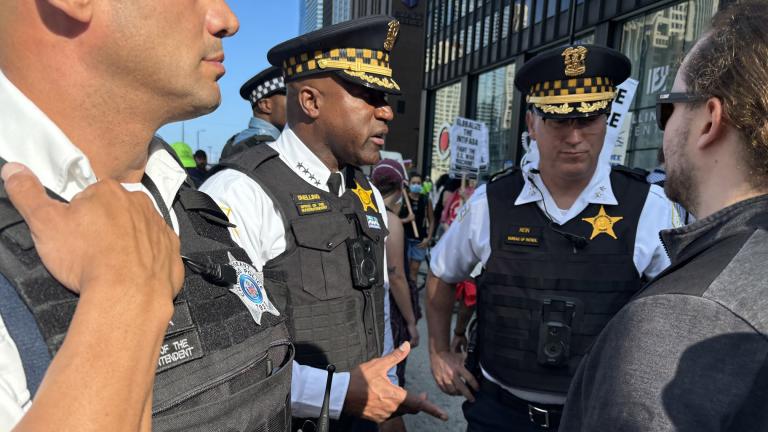
Chicago Police Supt. Larry Snelling has vowed to focus on dangerous drivers and criminal activity while reducing the overall number of traffic stops.
Between 2023 and 2025, the number of documented traffic stops by CPD officers has fallen more than 58%, according to CPD data. During the same period, homicides fell nearly 33% and shootings fell more than 37%, according to city data.
CPD’s traffic stop policy, last revised seven years ago, requires officers to document every time they stop a driver regardless of the reason by not only notifying dispatchers but also filling out a form that is better known as a “blue card.”
That paper card, filled out by hand, requires officers to document the reason for the stop, the driver’s name, address, gender, year of birth and “the officer’s subjective determination of the race of the driver of the vehicle.”
Officers are prohibited from asking drivers to identify their race, according to the policy. Each form identifies the officer by name and badge number.
In addition, officers must record the make and year of the vehicle they stopped as well as the date, the location of the stop and the time that the stop began and ended. Officers must also record whether they asked to search the vehicle, whether a search was conducted and the reason for that search, according to the policy.
The officer is also required to document whether drugs, weapons or other illegal items were recovered during the stop, according to the policy.
When initiating a traffic stop, officers must contact the city’s dispatch center, run by OEMC. That leaves a record of every traffic stop, not just those that result in the completion of a blue card as required by department policy, officials said.
Closed-Door Negotiations Continue
CPD leaders, city officials and representatives of Illinois Attorney General Kwame Raoul have been negotiating behind closed doors for the better part of a year over whether CPD officers should be banned from making traffic stops based on minor registration or equipment violations that are designed to find evidence of “unrelated” crimes.
Snelling has said police officers must be allowed to continue stopping drivers for improper or expired registration plates or stickers and headlight, taillight and license plate light offenses to ensure that Chicago’s streets do not become more “dangerous for everyone who are driving.”
However, a majority of the Community Commission for Public Safety and Accountability believes those stops, which the department acknowledges are designed to find evidence of “unrelated” crimes, “do more harm than good” and should be banned in most cases.
The commission, known as the CCPSA, has the authority to approve new CPD policies.
Those negotiations could lead to the expansion of the federal court order known as the consent decree to include traffic stops.
Any deal must have the support of not just the CCPSA but also the Illinois Attorney General’s Office as well as the independent monitoring team charged with enforcing the court-ordered reforms. U.S. District Court Judge Rebecca Pallmeyer, the judge overseeing the reform push, has the power to resolve any disputes.
Traffic stops have long been a flashpoint in the half-dozen serious efforts to reform the Chicago Police Department, since they put officers in close contact with Chicagoans, often under tense circumstances.
Officer Enrique Martinez was killed during a traffic stop in November, and Officer Ella French was killed during a traffic stop in August 2021.
During a March 2024 traffic stop, four officers fired 96 shots in 41 seconds at Dexter Reed, hitting him 13 times, shortly after he shot and wounded an officer, according to a preliminary investigation by the Civilian Office of Police Accountability, known as COPA. Reed had been stopped on suspicion for failing to wear a seat belt.
The city is facing a class-action lawsuit that accuses CPD of targeting Black and Latino drivers with a massive campaign of traffic stops in what the lawsuit calls the latest chapter of the city’s “long and sordid history” of racist discrimination.
Three of the named plaintiffs in that case have been stopped repeatedly since they filed the lawsuit in July 2023, court records show.
The judge presiding over that lawsuit has yet to rule on the plaintiffs’ request that it be expanded to include all Black and Latino Chicagoans who have ever been pulled over — or could be in the future.
WTTW News coverage of policing and police reform is supported by The Joyce Foundation.
Contact Heather Cherone: @HeatherCherone | (773) 569-1863 | [email protected]
Contact Jared Rutecki: @JaredRutecki | [email protected]