Politics
Jury Weighs Whether CPD’s ‘Code of Silence’ Led to Botched Raid That Traumatized 4 Kids
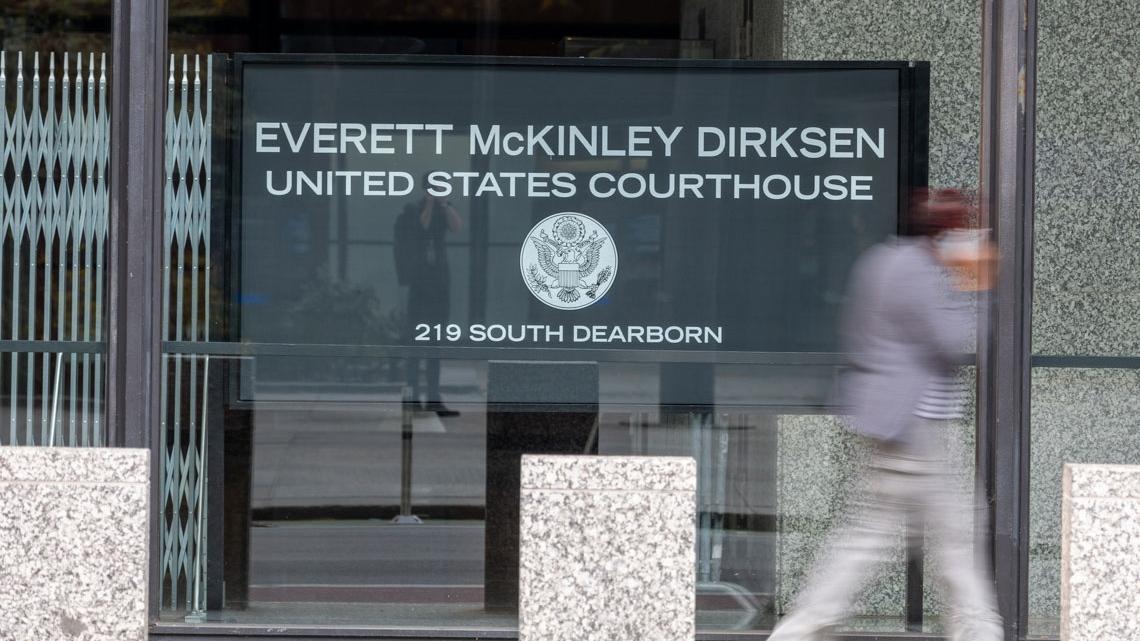 The Dirksen Federal Courthouse in Chicago is pictured in a file photo. (Andrew Adams / Capitol News Illinois)
A federal jury began deliberating Tuesday about whether a “code of silence” among Chicago Police Department officers led to a botched August 2018 raid of a Back of the Yards apartment that violated the civil rights of a family with four children.
After a three-and-a-half week trial, the eight-member jury is now deciding whether CPD officers traumatized Ebony Tate, her mother, Cynthia Eason, and four children on Aug. 9, 2018, when a CPD SWAT team set off flashbang grenades outside the family’s apartment before breaking down the door and repeatedly pointing assault rifles directly at the children.
Lawyers for the city and the officers argued that the officers did not point their weapons at any member of the family while serving a valid search warrant and did not violate CPD’s policies in effect at the time.
However, lawyers for Tate, Eason and the four children — who were 13, 11, 8 and 4 years old at the time of the incident — told the jury that city officials knew officers were routinely violating Chicagoans’ rights while serving search warrants and improperly using force against children and pointing guns at them and did nothing to hold officers accountable for misconduct.
Those problems were allowed to fester because of a “code of silence” that kept officers from reporting and testifying about wrongdoing by other officers, preventing officials from holding CPD officers accountable for misconduct, the attorneys argued.
Deliberations began at 3:30 p.m. Tuesday.
U.S District Court Judge John Tharp originally ordered former Mayor Rahm Emanuel to testify about his admission to the Chicago City Council in December 2025 that such a code existed. After vehement objections from the city, Tharp reversed his order.
Instead, the jury saw a video of Emanuel’s emotional speech, which was prompted by the outrage over the 2014 police murder of 17-year-old Laquan McDonald.
Al Hofeld, the family’s lead attorney, asked the jury to award between $2 million and $3 million each to Tate and Eason and a combined $10 million to $12 million to the four children, as well as punitive damages against the nine officers who raided their home more than eight years ago.
“This family still has scars,” Hofeld said. “They still hurt.”
While no one was physically harmed during the raid, the family was deeply traumatized and continues to suffer emotionally and mentally today, Hofeld told the jury.
“This was the most terrifying event of their lives,” Hofeld said. “Masked men broke into their home, pointed guns at them and, using profanity, ordered them out of their home.”
Chicago officials could have prevented the botched raid from taking place, but took no action even after Emanuel’s speech, a report from the Police Accountability Task Force and a 2016 probe by the U.S. Department of Justice during the Obama administration found that officers were allowed to act with impunity, Hofeld said. That investigation led to the consent decree, the federal court order that requires CPD to change the way it trains, supervises and disciplines officers.
Those reports are evidence that city officials knew CPD officers were using unreasonable force against children, including pointing guns at them, and did nothing to stop that from happening, Hofeld said. That should prompt the jury to award Tate, Eason and the four children a significant award and hold city officials accountable, Hofeld said.
The jury heard from Sybil Madison and Maurice Classen, who were members of the task force and went on to serve as former Mayor Lori Lightfoot’s top aides while she was mayor of Chicago. Both confirmed that the task force concluded there was a code of silence in CPD that prevented officers from being held accountable.
In addition, Assistant U.S. Attorney Patrick Johnson, who helped conduct the federal probe into CPD, testified the probe found that CPD had not provided officers with “adequate guidance to understand how and when they may use force,” which sent a message to officers that unreasonable force would be tolerated, and officers would not be punished.
That probe found that CPD had a “pattern and practice” of using unreasonable force against Chicagoans, including children.
However, under questioning from Marion Moore, a lawyer for the city, Patrick Johnson confirmed that the probe’s final report included anecdotal evidence, and that the investigation did not examine the actions of SWAT teams serving search warrants.
Moore told the jury that there was no evidence CPD had a “widespread, pervasive” practice of using excessive force against children, or that CPD leaders knew about such a problem.
In addition, the city and CPD immediately launched a comprehensive effort to correct the problems identified by that report, Moore said during her closing argument on behalf of the city.
Mayor Brandon Johnson said Wednesday that he was not aware that attorneys representing the city, who report to Corporation Counsel Mary Richardson Lowry, were arguing that those reports did not alert officials that officers were unreasonably using force against members of the public, including children.
The mayor said he remains committed to holding “every system accountable.”
‘Innocent People Caught In The Middle’
Eason, the children’s grandmother and Tate’s mother, was about to take a bath when officers conducted the raid. She was forced to leave her home even though she was not fully dressed, Hofeld said.
Eason was forced to stand outside her home in nothing but a T-shirt and underwear, Hofeld said. Tate suffered a panic attack, and was treated by paramedics while officers searched her home, both sides agreed.
Lawyers for the officers said that Eason was quickly given a blanket to cover herself.
There is no body-worn camera footage of the raid, since officers assigned to SWAT teams were not required in 2018 to wear them, according to the lawsuit.
No drugs or weapons were recovered during the search, nor was anyone charged with a crime based on evidence discovered by the officers during the raid, records show.
The search warrant obtained by police to search the Tate and Eason apartment identified a man who did not, and had never, lived in the home, but lived nearby, according to the lawsuit.
“These were innocent people caught in the middle between the police and the bad guy,” Hofeld said.
Although officers were not authorized to enter the Tate and Eason apartment without announcing their presence, officers used a pry bar to break down the apartment’s door without warning, Hofeld said. Lawyers for the officers and the city said officers did knock and announce their presence as required by CPD policy.
The Civilian Office of Police Accountability, the agency charged with investigating police misconduct, never determined whether officers violated CPD policy during the raid, according to documents obtained by WTTW News through a Freedom of Information Act request.
None of the officers involved were disciplined.
“These are decent human beings who hold themselves to the highest professional standards,” said Lawrence Kowalczyk, the attorney for the officers.
Kowalczyk called the family’s testimony “absurd” and accused them of fabricating their stories in an “attempt to get money.”
Contact Heather Cherone: @HeatherCherone | (773) 569-1863 | [email protected]
WTTW News coverage of policing and police reform is supported by The Joyce Foundation.