Arts & Entertainment
Elizabeth Catlett, a Master Artist With a Message, Gets Her Due at the Art Institute of Chicago
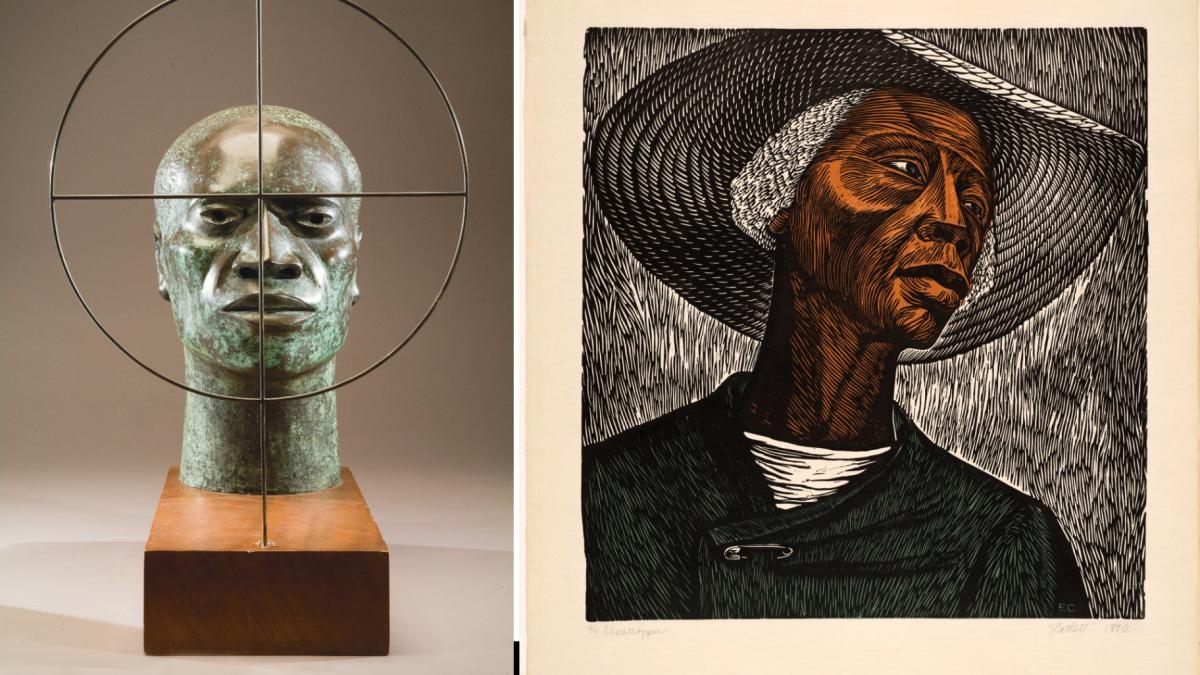 Elizabeth Catlett’s “Target Practice” sculpture and “Sharecropper” linocut. (Courtesy of the Catlett Mora Family Trust)
In 2003, the 85-year-old artist Elizabeth Catlett told NPR: “I, a Black woman artist, have been invisible in the art world for years.”
Over a long career, Catlett depicted the character and strength of Black women. Her prints and sculptures addressed social injustice, and she championed domestic workers, nurses and sharecroppers.
Early on, she portrayed Sojourner Truth, Harriet Tubman and 18th century poet Phillis Wheatley. Years later, she depicted Rosa Parks and Angela Davis.
Elizabeth Catlett was the grandchild of enslaved people. Born in Washington, D.C. in 1915, she lived through Jim Crow segregation up to the first Obama administration. She studied in Chicago before settling in Mexico for the next six decades.
Catlett dedicated herself to rigorous craftsmanship as much as justice. Her artistic practice was marked by versatility — she made social realist prints for the masses, and shaped wood or stone into sculptures of organic abstraction. She would choose the medium that best fit the subjects.
And she created artwork despite intimidation from the U.S. government. During the Cold War, she was declared an “undesirable alien.”
Now, the Art Institute of Chicago is giving the artist her due with a solo show that surveys 75 years of the artist’s work. It is called “Elizabeth Catlett: A Black Revolutionary Artist and All That It Implies.”
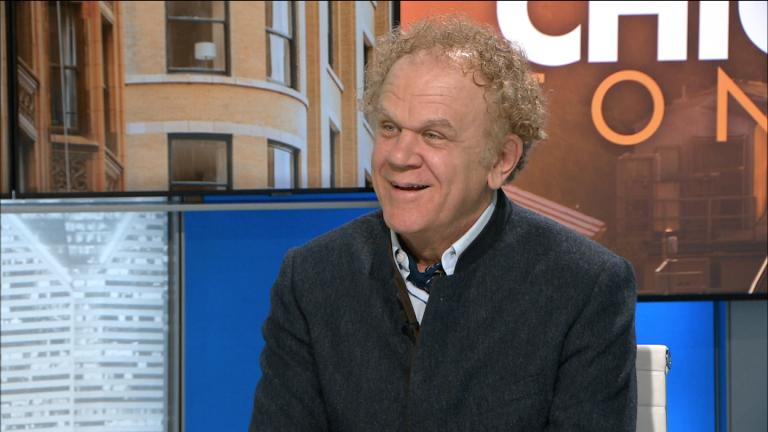
WTTW News spoke with curator Sarah Kelly Oehler and asked about the title of the exhibition.
“It’s a quote from Elizabeth Catlett herself in 1970. She was scheduled to speak at a conference at Northwestern and applied for a visa to visit the U.S,” Oehler said. “She was denied the visa, and she talked at this conference quite openly about that fact over telephone. She said, ‘I hope I am a Black revolutionary artist and all that it implies.’ It’s just a powerful assertion of who she thought she was and all that she thought she could be.”
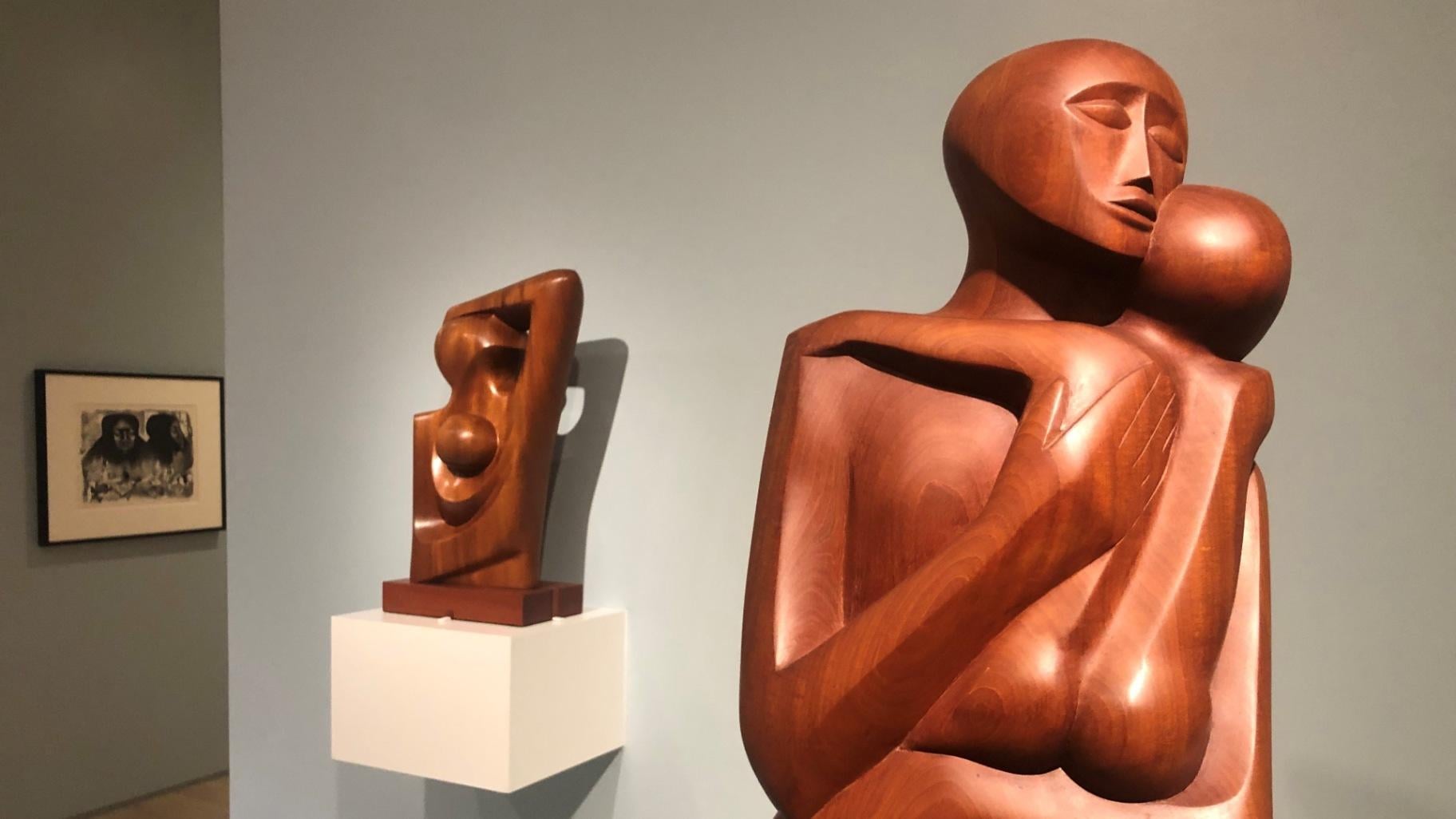 “Elizabeth Catlett: A Black Revolutionary Artist and All That It Implies” is at the Art Institute of Chicago through Jan. 4, 2026. (Marc Vitali / WTTW News)
As an aspiring art student, Catlett was denied a scholarship to the Carnegie Institute of Technology when they discovered she was Black.
She graduated with honors from Howard University and then earned a master of fine arts degree at the University of Iowa.
In Iowa, she was mentored by Grant Wood, the Midwestern artist who painted “American Gothic.” He suggested that she make her work speak to “something you know the most about.”
Catlett expanded her artistic skillset in Chicago, learning ceramics at the School of the Art Institute and lithography at the South Side Community Art Center, where she was a studio mate of Margaret Burroughs. She also befriended playwright Lorraine Hansberry and married her first husband, artist Charles White.
In 1946, she won a fellowship to Mexico to study, and she stayed for six decades. She worked at Mexico City’s renowned print collective the TGP (Taller de Gráfica Popular), which promoted revolutionary causes and had members who were in the Communist Party. Her artistic circle included Frida Kahlo and Diego Rivera.
The U.S. Embassy took note of her activism and an investigation by the House Un-American Activities Committee in the 1950s declared Catlett to be “a threat to the well-being of the United States.”
Oehler calls her nothing less than an artistic master who became an expert in different media, mostly printmaking and sculpture.
“She absolutely wanted to perfect her craft,” Oehler said. “But she also recognized that the media that she chose could have a very different impact on the message she was trying to convey. She saw her prints as an opportunity to speak openly and bluntly. She wanted them to speak broadly to many audiences.
“With her sculptures she wanted the lyricism of the form to shine forth. She was always intentional about what she chose to work with, whether it was wood or marble, but regardless of the medium, she wanted to also make sure that the artwork itself was impeccable.”
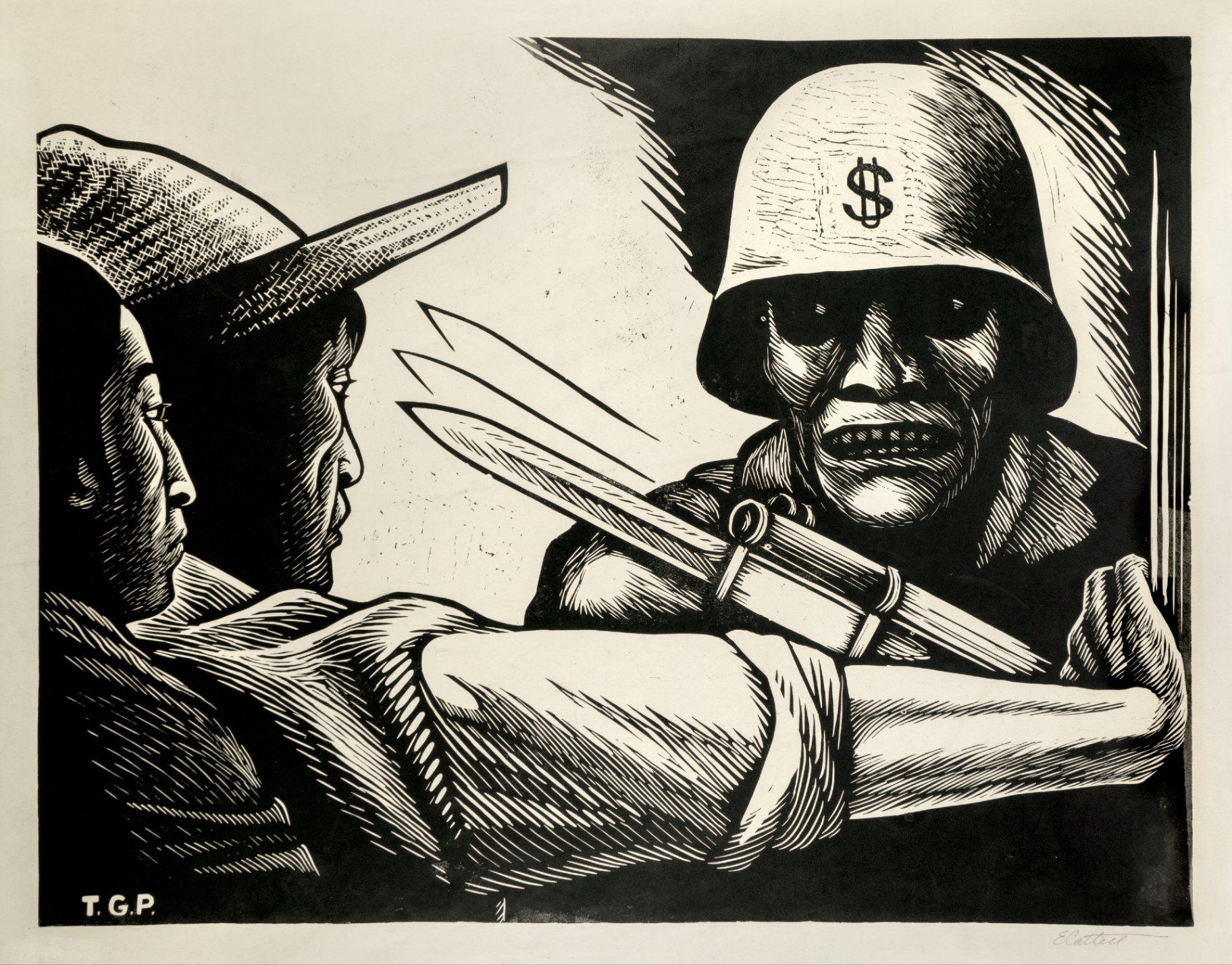 A print by artist Elizabeth Catlett.
How her work would be encountered was also a primary concern.
“She wanted every work that she created to be accessible,” Oehler said. “She thought about her audiences as being everyday people who didn’t necessarily have access to art.”
One example is the wooden sculpture “Floating Family,” which hangs outside the exhibition in the great hall of the Modern Wing. Catlett created it as a commission for the city of Chicago; it’s on loan from its usual home at the Legler Regional Library in the West Garfield Park neighborhood.
Catlett’s work is marked by influences from primitive art to modernism. Her imagery echoes artwork from Africa, Europe and the Americas.
The artist was active until late in life, and she died in 2012 at the age of 96 in Cuernavaca. Months before her death, she said, “I still believe in getting rid of discrimination.”
This exhibition, supported by Chicago’s Terra Foundation for American Art, reframes her life and legacy.
“All of these works have a richness,” said Oehler. “Whether she used linocut mixed with woodcut, whether she used the grain of onyx to be gorgeously aligned with the composition, or whether the wood is something that you just want to caress because it’s so beautiful. This was part of the strength of her work. She wanted people to enjoy it.”
“Elizabeth Catlett: A Black Revolutionary Artist and All That It Implies” is at the Art Institute of Chicago through Jan. 4, 2026.
Marc Vitali is the JCS Fund of the DuPage Foundation Arts Correspondent.