Education
Emerald Ash Borer
Invasive species threatens Illinois Ash Trees
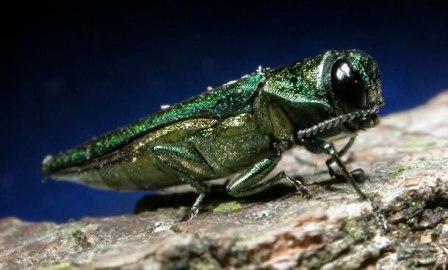
In Chicago and northeastern Illinois, ash trees are everywhere. And wherever there are ash trees, there's a good chance there are emerald ash borers (EAB). Despite their green color, these beetles are not good for the environment. They are, in fact, responsible for the destruction of the ash trees that comprise an estimated 20 percent of Chicago’s street trees.
The EAB is native to Asia, but in June 2002, EABs were spotted in Michigan, their first appearance in the U.S. Six years later, an EAB infestation was confirmed at 29th and State Street in Chicago. Since then, the Illinois Department of Agriculture (IDA) has issued an eight-mile quarantine around areas with known EABs.
Some scientists project that in about 10 years, the EAB will have destroyed all the ash trees in the area. However, officials remain optimistic.
“When you are dealing with an invasive species that establishes itself over such a broad area, it takes a team effort to address it effectively,” said Matt Smith, Chief Spokesperson for the Chicago Department of Streets & Sanitation, of which the Bureau of Forestry is a part. “We helped build such a team with our Federal and State allies when we dealt with the invasion of the Asian Longhorned Beetle (ALB). In the end, we were able to eradicate the ALB. While we are still fighting EAB and watching for new invasive insects, we will continue to use the existing line of communications to coordinate efforts against future invaders.”
There are approximately 92,000 ash trees in Chicago’s public way, according to the Streets & Sanitation Department, as well as an estimated 400,000 on private property.
“The real impact is in our communities,” said Paul Deizman, Forest Management Programs Administrator of the Illinois Forestry Division. “There will be communities that lose 60 to 70 percent of their street trees. Those are the trees that are going to have an impact on our environment—urban storm runoff, overheating of cars, too much sun in everyone’s yard.”
There are three main approaches to the problem: chemical agents, bio-controls and tree replacement. Since 2009, the Streets & Sanitation Department has been applying the insecticide TREE-äge to ash trees. TREE-äge is 99 percent effective and it’s the best method for protecting individual trees. However, the treatment must be renewed every three years.
On a larger scale, the Streets & Sanitation Department has been working with the U.S. Department of Agriculture, among others, on various bio-controls, or natural predators of the EAB. Specifically, they have been studying three wasp parasitoids: Spathius agrili, Tetrastichus planipennisi, and Oobius agrili. These bio-controls are not without their risks.
“Most of the time, when we tinker with nature it doesn’t go very well,” said Edith Makra, Community Trees Advocate at The Morton Arboretum. “The criticism is that if this natural predator is brought in, how do we know it won’t escape and kill a desired species?”
However, all three parasitoids appear to affect only the EAB. Officials began releasing them in small increments in 2009, and they are planning an ongoing release of approximately 7,500 more this summer. That might sound like a lot, but these tiny, non-stinging wasps range from the size of a small ant to ¼ the size of a poppy seed.
Long term, many ash trees need to be slowly phased out and replaced with a variety of trees in order to prevent a similar situation. “In the future, such trees could include different varieties of ash trees, or hybrids, that might prove resistant to the EAB,” said Smith. “Right now there is research underway at institutions like The Morton Arboretum to grow and test such different varieties.”
Symptoms of EAB infestation include crown dieback, in which branches at the top of the tree die, and vertically split barks. Another sign of infestation is the distinctive exit hole—“D” shaped with a 1/8 inch diameter—left by EABs as they exit the tree. These holes can occur anywhere on the trunk or upper branches.
To prevent the EAB from spreading further, it’s important not to transport firewood. Instead, burn it where it has been found.
“It’s good firewood, but the worst thing to do is to move it,” said Deizman. “We do not want to see the accordion expand and we don’t want to give it to any other state any faster than they are going to get it naturally.”
There are other uses for ash trees affected by the EAB. The Illinois Emerald Ash Borer Wood Utilization Team works to gather and use affected ash trees in wood products ranging from baseball bats to cabinetry.
“Ash is actually a very good wood,” said Makra. “It has a lot of properties like oak, and it’s very strong and shock absorbent.”
The EAB does not damage the wood of the tree it kills so the affected wood can be safely transformed into lumber. Although it’s impossible to reverse the damage, these products present a beautiful and practical way to reclaim the trees that the EAB has destroyed.

Politics
Bill Clinton in Chicago
Eleven years after leaving office and it’s still the economy for former president Bill Clinton. He’s in town with his Clinton Global Initiative for a summit on jobs and spurring growth in the U.S. economy. He also had kind words for the city’s current mayor – his former White House staffer: Rahm Emanuel. “I predict to you his tenure will be one of the most brilliant chapters in this city’s long and storied history,” said Clinton. Chicago is the ideal place for the conference, he says, and not just because of Emanuel. “It’s a model for what we can do all over America,” he said, focusing on the city’s commitment to building LEED-certified municipal buildings. Clinton spoke before a crowd of about 700 leaders from the business and non-profit world, all who were attending because they had committed to work toward the organization’s goals of improving the economy. Clinton expressed optimism about the direction of the country, despite a dour unemployment picture. One of the signs, he said, was that banks in America had $2 trillion in cash that was not committed to lending. If banks lent that all of that money, it would, he said, “end the American and global economic slowdown in about 15 minutes.” One important project to come out of Wednesday’s meeting focuses on the rebuilding of the nation’s infrastructure. The AFL-CIO and the American Federation of Teachers announced a plan to invest $10 billion in union employee pension funds to go toward rebuilding the nation’s roads, bridges, highways and retrofitting buildings. AFT President Randi Weingarten called them sound investments for workers with the added benefits of contributing to the public good. The Clinton Global Initiative event continues Thursday with scheduled speakers, including Indiana Governor Mitch Daniels and U.S. Treasury Secretary Timothy Geithner.
Arts & Entertainment
Architect Louis Sullivan
A new book atempts to shed new light on the master architect
He was brilliant and passionate, hot-tempered and egotistical, and he altered the course of American architecture. Louis Sullivan's life story is like a Greek tragedy. And his buildings are works of great art. In the mid-twentieth century, many of his buildings were torn down and Sullivan himself was nearly forgotten.
In their new book, Louis Sullivan: Creating A New American Architecture, author Patrick F. Cannon and photographer James Caulfield attempt to shed new light on a master architect who was once underappreciated and some would say nearly forgotten, but is now celebrated and widely studied. They join us to discuss the book on Chicago Tonight at 7:00 pm.
Check out a slideshow of Sullivan's architecture below.

For more information on the book, click here.
For more on Louis Henry Sullivan, click here.
Arts & Entertainment
Cabin Fever
The clash between nature and technology can be all too familiar these days. One man from suburban Chicago has set off to rediscover balance with nature, and explore a modern interpretation of Henry David Thoreau. Tom Montgomery Fate, author of Cabin Fever: A Suburban Father’s Search for the Wild, joins us on Chicago Tonight at 7:00 pm.
The following is an excerpt from Fate's book:

One sunny afternoon a few years ago, I drove to southwest Michigan
to build a cabin in the woods. It was spring break, and I had
just reread Walden, Henry David Thoreau’s nineteenth-century account
of his life in the woods at Walden Pond. The famous hermit philosopher
had again inspired me, but it was different from
the first time I had read it: I was not an idealistic nineteen-year old
college freshman, but a harried and married forty-six-year-old
father of three in suburban Chicago. Different things mattered.
The book called me with more urgency—from my distracted
middle-class, middle-aged life into the wild solitude it conjured.That same morning, before leaving, I discussed the weekend
with my wife, Carol, packed food and clothes, and then went
to the garage to look for tools. When I pushed the remote and
the garage door hummed open, I abruptly recognized my life: a
wild tangle of bicycles and strollers and grilling utensils and patio
furniture and wet cardboard boxes full of moldy books and kids’
clothes. Amid the clutter, I found an old spade, two sawhorses, a
metal tool box, and a post-hole digger, all of which I tossed into
the back of our minivan. On the two-hour drive to Michigan that
day, I recited Thoreau’s mantra—“Simplify, simplify”—as a kind
of prayer, thinking it might offer me some guidance. But it never
really did.

We finished the cabin in two years—or at least stopped working
on it then. Cobbled together with the help of family and
friends, and with more patience than expertise, we built it on a
fifty-acre plot of woods and meadow we own and share with six
other families, friends from our old church. They bought the land
cheap thirty years ago—a farm abandoned after a fire. It has since
been slowly restored: the stone farmhouse rebuilt, thousands of
pines and oaks planted, a large garden dug. And we maintain a
network of walking trails that wind throughout the property.Were he alive today, Thoreau might have little interest in our
experiment in Michigan. But he might be a bit curious. He did,
after all, anticipate those readers who would naively aspire to his
ideals. In the first chapter of Walden, he addresses the relevance of
his stint in the woods for the interested novice: “I would not have
anyone adopt my mode of living . . . but I would have each one be
very careful to find out and pursue his own way.”From: Cabin Fever: A Suburban Father’s Search for the Wild by Tom Montgomery Fate
Copyright © 2011 by Tom Montgomery Fate
Reprinted by permission of Beacon Press, Boston
http://www.beacon.org/productdetails.cfm?SKU=0096
Click here to visit the author's website.
Arts & Entertainment
Architect Louis Sullivan
Louis Sullivan altered the course of American architecture. We hear from the author and photographer of a new book on Sullivan that attempts to shed light on a master architect who was once underappreciated and some would say nearly forgotten.
Arts & Entertainment
Modern Day Thoreau
One local man has set off to rediscover balance with nature, and explore a modern interpretation of Henry David Thoreau. We speak with the author of Cabin Fever: A Suburban Father's Search for the Wild.
Science & Nature
Emerald Ash Borer
The hungry insect in question is the emerald ash borer which is devastating the area's ash trees. Jay Shefsky introduces us to some researchers who are trying to understand the bug well enough to find an ash tree that can co-exist with this pervasive pest.
Politics
Mayor Emanuel and Labor Unions
Mayor Emanuel challenged organized labor to partner with him in solving a $30 million budget shortfall or face the loss of 625 city jobs. But city labor leaders say there have been absolutely no negotiations between the city and organized labor. Elizabeth Brackett has the story.
Trending
Police Brass Agrees to Suspend Officers for Violating Rights of Black Driver During Downtown Traffic Stop

Roseland Hospital Failed to Monitor a Patient During a Mental Health Crisis, Regulators Say. Now He’s Charged With Killing His Wife

Border Patrol Chief Greg Bovino Back in Chicago as Federal Immigration Operations Ramp Back Up

4 More Bus Routes Will Be Added to CTA’s ‘10 Minutes or Sooner’ Initiative

Rival Budget Proposal Advances Calling for $473M in New Taxes, $35M From Advertising on Light Poles and City Vehicles

Sign up for the WTTW News newsletter
Comments
- Privacy Policy
- Terms of Use
- Public File
- Registered 501(c)(3), EIN: 36-2246703
- © 2025 WWCI