Business
Illinois Tax Revenue From Gambling Increased 19% Last Year, Report Finds
 A massive 2,000-square-foot television wraps around the DraftKings Sports Bar at Wrigley Field. (Maggie Dougherty / Capitol News Illinois)
Article Summary
- The state’s annual wagering report shows tax revenues from casinos, sports gambling, slot machines and the lottery exceeded $2.7 billion, a 19% increase over the previous fiscal year.
- Sports wagering has been driven by high-risk, high-reward parlay bets. The data shows that bettors in Illinois lost over $875 million on parlay bets alone, accounting for over 60% of total losses.
- Meanwhile, a federal judge ruled in favor of Kalshi, a prediction market, in its legal battle over the state’s attempt to regulate it as a sportsbook.
This summary was written by the reporters and editors who worked on this story.
CHICAGO — Illinois bettors lost more money than ever last year, according to a new state report.
State coffers, meanwhile, went in the opposite direction, collecting a record $2.7 billion in gambling-related revenue — a 19.2% increase from the previous year. It marks a 90% increase from fiscal year 2019, the final year before the state approved a massive gambling expansion aimed at raising revenue for the state’s ongoing capital infrastructure plan.
A report released this month by the Commission on Government Forecasting and Accountability noted revenues are expected to grow further in the coming years, as several new permanent casinos open, new slot machines enter Chicago bars and restaurants, and sports wagering continues its rapid growth with new fantasy sports offerings.
For the second year in a row, video gambling machines surpassed the Illinois Lottery as the largest-grossing source of wagering revenue in the state. Those machines brought in more than $1 billion in state and local tax revenues, while lottery revenues remained relatively flat at $788 million.
Sports wagering remains the fastest-growing source of gambling revenue, with more than $15 billion wagered in 2026 alone, generating $593 million in state taxes.
Casino receipts grew 13% from the year prior, but COGFA warned that recent growth is largely due to new casinos opening rather than better performance among individual casinos. Since state lawmakers passed a massive gambling expansion in 2019, the number of casinos allowed to operate in Illinois has risen from 10 to 17.
Prior reporting by Capitol News Illinois and the Illinois Answers Project found that gamblers in Illinois lost nearly $8 billion last year alone.
Adam Hoffer, director of excise tax policy at the Tax Foundation, a nonpartisan tax policy nonprofit, said gambling taxes like Illinois’ can put the state’s interests at odds with the interests of residents struggling with gambling addiction.
“This puts the state in a weird position, right?” Hoffer said. “They want to discourage activity on one hand, but it’s their revenue source on the other hand.”
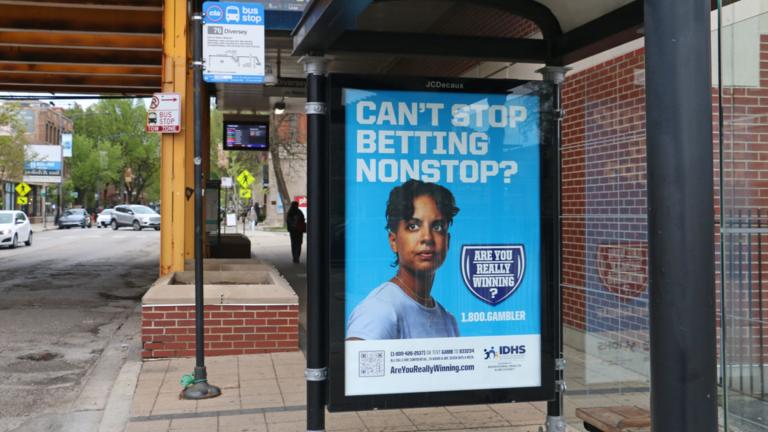
The state last assessed problem gambling during the pandemic when sports gambling wasn’t yet fully implemented. That report estimated 383,000 Illinois adults had a gambling problem, and another 761,000 were at risk of developing one, though some clinicians consider the estimates an undercount.
Problem gamblers have one of the highest rates of suicide; the assessment estimated one in 10 problem gamblers in Illinois had thought about or attempted to end their life that year. One in three had done so in their lifetime, it found.
Parlaying Losses
Sports gambling has become a billion-dollar industry in Illinois in the six years since it was legalized. Last year, bettors in the state placed more than 319 million sports wagers. Nearly 99% of those bets were made online.
Fueling that growth are parlay bets, which allow bettors to stack multiple outcomes — the Padres beat the Cubs, the Sox make it to the World Series and Tyson Bagent throws two touchdowns against the Packers — into a single bet.
If even one leg of the bet fails, the whole parlay fails. Because the odds get worse as more legs are added, the bets offer high payouts on relatively low wagers, making them particularly attractive.
“Especially if you’re at a 16-leg parlay that you might be able to put in $1 and it’ll pay you $100,000,” recovering compulsive gambler Caleb Driker-Ohren said. “All it takes is one team to win a game. Like, how hard is that? Just get another team to win their game and then when it hits, too, it’s a rush.”
Parlay bets are so attractive, in fact, that bettors placed them almost 200 million times in the past fiscal year, accounting for three in every five bets placed.
And while parlay bets were responsible for almost a third of sports wagering payouts, parlay bettors also accrued the highest net losses at $879 million; nearly 62% of all betting losses in the year came from parlays.
Gambling losses are disproportionately felt by compulsive gamblers, especially when it comes to sports betting. Though the breakdown in spending has not been studied in Illinois, a 2024 study in Connecticut found that nearly 71% of all legal gambling revenue in the state came from the less than 7% of residents identified as problem or at-risk gamblers.
Over half of sports bets, it found, were made by less than 2% of Connecticut residents identified as compulsive gamblers.
Despite bettors placing fewer bets this year than the year before, state tax revenues were still higher thanks in part to a new per-wager tax instituted for bets placed online.
Illinois’ sports wagering revenue outpaces that of other states that have enacted similar legislation in recent years. Gamblers in Pennsylvania, which has a similar population size and opened sports betting two years before Illinois, saw losses of $663 million in fiscal year 2026, trailing Illinois’ $1.4 billion.
Gas Station Casinos
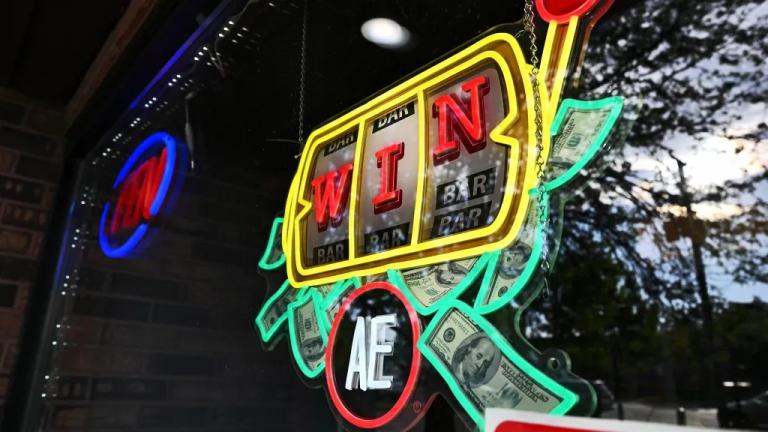
When Illinois first allowed slot machines, or video gambling terminals, outside of casinos in 2012, insiders estimated they would plateau at around 20,000 machines.
But while casinos and other forms of gambling were limited amid the pandemic, video gambling terminals flourished. Illinois sets no limits on the number of establishments that can offer video gambling.
The state is now nearing 50,000 video gambling terminals, or “the equivalent of over 40 ‘full-size’ Illinois casinos,” according to the report.
Chicago’s city council recently voted to lift its longtime ban on video gambling terminals. Since over a fifth of the state population resides in Chicago, the report predicts the city’s legalization to have a “huge impact” on video gambling revenues.
Already, Illinoisans are losing triple the money they did a decade ago to these slot machines, which are considered one of the most addictive forms of gambling.
That’s not just because there are more machines, the report shows; the net income per machine has increased from around $117 per day in 2016 to over $182 in 2026.
Illinoisans lost more than $3.3 billion in total playing slots last fiscal year. For the second year in a row, state and local governments netted over $1 billion in video gambling taxes.
Prediction Markets
One somewhat unknown variable when it comes to sports betting revenue is the continued growth of unregulated prediction markets.
State lawmakers passed a law attempting to bring prediction markets like Polymarket and Kalshi under the regulatory umbrella of sports betting, though the move faced an expected legal challenge.
It would have created a fee structure that budget analysts predicted would have brought in $5 million in state revenue. The law would also have subjected prediction markets to other sports betting regulations, like requiring customers to be 21 and older and disallowing bets on in-state college teams.
The Illinois Gaming Board sent cease and desist letters to 13 online operators, including Kalshi and Polymarket, seeking to bring them into compliance.
The companies, however, maintain that they are exchange markets regulated exclusively by the Commodity Futures Trading Commission, and that Illinois’ attempt to regulate them violates the Supremacy Clause of the U.S. Constitution.
Kalshi, its financial partner Coinbase and the CFTC sued the state in June to block the taxes from taking effect.
A federal judge ruled in their favor this week, issuing a preliminary injunction to protect the companies against Illinois’ enforcement of its gambling regulations based on her finding that the markets should be federally regulated as financial swaps, not gambling.
“Many of the financial instruments at issue are likely swaps as defined by the Commodity Exchange Act — they just happen to be swaps that people find entertaining and fun,” U.S. District Judge Martha Pacold wrote in her ruling.
She did not yet rule on whether Kalshi could be subject to the state’s transaction fees, saying more argument was needed.
Capitol News Illinois is a nonprofit, nonpartisan news service that distributes state government coverage to hundreds of news outlets statewide. It is funded primarily by the Illinois Press Foundation and the Robert R. McCormick Foundation.