Crime & Law
Federal Judge Finds US Attorney Andrew Boutros Committed ‘Clear Violation’ of Court Order in Gang Case
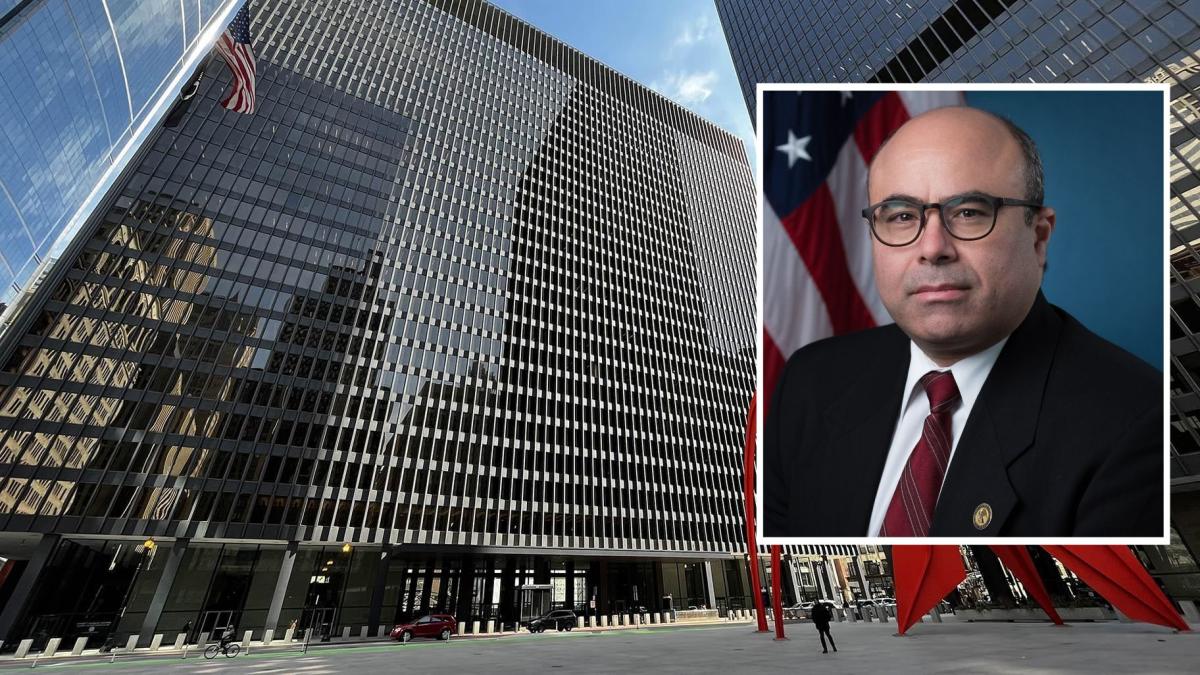 (Department of Justice, Capitol News Illinois)
A federal judge has found Chicago’s U.S. Attorney Andrew Boutros committed a “clear violation” of a court order when he openly discussed a criminal complaint in a kidnapping and murder case that remained under seal last week.
Boutros appeared Thursday morning inside a packed 25th-floor courtroom before Magistrate Judge Laura McNally, who found her sealing order in the case “was not honored” when he discussed the charges filed against three reputed Tren de Aragua gang members last week.
McNally found Boutros did not act in “open defiance” or with any “nefarious intent” when he spoke about the case at a Washington D.C. press conference last week and made clear there would be no further investigation, sanctions or consequences.
But she took issue with the embattled federal prosecutor’s explanation about why her order was violated.
Boutros said the way things played out was “all very regrettable and very unfortunate because like you, I take very seriously orders and orders from the court.”
“I always have,” he said, “and I always will.”
The criminal complaint at issue charges three men — Josue Pacheco Torres, 26, Julian Pachano, 19, and Kleiver Monasterio Briceno, 20 — with kidnapping conspiracy and committing a kidnapping that resulted in death.
The three, who are believed to be Venezuelan nationals, allegedly conspired to kidnap a man who was walking near Meyering Park on the South Side of Chicago on May 18, prosecutors said.
The victim was forced into a car and initially driven to a Chicago apartment before the defendants and other co-conspirators allegedly transported him to an abandoned building in the city where he was later found dead.
News of those arrests first surfaced when Boutros — standing alongside FBI Director Kash Patel and Acting Attorney General Todd Blanche — discussed the case during a July 1 press conference in Washington D.C.
At that time, two of the defendants were in federal custody, but one was still at large.
Boutros said his intentions were to comply with the order and he believed that by the time he landed in Washington for the press event, all three men would be in custody and the sealing order would have dissolved.
“The stars did not align,” he said.
Boutros claimed he “didn’t ask” for this press conference or to go to Washington, and that ahead of that event, he asked the prosecutors assigned to the case to take steps to unseal the complaint, affidavit and arrest warrants.
One prosecutor physically went to McNally’s chambers to discuss that request and Boutros said he believed when he entered the press event, that the case either was being unsealed or had already been unsealed.
He later learned that was not the case.
McNally on Thursday walked Boutros and those present in court through the way events leading up to that press conference played out.
She said she signed off on the complaint and sealing order brought to her last Monday by government prosecutors, who argued that order was necessary at the time because none of the defendants were yet in custody, and news of the charges could result in their flight and the destruction of evidence.
The following afternoon, an advisory disclosing the July 1 press event was published. Even so, McNally said prosecutors made no “effort at that time to unseal anything.”
“I got nothing,” she said.
Then on July 1, shortly before the 10:30 a.m. press conference, McNally said she received an urgent call from prosecutors requesting a ruling to unseal the complaint “in the next 15 minutes.” Soon after, she received a copy of the complaint that included proposed redactions, but no explanation about why the seal was no longer necessary.
McNally said she had a full schedule and wasn’t able to take up the motion until hours later, when she ultimately denied it.
“Fifteen minutes door-to-door is not a reasonable time to assume that a court will be able to receive a request without a motion, consider that request and issue a ruling,” she said.
Thursday’s hearing marked the second time in recent months Boutros has appeared before a federal judge upset by his office’s conduct, following the abrupt dismissal of the “Broadview Six” case, which was torpedoed by allegations of grand jury misconduct and a subsequent cover up levied against federal prosecutors.
He has since faced repeated calls for his resignation from elected officials, most recently by members of the Chicago City Council.
Boutros filed a motion himself Wednesday asking McNally to strike Thursday’s hearing, arguing there was “no need” for it because he had acted in “good faith” and “there has been no harm to any defendant or law enforcement officer” by speaking about the case.
In that motion, Boutros claimed that he believed the press announcement “complied with the letter and spirit of the sealing order,” as it dealt with facilitating “the enforcement of criminal law.”
McNally denied that request and ordered Boutros to appear in order to “remind leadership, including you” that sealing orders “must be scrupulously followed.”
Boutros said he took McNally’s concerns “very seriously” and pledged to re-examine the series of events to “see how we can do better.”