Arts & Entertainment
Hear From the Architects Behind the Obama Presidential Center
At the end of the Obama presidency a question was posed to architects around the world: Who wants to design the Obama Presidential Center on the South Side of Chicago?
More than 140 architecture firms applied, but only one got the proverbial golden ticket.
WTTW News sat down with the principal architects of TWBTA to discuss the creativity that would change the skyline of the South Side and what it was like working with the man who inspired it all: former President Barack Obama.
“He wanted it to be a living place with lots of energy and all of the interest that he had as a young man and as a president, rather than a mausoleum,” architect Tod Williams said.
“He was a very interesting client, a very knowledgeable client,” architect Billie Tsien said.
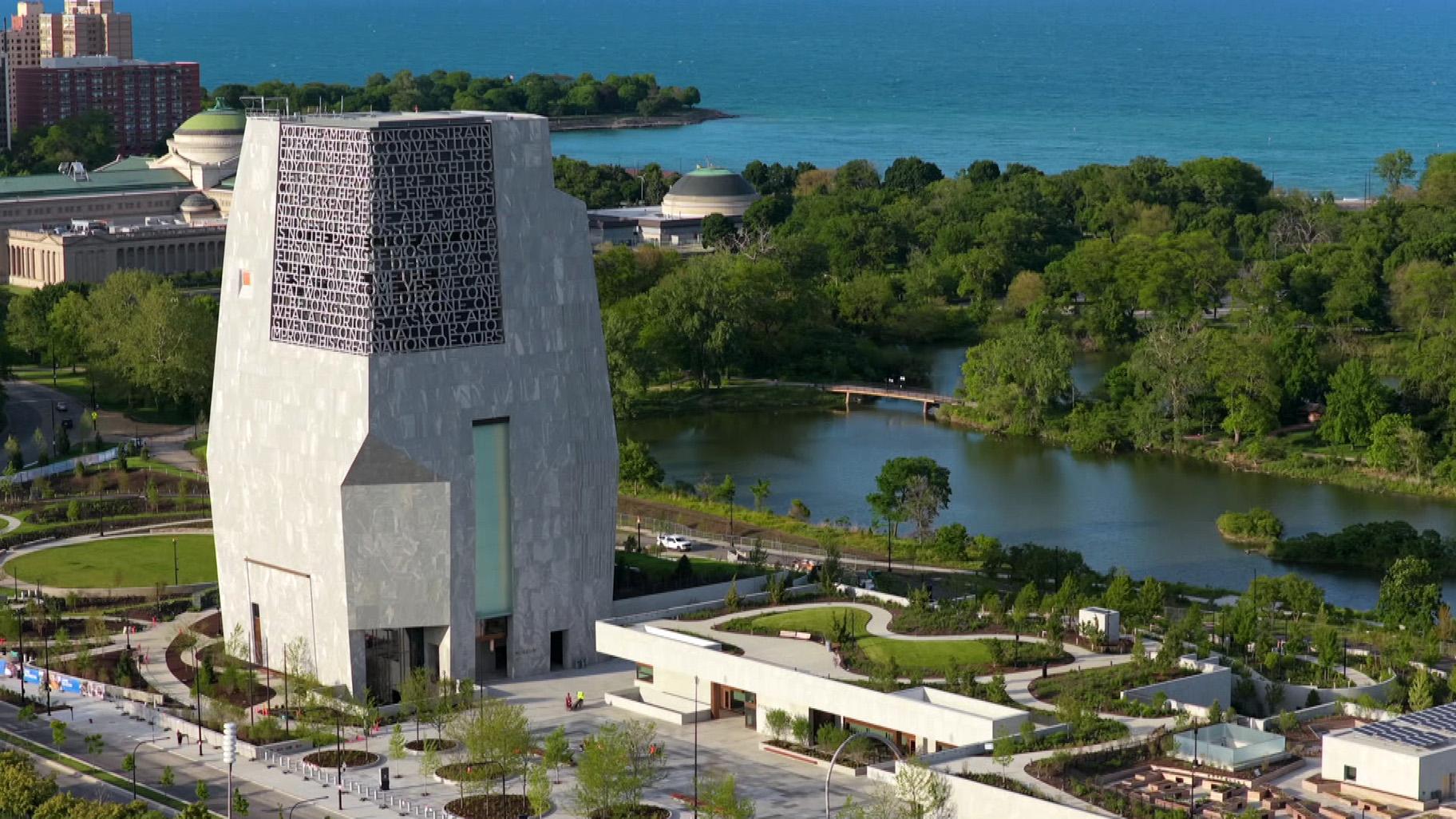 (Drone footage courtesy of Foremedia Productions LLC)
Williams and Tsien are the design minds who won the bid for the Obama Presidential Center — a process that took months to secure and included a one-on-one meeting with the then-president in the Oval Office.
“It was certainly thrilling,” Williams said, “but also slightly terrifying.”
“You know the bowl of apples that you always see in pictures?” Tsien said. “I took an apple and I kept it for a really, really long time.”
“You didn’t take a bite of that thing,” Williams recalled.
“No, it was a special apple,” Tsien said.
The architects landed the bid thanks to their neighborhood-inclusive campus design — a non-negotiable for the Obamas.
“Mrs. Obama was very involved in creating a sort of, in emphasizing the importance of this being a place for families and for people to come and feel a sense of joy,” Tsien said. “She was very much about the site and how it’s going to be used by the people of Chicago.”
This is apparent when you look at the campus from above.
The winding trails lead you anywhere from a basketball court to a sledding hill to a library to the most prominent piece of the 19.3-acre campus: the eight-story museum building.
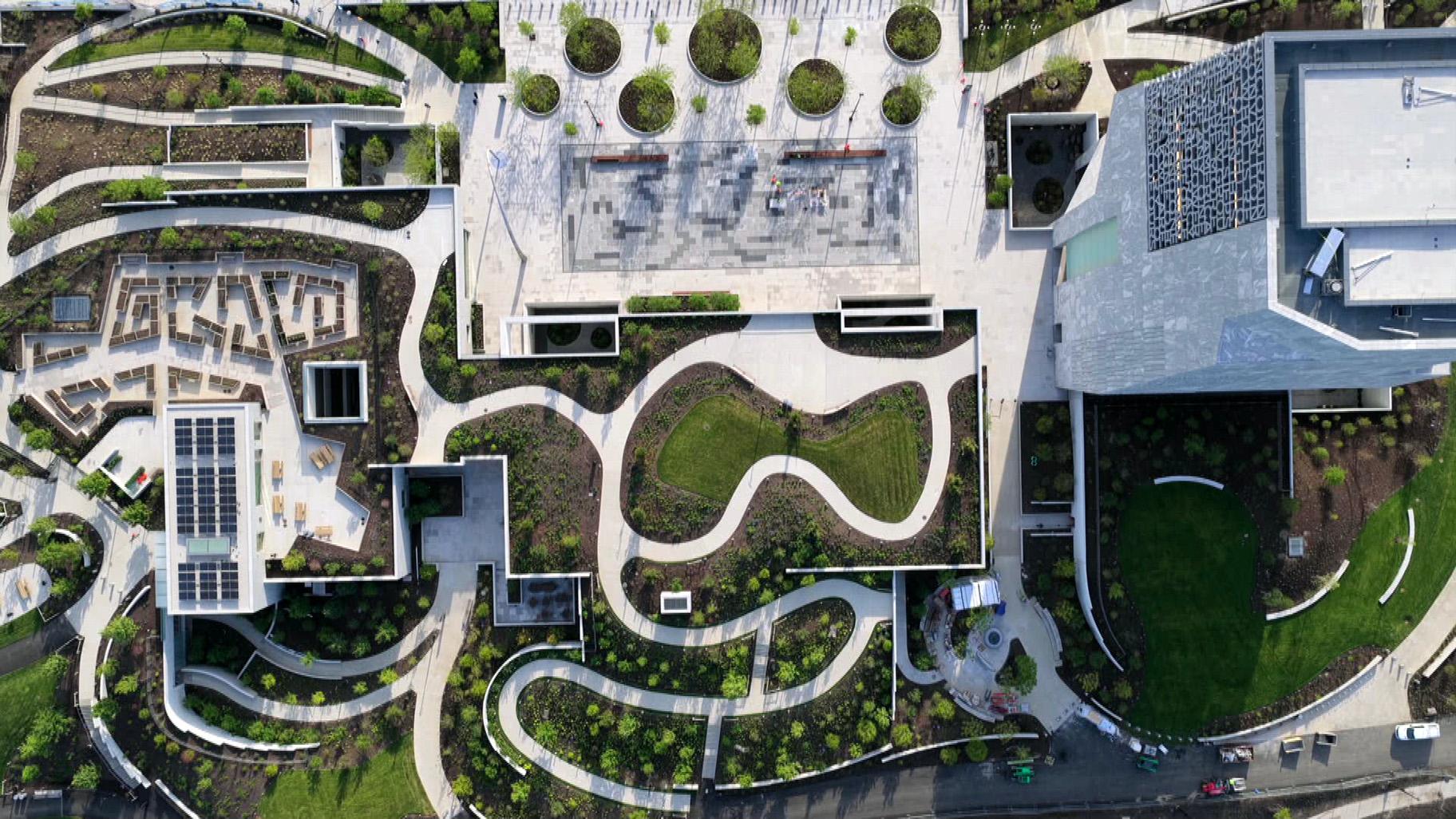 (Drone footage courtesy of Foremedia Productions LLC)
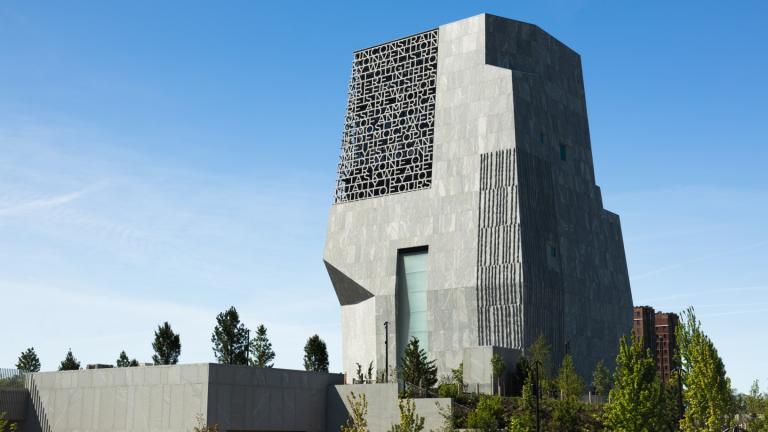
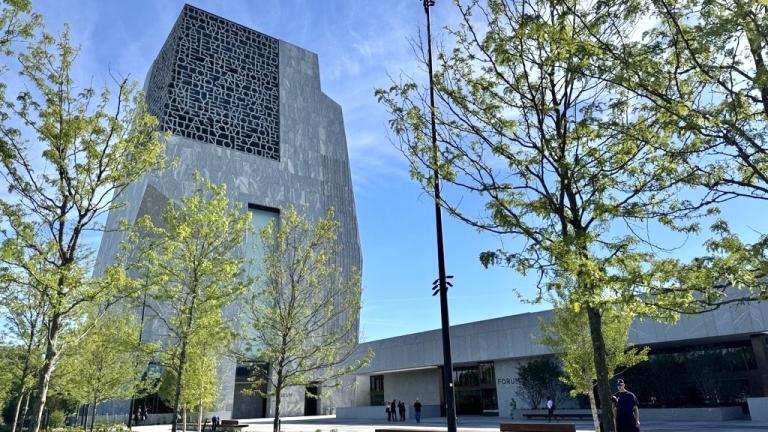
This 225-foot museum, with a shape inspired by four hands coming together, had several design changes over the years. The facade was originally set to be marble, but Chicago contractors knew that material wouldn’t stand up to our extreme seasonal weather changes.
So Williams and Tsien pivoted to granite, specifically tapestry granite from New Hampshire with its marble-like swirls.
Tsien said the material was intriguing because it “changes so much. So when it rains, it becomes very dark and moody, but then it dries out very quickly and become sort of a little bit more pink.”
The striking exterior has come under some harsh criticism, being called cold, foreboding and monolithic. But like most good architecture, form follows function: The museum exhibits required windowless rooms.
“Because of the artifacts,” Tsien said, “and because of lighting, and because the creation of a sense of drama. So they didn’t want bright lights. So that was a sort of done deal.”
Up top, the building is wrapped in five-foot letters from Obama’s “You are America” speech, which marked the 50th anniversary of the march from Selma to Montgomery.
That’s where the windowless exterior gives way to light.
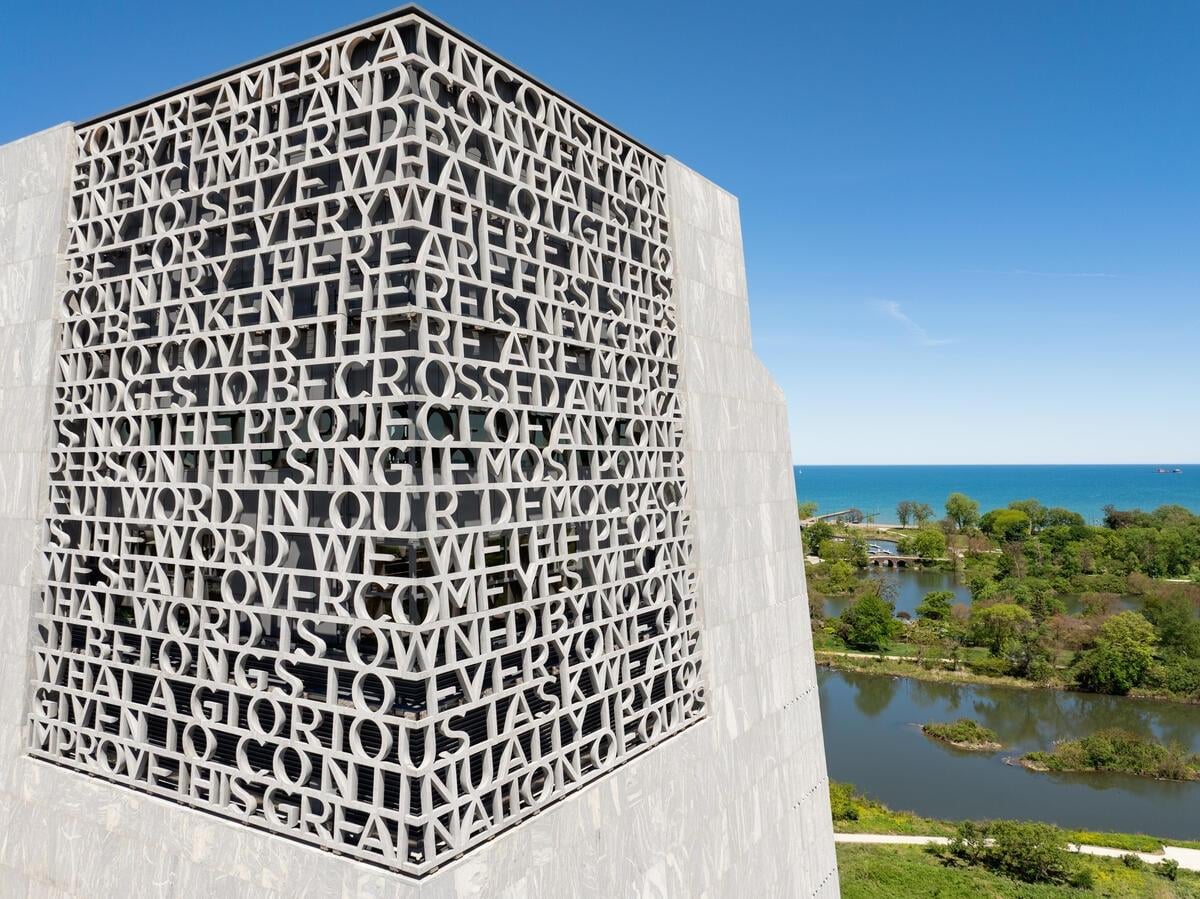 The Obama Presidential Museum in Chicago on May 14, 2026. (The Obama Foundation)
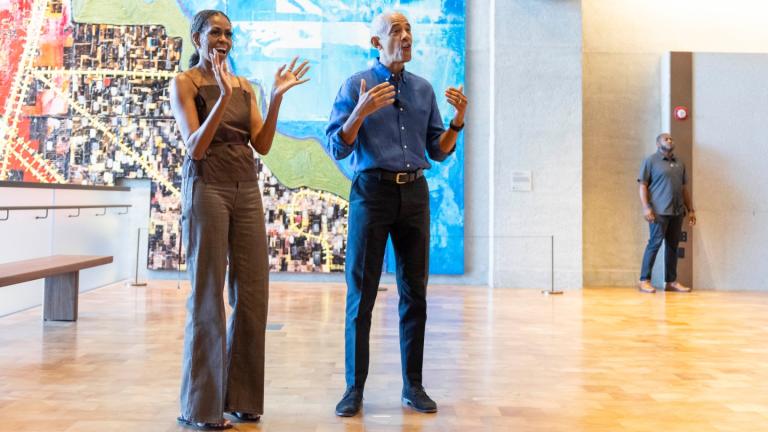
On the eighth floor in the Nelson Mandela Sky Room, visitors can look through Obama’s words onto a view that’s not normally celebrated. Instead of looking to downtown, these views are of the West Side and South Side, the place where former first lady Michelle Obama and Barack Obama called home.
The architects intended the words to be read only in fragments from below.
“To some extent we realized that decoration at the top of the building is often not perfectly discernible to people who are on the ground floor or on the land below,” Williams said. “So we realized it needed to animate the top.”
Obama Foundation CEO Valerie Jarrett said that looking through the words from the top is almost like being inside the mind of Barack Obama, who called the speech one of his most meaningful as it “best captures what American should be.”
That’s a sentiment Williams and Tsien hope their new campus will foster for the future.
“I think the best of this building is to come,” Williams said, “and it’s going to come way beyond our own lives. Maybe 200 years out, maybe 500. I hope it’s that long.”
WTTW News arts coverage is supported by the JCS Arts, Health & Education Fund of the DuPage Foundation.