Science & Nature
Rare Ghost Orchid Blooms at Chicago Botanic Garden, Catch It While You Can
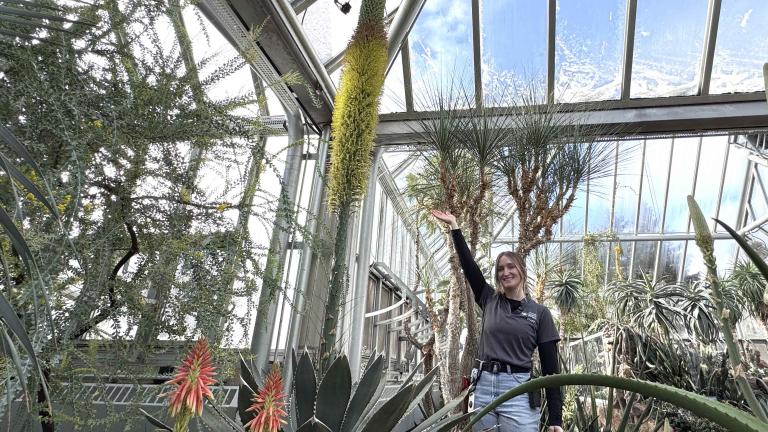
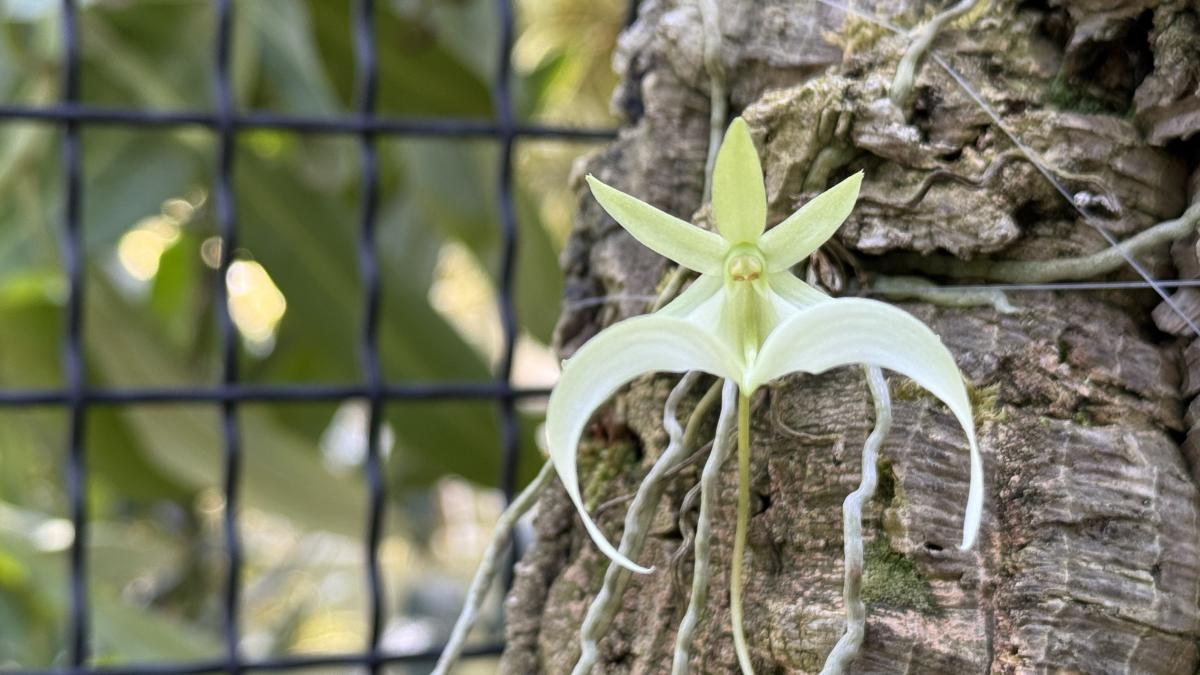 A rare ghost orchid has bloomed at Chicago Botanic Garden, where staff are helping conserve this species, which continues to decline in the wild. (Patty Wetli / WTTW News)
In the 2002 movie “Adaptation,” characters’ obsessive pursuit of the rare ghost orchid leads them deep into the swamps of Florida, and not everyone makes it out alive.
A less risky proposition: visiting the Chicago Botanic Garden, where a ghost orchid (Dendrophylax lindenii) began blooming Friday and will be on public display in the Tropical Greenhouse through May 25.
When it’s not flowering, the leafless ghost orchid is just a jumble of roots attached to a host tree. Back in March, Johanna Hutchins, orchid floriculturist at the garden, saw a flower spike emerge from one of the many ghost orchids she tends, and she’s been holding her breath ever since.
“I’m always a bit anxious because I know … there’s a lot that can go wrong,” Hutchins said. “They (the orchids) can be very finicky and it can get to a certain point and then the flower spike can abort, the bud can abort, the whole plant could die — that hasn’t happened to me yet — but I have had flowers abort on me before. Sometimes the environmental conditions aren’t quite right.”
This time, all the stars aligned. The ethereal white flower, which appears to hover in mid-air, has spread its petals. “It has this aura of mystery, almost,” Hutchins said.
Garden visitors now have an opportunity to witness a bloom that is becoming rarer and rarer in the wild.
The ghost orchid is limited to a handful of isolated populations in Florida’s western Everglades, as well as a separate population in Cuba’s Guanahacabibes National Park.
Fewer than 1,500 known plants still exist in the wild in Florida, where habitat loss, climate change and poaching have contributed to the orchid’s declining numbers. (Less than 250 plants are found in Cuba.)
Of those 1,500 plants, not all flower, and of those that bloom, only a small percentage create seed capsules, according to Hutchins.
“You don’t see that recruitment of younger plants that’s necessary to keep populations healthy and growing,” she said.
(Video by Patty Wetli / WTTW News)
In June 2025, the U.S. Fish and Wildlife Service proposed adding the ghost orchid to the federal endangered species list, finding that the “viability of the species is currently at risk.”
Category 4 and 5 hurricanes have slammed into the orchid’s habitat, the agency noted, with storms causing 30% loss at one site and taking out 48 plants at another just by uprooting a single host tree.
Poaching, according to the agency, is equally devastating, particularly because thieves tend to target mature plants. The situation is so severe that staff at one nature preserve has stopped maintaining roads in order to limit access.
Greenhouse-raised plants, like those at Chicago Botanic Garden, are one bright spot in the species’ potential conservation, the Fish and Wildlife Service said, with advancements being made in introducing these hot-house orchids into the wild.
Indeed the garden’s blooming orchid will be taken off display while it’s still flowering in the name of science: “We’re going to be pollinating it and doing some research,” Hutchins explained.
One thing the team at the garden is studying is how best to store the orchid’s pollen — crucial since the plant only sends out a single bloom — which Hutchins and her team can then send to other researchers to pollinate their plants, or the garden can use the pollen itself on future ghost orchids.
But the garden’s ability to introduce the ghost orchid to its visitors and share the plant’s story is in many ways as important to conservation efforts as research.
The plight of this charismatic orchid can be extrapolated to plants in general, Hutchins said.
“It’s a message that, ‘Well, it applies to the ghost orchid, it also applies to so many other orchids, to so many other plants everywhere,’” she said. “Every person we get the message to helps.”
Rare Beauty
Ghost orchids are weirdly wonderful in so many ways. Here are some fun facts:
— They’re an epiphyte, or a plant that grows on another plant.
— Ghost orchids (in the U.S.) tend to use the water ash and pond-apple as hosts, and bald cypress to a lesser extent.
— The ghost orchid relies on a specific (as yet unnamed) mycorrhizal fungus for its water and nutrition. This fungus is found in the host tree’s bark.
— The plant’s pollinators remained a mystery until 2018, when photographers finally captured visual evidence of pollination in action. They identified the fig sphinx moth and pawpaw sphinx moth.
Contact Patty Wetli: [email protected]