Crime & Law
Michael Madigan Makes Appellate Case, Asking Court to Vacate Corruption Convictions
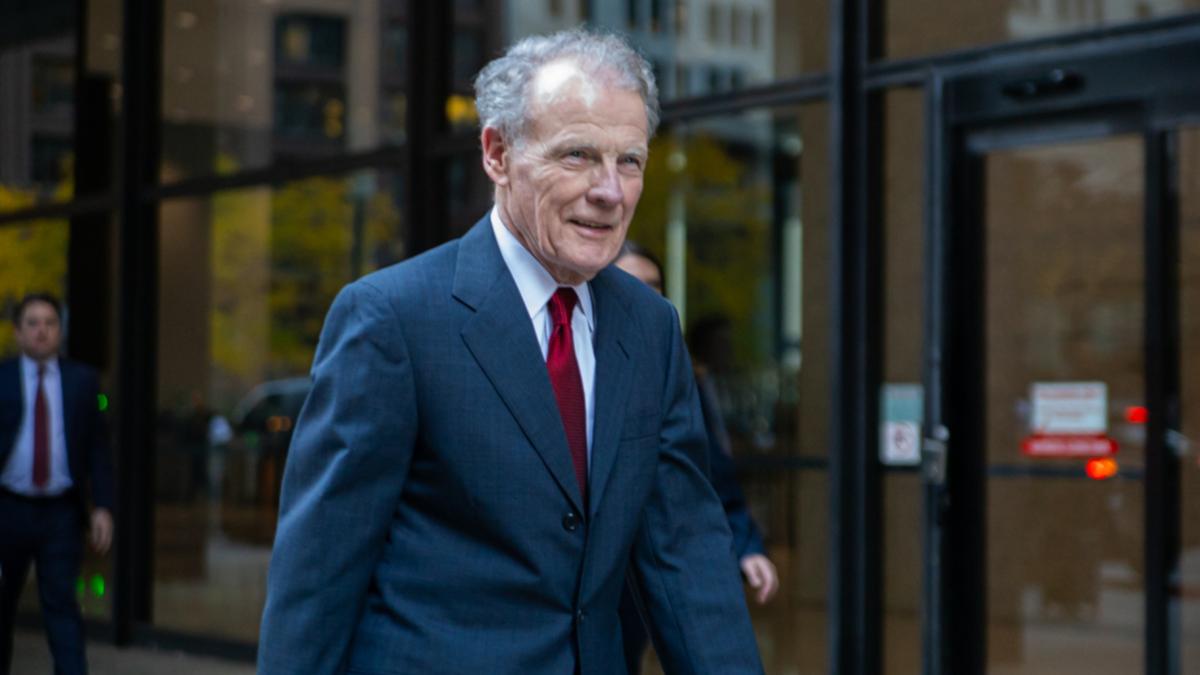 Former Illinois House Speaker Michael Madigan leaves the Dirksen Federal Courthouse after the first day of his corruption trial on Oct. 22, 2024. (Andrew Adams / Capitol News Illinois)
Michael Madigan’s landmark corruption case returned to Chicago’s federal courthouse Thursday, where his attorneys asked an appellate court to overturn the powerful former Illinois House speaker’s multiple convictions following a four-month trial that ended early last year.
Attorneys for Madigan and the federal government presented their arguments before the Seventh Circuit Court of Appeals during a hearing Thursday inside a 27th-floor courtroom in the Dirksen Federal Building.
Both sides had 20 minutes to make their arguments before the three-judge panel, which will decide whether to uphold or toss out the convictions rendered in one of the most high-profile criminal trials held in Chicago in recent decades.
While Madigan was not present in court Thursday, members of his family did attend the hearing, including his daughter, former Illinois Attorney General Lisa Madigan.
Madigan represented the 22nd District on Chicago’s Southwest Side for 50 years, spent decades chairing the Illinois Democratic Party and served as Illinois’ House speaker for 36 years before he retired in 2021 amid expanding corruption allegations that swirled around him and his 13th Ward political operation.
He’s now serving a 7.5-year sentence at a federal prison in West Virginia.
Madigan was tried in late 2024 and early 2025 alongside his longtime ally and confidant Michael McClain on charges alleging they orchestrated five separate corruption schemes, wielding the speaker’s immense political power to reward loyal allies and enrich himself.
A 12-person jury found the former speaker guilty on 10 of 23 total charges, with his convictions centering on two of those schemes: his efforts to secure a valuable state board position for disgraced former Chicago Ald. Danny Solis, and his bribery efforts involving Commonwealth Edison.
In the most wide-ranging of those schemes, Madigan and McClain were accused of arranging subcontractor jobs for several of the former speaker’s associates with ComEd, which paid them $1.3 million even as they did essentially no real work for the company.
The jury failed to convict McClain on any charge, though he was previously convicted in the separate “ComEd Four” case and is currently serving a two-year prison sentence in Kentucky. His attorneys are expected to present their own appellate arguments before the Seventh Circuit next month.
At his sentencing last June, U.S. District Judge John Blakey found that Madigan acted as the “central command post” of the bribery schemes, and repeatedly perjured himself while testifying at trial in an attempt to conceal his guilt and mislead the jury.
“It was a nauseating display … of perjury and evasion,” Blakey said at the time, calling Madigan’s testimony hard to watch at times. “You lied sir. You lied. You did not have to.”
Federal prosecutors at trial alleged Madigan used ComEd as his “own personal piggy bank” and orchestrated various moves for the company through McClain.
Assistant U.S. Attorney Julia Schwartz on Thursday told the court the jury received “abundant evidence” to prove Madigan engaged in a quid pro quo bribery scheme and that he “corrupted state government at the highest levels” when he repeatedly agreed to trade his official actions for personal gain.
But Madigan’s attorneys in their appeal claim the government’s prosecution of their client “pushed federal bribery law over the boundaries set by the Supreme Court.” They took issue with “erroneous” instructions given to jurors over the definition of the term “corruptly” and alleged federal prosecutors engaged in a “blind pursuit of Madigan.”
Madigan’s appeal team argued the government’s claims — that he agreed to take some unspecified action on future, unspecified legislation — are far too vague to support a conviction.
“The government did not prove a promise to act on a specific question or matter,” attorney Amy Mason Saharia told the court. She added that while bribery cases often involve trips to Las Vegas or designer watches, the only benefit offered to Madigan was that his political allies received work.
In a filing last month, Madigan’s attorneys claimed the ComEd legislation that Madigan backed did not go “against the public interest” nor did Madigan take “any anomalous action” to support it.
“Officials routinely make promises to the public about what they will do in office to warrant support. This is politics,” Madigan’s defense team wrote. “It is not obvious that accepting valuable things from constituents without intending to be influenced or rewarded (but understanding the constituents desire such influence) is inherently wrongful, unlawful, or … ‘forbidden.’”
Jurors at the four-month trial listened to scores of recorded conversations, captured either through a government wiretap or by cooperating witnesses including Solis, who acted as an undercover mole in order to avoid his own prison sentence on separate corruption charges.
Madigan at trial claimed he never actually intended to recommend Solis for the board seat position, despite a recorded conversation between the men which allegedly showed Madigan telling Solis he planned to do exactly that.
Madigan’s appellate team instead argued that prosecutors cherry-picked “two- and three-word fragments” from those recordings, stripped of context.
“Examined in full, even viewed in the light most favorable to the government, the evidence did not prove a quid pro quo,” they wrote.
It’s not immediately clear when the Seventh Circuit will issue its ruling.
Madigan reported to a federal prison facility in Morgantown, West Virginia last October where he began serving his sentence. Prison records indicate his projected release date is Jan. 13, 2032.