Politics
Chicago Appeals Order Requiring Officials to Destroy Millions of Police Body-Worn Camera Videos
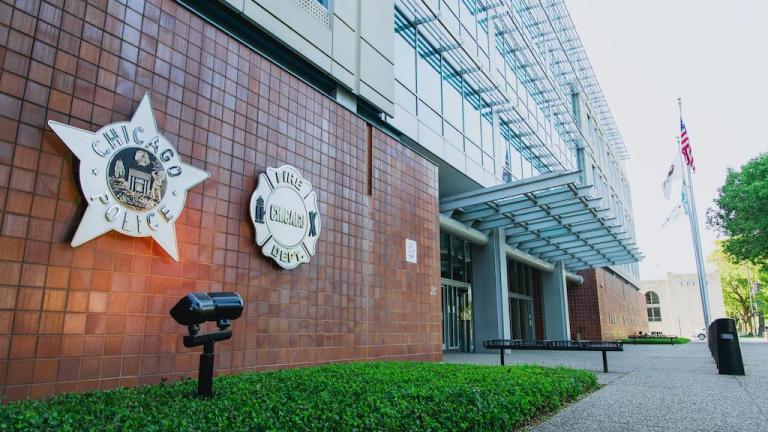
 (Michael Izquierdo / WTTW News)
Chicago lawyers appealed a ruling from a Cook County judge that ordered officials to delete millions of body-worn camera videos that have not been flagged for further review, records show.
After the city’s appeal, Cook County Circuit Court Judge Michael Mullen agreed to stay his order that gave the city until Monday to delete the estimated 14 million to 20 million body-worn camera videos in CPD’s system and stop storing videos older than 90 days that are not part of an active review, records show.
Lawyers for the city believe Mullen’s ruling is “legally incorrect,” according to a statement from the Chicago Department of Law
Destroying those videos will lead “to the permanent loss of evidence that may be essential for lawsuits and other challenges to police practices,” according to the statement.
Requiring the city to delete those videos could complicate efforts by a team appointed by a federal judge to assess the city’s compliance with the federal court order known as the consent decree, which requires CPD to overhaul the way it trains, supervises and disciplines officers while weakening “oversight by limiting the development of accurate, evidence‑based assessments of how policing is actually carried out,” according to the statement.
The city has never destroyed even a single video captured by a CPD officer’s body-worn camera, according to evidence presented to Mullen during the court case brought by the Fraternal Order of Police, Lodge 7.
Union President John Catanzara Jr. did not respond to a request for comment from WTTW News.
Mullen ruled that state law required the city to delete body-worn camera footage that has not been flagged for further review after 90 days, citing the “clear language” of the Illinois Law Enforcement Officer – Body Worn Camera Act, which took effect in 2016.
Less than 1% of videos captured by officers’ body-worn cameras have been flagged for further review, according to court records.
Mullen ruled that it was illegal for the city to keep body-worn camera footage for longer than 90 days, since state law says that footage “must” be destroyed.
Despite that, city officials have “enacted their own policy of the indefinite retention” of the videos captured by the body-worn cameras and have disciplined officers based on footage older than 90 days that was not flagged for review, Mullen ruled.
“This ongoing practice is a blatant disregard of (the state law’s) clear command,” Mullen wrote.
There are seven grounds for body-worn camera footage to be flagged and retained, Mullen said.
The court order known as the consent decree, which requires CPD to overhaul the way it trains, supervises and disciplines officers does not require CPD to keep all body-worn camera footage indefinitely, Mullen determined.
In fact, the consent decree requires the city to follow the state’s body worn camera law, Mullen ruled.
Keeping those videos violates CPD officers’ right to privacy, Mullen ruled.
In a separate part of the lawsuit brought by the police union, Mullen ruled two different state laws allows investigators with the Civilian Office of Police Accountability to probe fatal police shootings.
The police union, which has long sought to block the agency better known as COPA from probing fatal police shootings, appealed that ruling.
Mullen determined that the Illinois Police Training Act and the Police and Community Relations Improvement Act do not require COPA investigators to be sworn law enforcement officers or undergo the same training as lead homicide detectives.
In the less than nine years COPA has existed, its investigators have probed 139 deaths caused by Chicago police officers, records show.
COPA probes the most serious allegations against CPD officers, including claims of excessive force, bias-based verbal abuse, firearm discharges, deaths or serious injuries in custody, sexual misconduct and improper searches or seizures.
The agency’s job is to determine whether officers complied with CPD policies. Officials refer any evidence that officers may have committed a crime to the Cook County State’s Attorney’s Office.
Chicago police officers who lead homicide investigations undergo 560 hours of training from the Illinois Law Enforcement Training and Standards Board. Since COPA investigators undergo 40 hours of training from a private vendor approved by the board, Mullen ruled that satisfied the law’s requirements.
Because COPA investigators do not investigate whether an officer should be charged with a crime in connection with a homicide, they are not subject to the requirements imposed on officers charged with leading homicide investigations by state law, Mullen determined.
It is likely to be more than year before the Illinois 1st District Appellate Court rules on these issues, if the justices decide to consider the appeals.
WTTW News coverage of policing and police reform is supported by The Joyce Foundation.
Contact Heather Cherone: @HeatherCherone | (773) 569-1863 | [email protected]