Science & Nature
A Desert Bloom in the Dead of Winter? It’s Always Summer at This Greenhouse Garden
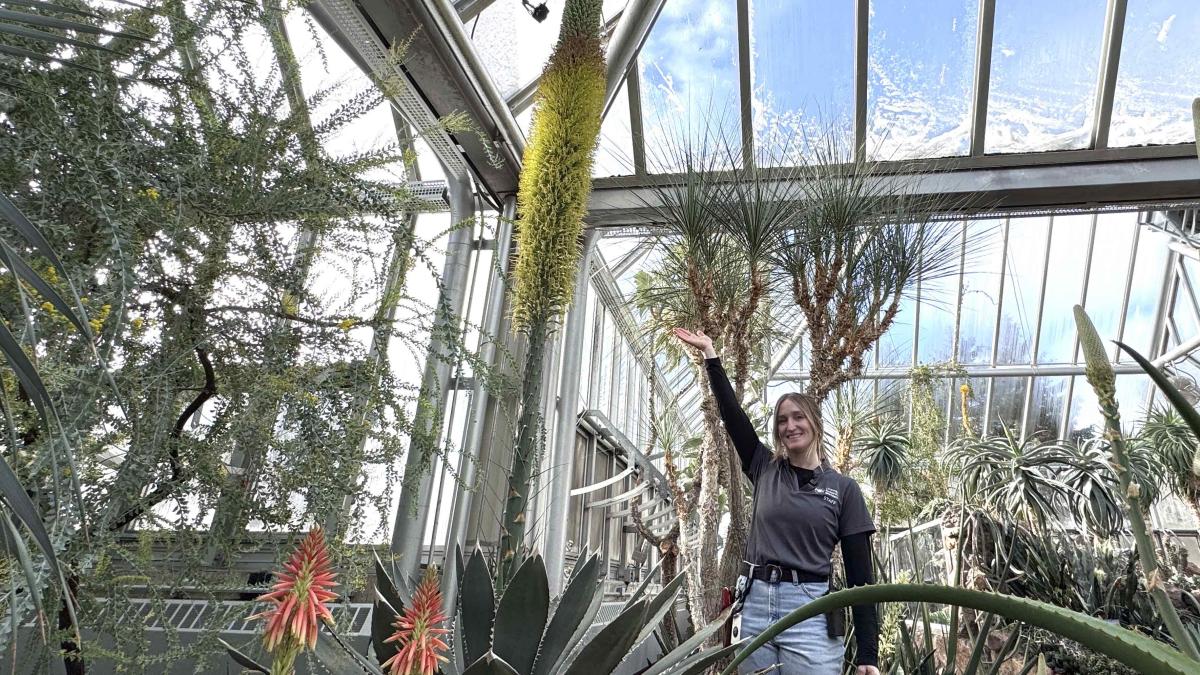 Horticulturalist Sarah Nolimal in the Chicago Botanic Garden’s arid greenhouse. (Patty Wetli / WTTW News)
During the dead of winter, most Midwest gardeners are scrolling through seed catalogs, drawing up new planting schemes and generally whiling away the days until spring.
There’s no off-season for horticulturalist Sarah Nolimal.
It’s always summer in the Chicago Botanic Garden’s arid greenhouse, where Nolimal tends to an assortment of cacti, agave, aloes and other succulents that require year-round warmth. It could be freezing outside — or in the case of this winter, sub-freezing — but in the greenhouse, the thermostat is set to a balmy 70 degrees during the day.
Gardening under glass, Nolimal said, certainly comes with its advantages.
“To hear the rain pelting down is really cool while you’re still dry and doing whatever gardening needs to be done,” she said.
It also comes with limitations, in the form of walls and a roof. Plants need to be kept in check, sometimes against their natural tendencies. Typically that involves pruning or moving a specimen that isn’t playing nice with neighbors.
But in rare instances, a plant can’t be contained, and Nolimal finds herself literally busting through the glass ceiling.
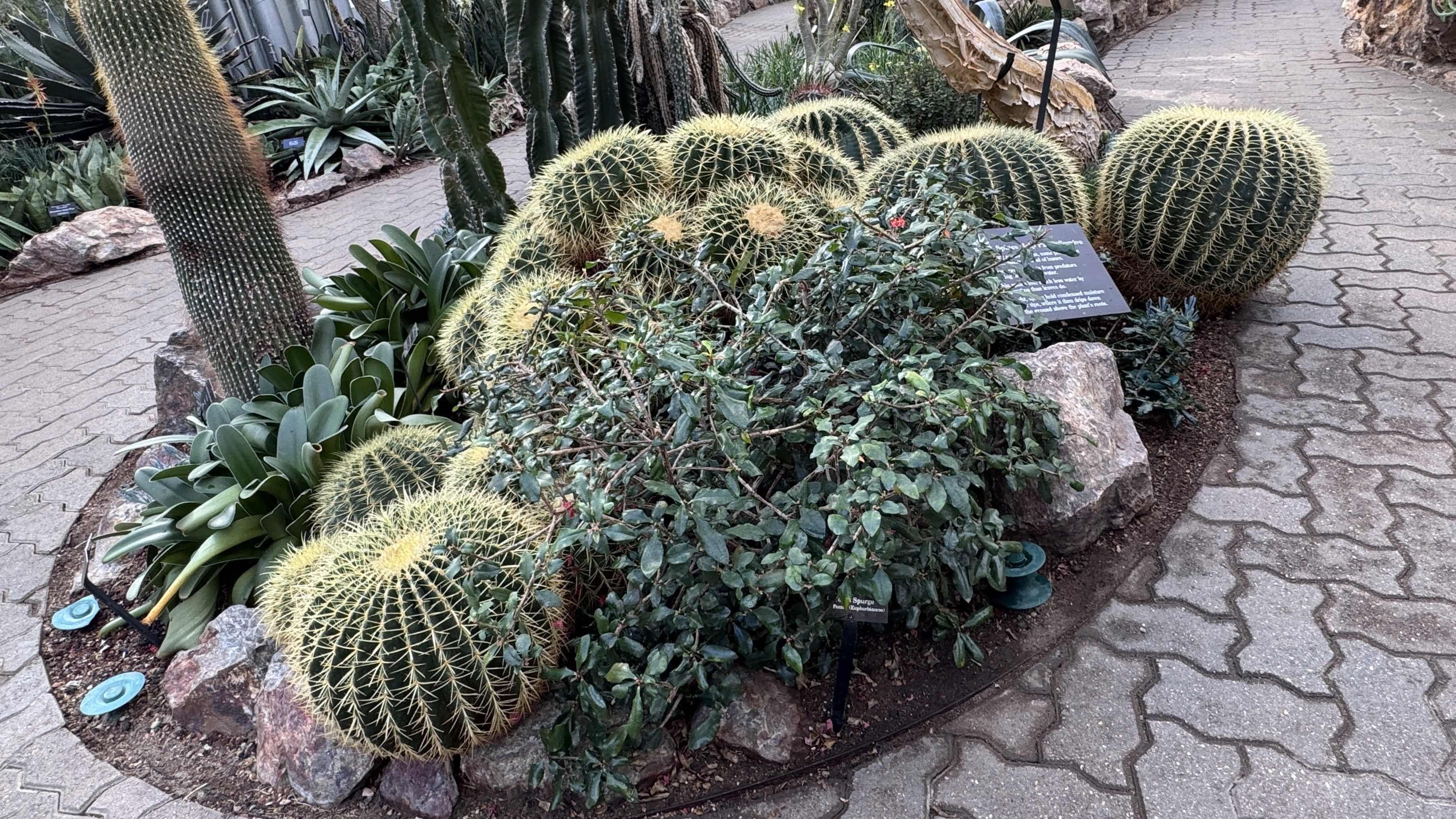 This golden barrel cactus dates back to the greenhouse’s opening in 1979. It reproduces via “pups,” or clones, one of which is jutting into the garden’s pathway. “I like to think of it as a speed bump,” said horticulturalist Sarah Nolimal, but there have been discussions about whether it should be removed. (Patty Wetli / WTTW News)
“I would say our gardens are more static,” Nolimal said. “Especially in this room, the arid greenhouse, all these plants are so slow-growing because they are adapted to do that. … So when you do have something as simple as a new leaf or something blooms, it’s like, ‘Wow.’”
A major “wow” moment came in late 2025.
Nolimal and her colleague Laura Nulty noticed a foot-tall stalk emerging from one of the greenhouse’s so-called “century” agaves, a signal it was preparing to bloom.
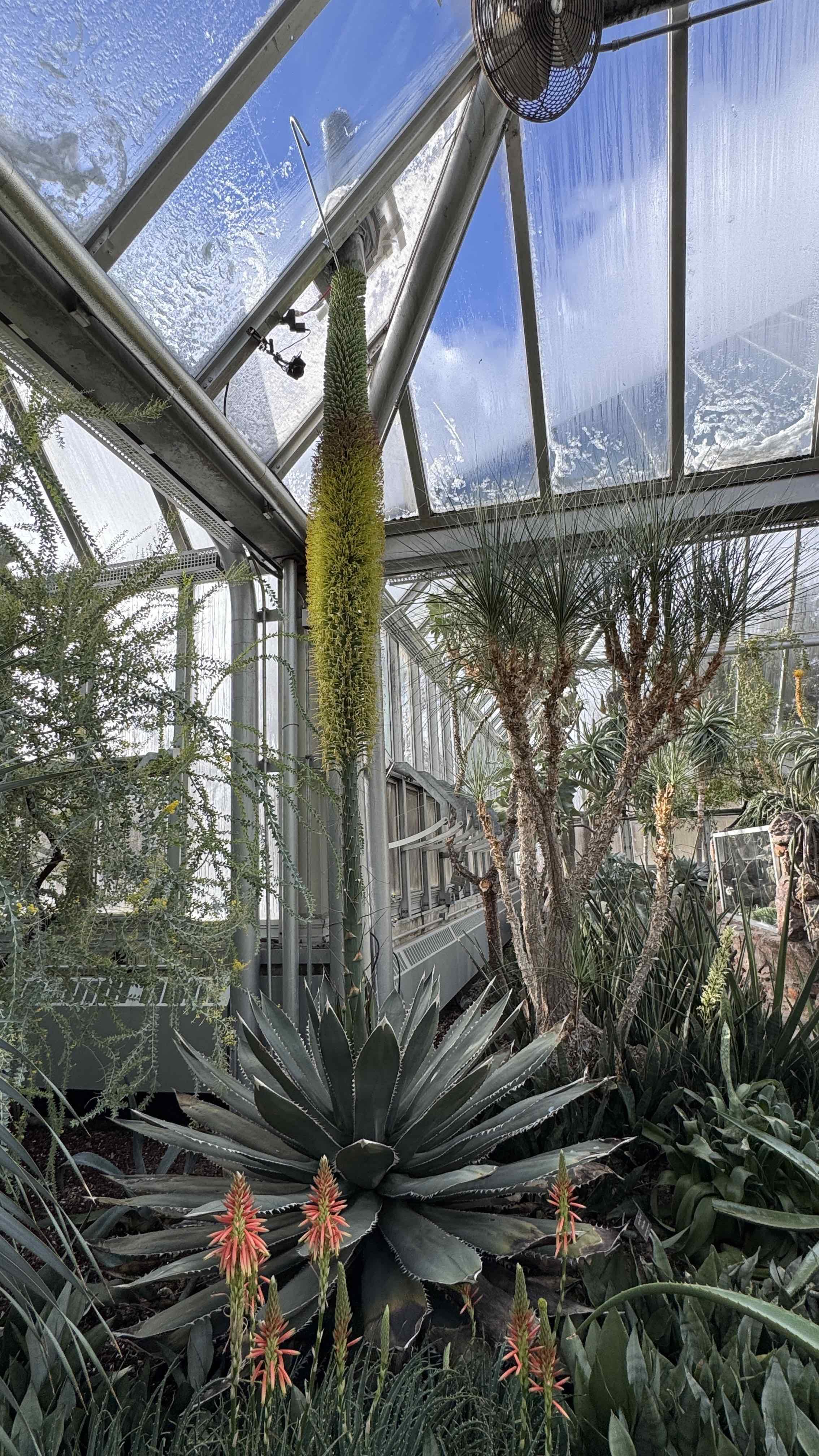 The giant agave stalk “broke” the glass ceiling. This so-called century plant flowers once in its life and then dies. (Patty Wetli / WTTW News)
These agaves are one and done, flowering once in a lifetime in spectacular fashion and then dying. Chicago Botanic Garden hadn’t experienced a century plant bloom since 2010.
“What has been so surprising to us is that we kind of didn’t think that this plant was necessarily on its way up. We thought it was on its way out,” Nolimal said.
They’d been fooled by dead foliage at the base of the plant, which, it turned out, was less a sign of the plant’s poor health and more a matter of staff avoiding regular “grooming” of the prickly leaves.
“It’s really a vicious plant,” Nolimal said. “So no one wanted to get in there and get their eyes poked out.”
Once an agave begins its bloom cycle, it’s hard to predict how tall the plant will get. Certain species can top 20 feet, but due to some gaps in record keeping, Nolimal didn’t know exactly what kind of agave she was dealing with.
She did know this particular specimen had been planted under an angle in the greenhouse roof, at a low point. And that it had an unfortunate sense of timing, choosing winter to shoot for the heights instead of spring.
With the stalk growing 4 to 6 inches a day, it quickly bumped up against the ceiling. Ultimately the greenhouse team was able to remove a small pane of glass, bend the tip of the agave stalk toward the opening and thread it through a jury-rigged tube to allow it to continue its upward climb.
Despite their best efforts, the weather did not cooperate, with a bitter freeze arriving in mid-December just as the agave poked its head outside.
The tip “basically turned to mush,” Nolimal said. “It’s still attached to the plant, but it’s really soft and mushy and it looks rotten.”
Still, the agave proved remarkably resilient. While its growth may have been stunted, it continued to bloom in full, with flowers opening first at the bottom of the stalk and working their way toward the top.
In late January, the agave was still in mid-bloom as Chicago Botanic Garden closed the greenhouse to the public in order to prepare for its annual orchid show. Nolimal planned to leave the spent stalk in place as a sort of “plant skeleton.”
“I think it’s an exciting tale to tell,” she said, “so I’m going to leave it as a structural piece for however long I can get away with it.”
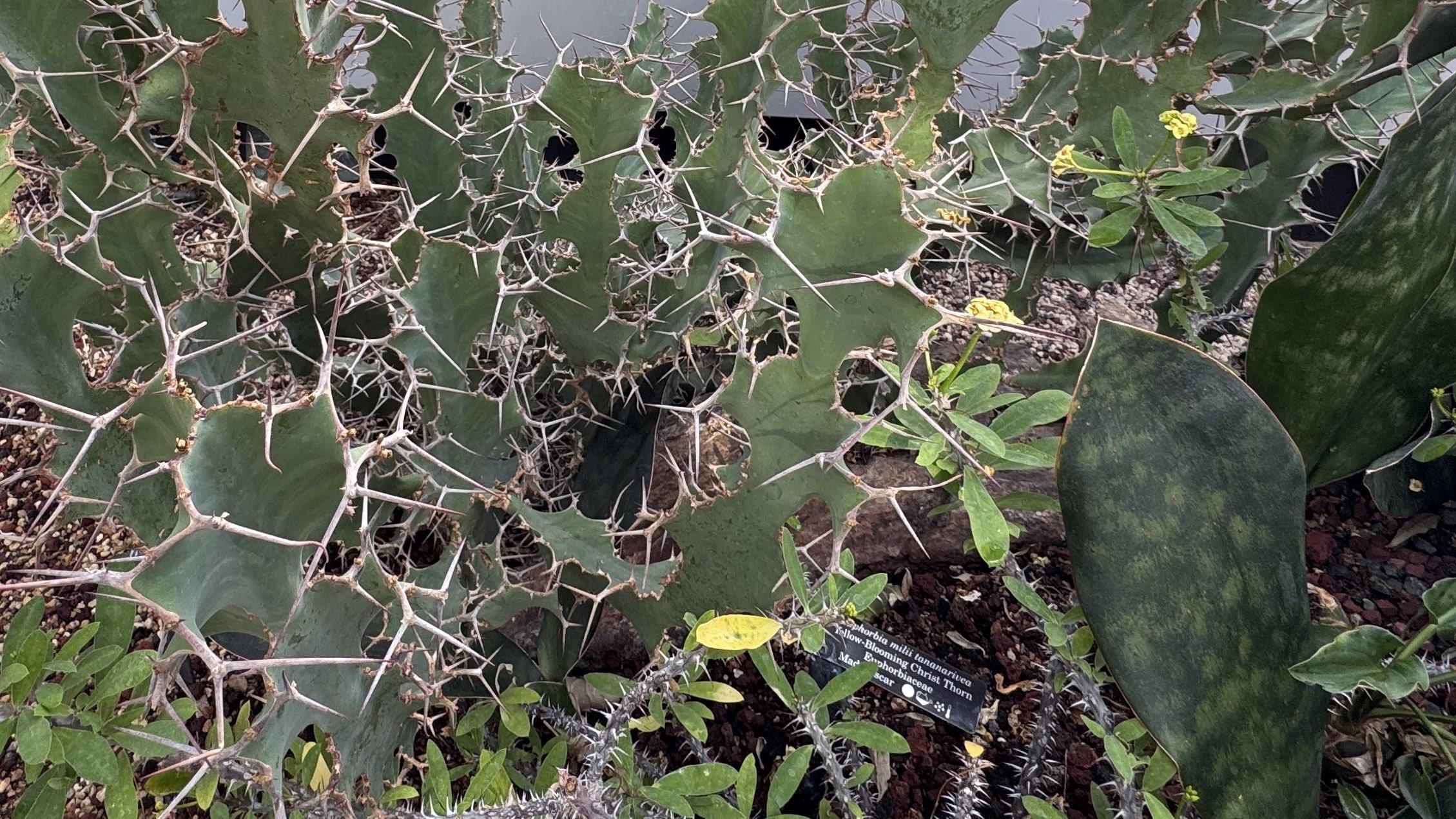 “Planting that one was really tricky,” Nolimal said of the aptly named christ thorn, a member of the euphorbia family. “You can see how those (thorns) are just built to be fighters.” She kept it arm’s length, as far away from her face as possible, while maneuvering it into place. (Patty Wetli / WTTW News)
The arid greenhouse, which opened in 1979, may be most popular with visitors as a winter escape, but Nolimal, who’s been on the job for four and a half years, said the garden holds its own against its outdoor counterparts.
“There’s flow, there’s design, there’s varied heights, there’s colors, there’s textures,” she said — just on a more compact scale.
Because planting beds are smaller and narrower, the challenge, from a horticulturalist’s perspective, is to maximize the real estate.
“We have to have the most interesting plants that we can,” said Nolimal. “You can’t hide anything.”
The charm is often in the details — a pattern, a shape, a scent — which demands more of visitors’ attention, calling for them to slow down, lean in (carefully) and appreciate the quirks of individual specimens.
“A lot of the flowers in this house specifically are so tiny,” Nolimal said, “you could really easily miss them.”
The reward is a deeper appreciation for the amazing variety within the plant kingdom.
“You ask a kid to draw a plant, they draw a couple leaves, big flat broad leaves,” said Nolimal. “But (cactus) spines, they’re just modified leaves. It’s the mystery of plants.”
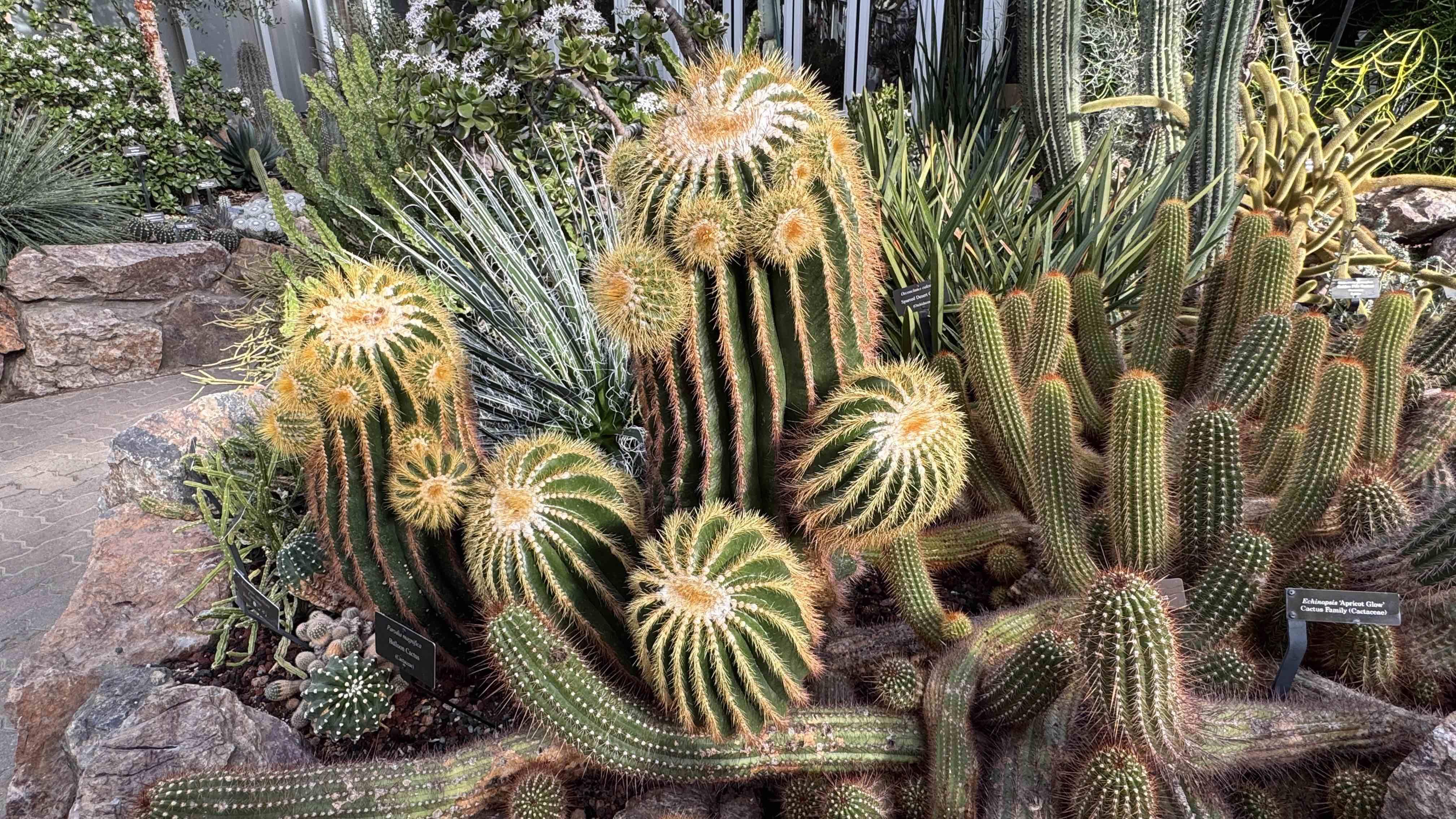 The garden’s balloon cactus, native to Brazil, is popular with guests, in part because it looks like it has googly eyes. (Patty Wetli / WTTW News)
For Nolimal, a native of Bartlett, Illinois, the real magic of the greenhouse is what she calls its “transportative” quality.
“Which, I know, is not an actual word, but I like to use that verbiage because it takes me somewhere else,” she explained.
There’s nothing like it in Chicago, or technically the world, for that matter.
“These plants, they’re mixed from all over the place," she said, “so you don’t really find them all together except in this unique landscape here. This kind of reminds me of seeing other parts of the world every day.”
A stroll along the greenhouse path can take a guest, within minutes, from South Africa, where the poisonous gifboom tree grows, to South America courtesy of the torch cactus.
“It feels like a really unique place to be,” Nolimal said. “I can’t imagine doing something else.”
Greenhouses at the Chicago Botanic Garden are currently only open to Orchid Show ticketholders through March 22.
Contact Patty Wetli: [email protected]