Politics
City Council Votes 29-19 to Approve Rival Spending Plan, Rebuking Mayor Johnson
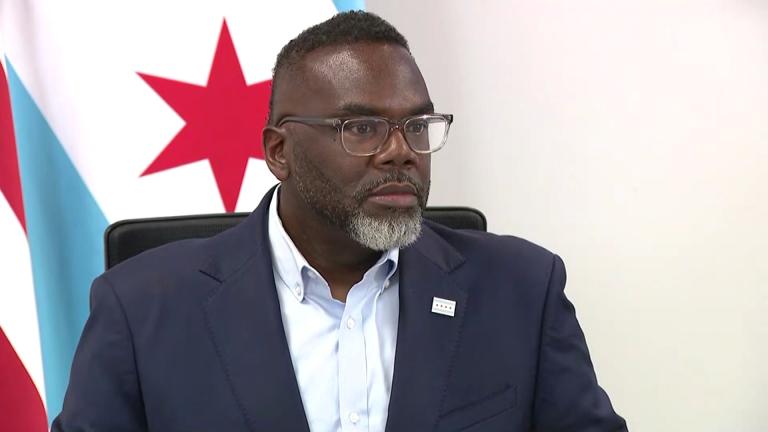
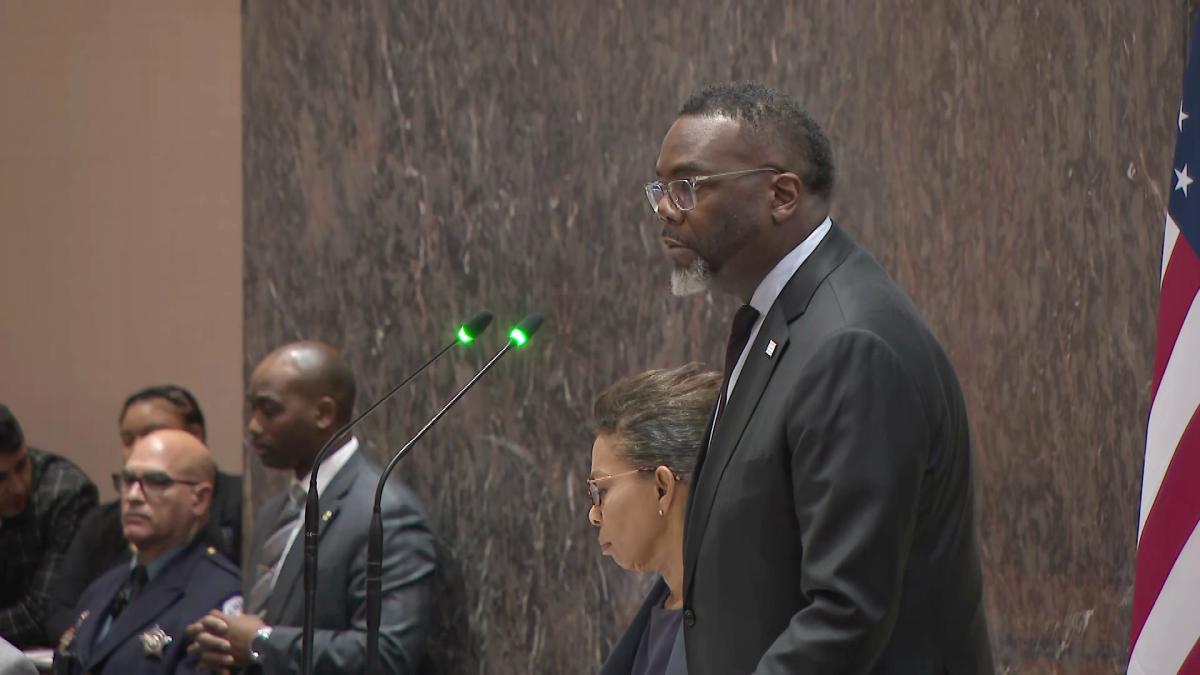 Chicago Mayor Brandon Johnson at the Dec. 19, 2025, Chicago City Council meeting. (WTTW News)
The Chicago City Council voted 29-19 to approve a plan to bridge the city’s $1.19 billion budget gap without hiking a per-employee tax on large firms, delivering a major rebuke to Mayor Brandon Johnson.
For the second straight day, Johnson stopped short of promising to veto that spending plan but said he has “serious and significant concerns about the plan,” which he and the city’s top financial officials contend would leave the city with a deficit of more than $163 million.
That spending plan calls for more than $473 million in new taxes and relies on $35 million in revenue from advertising on city light poles and in other public spaces.
Opponents of the mayor would need to find five additional votes to override a mayoral veto.
The City Council also voted 39-11 to approve a plan backed by Johnson to borrow $1.8 billion. That includes $166 million to cover the cost of raises for firefighters who worked without a contract for four years, $283 million to cover the escalating cost of police misconduct settlements and fund the city’s infrastructure program for 2026 and 2027, which includes $144.6 million to repair bridges and viaducts, $174 million for street resurfacing and $173 million to replace lead service lines.
Chicago had $10.6 billion in outstanding debt backed by the city’s property tax and sales tax receipts at the end of 2024, according to the city’s 2024 Annual Comprehensive Financial Report.
In addition, the City Council approved a measure that would allow city officials to refinance $1 billion of the city’s debt during 2026.
The plan approved by the City Council Friday raises the necessary revenue for the city’s 2026 spending plan, with the ordinances that would allow the city to spend those funds set for a final vote on Saturday.
Johnson again called the spending plan’s proposal to collect an additional $89 million from Chicagoans who owe to the city ambulance payments, utility bills, red-light camera tickets and other debt “morally bankrupt.”
The budget would allow the city to sell the debt to a private company, and Johnson has said those firms would target the poorest residents, including Black and Brown residents, and would be unlikely to materialize.
The additional revenue from that debt collection push replaces the $82 million that would be generated by Johnson’s proposal to levy a $33 per month per employee tax on companies with 500 or more employees in order to fund violence prevention and youth employment programs.
There are just 11 days left before the deadline to avoid an unprecedented shutdown of city government. Officials cannot pass a short-term ordinance to keep City Hall functioning while negotiations continue, officials said. That means without a budget agreement, more than 30,000 workers will not be paid and city services will stop.
The spending plan counts on $176.6 million in revenue that was not included in the mayor’s plan. But those changes will actually result in an $8.3 million loss to the city, officials said.
Ald. Stephanie Coleman (16th Ward) and Ald. Andre Vasquez (40th Ward) did not vote on the spending plan. Vasquez said after the vote that he would have voted no with the majority of the City Council’s Progressive Caucus, which he co-chairs. Coleman supported the plan opposed by the mayor.
Vasquez and Ald. Matt Martin (47th Ward), who is also a member of the Progressive Caucus, also voted against last year’s budget and spending plan.
Three members of the Progressive Caucus voted for the spending plan opposed by the mayor: Ald. Desmon Yancy (5th Ward), Ald. Ronnie Mosley (21st Ward) and Ald. Ruth Cruz (31st Ward). All three alderpeople are in their first terms.
Four members of the City Council’s Black Caucus — each handpicked by Johnson to serve as committee chairs — voted for the plan opposed by the mayor: Ald. Pat Dowell (3rd Ward), Ald. Gregory Mitchell (7th Ward), Ald. Michelle Harris (8th Ward) and Ald. Emma Mitts (37th Ward).
Dowell, who helped lead the charge against the so-called head tax, and crafted the spending plan approved Friday, said Chicago is “at a critical juncture.”
“We have emerged today with a budget plan that protects programs which are vital to those most in need while setting us on a right path toward a stronger fiscal future,” said Dowell, who was the first moderate member of the City Council to endorse Johnson.
Johnson on Friday renewed his push for the head tax, introducing a revised spending plan just minutes before a majority of the City Council voted to approve a measure he has rejected.
“This measure expressly rejects reliance on the sale of involuntary debt to third-party collectors, whose aggressive and predatory practices disproportionately burden working families across the city,” Johnson wrote to the City Council.
In addition, Johnson’s newest proposal would allow slot machines and video poker games to be installed at Midway airport, while continuing to allow video gaming only in the city’s temporary casino. The permanent casino is scheduled to open in River West in 2026.
The spending plan approved Friday relies on an additional $29.3 million that would come from new advertising on 3,000 city light poles, city vehicles and iconic bridge houses along with $6 million from an “augmented reality” advertising licensing program that would allow companies to impose videos and other content on city properties like Millennium Park or the Riverwalk that can be seen through a smartphone, virtual reality glasses or tablet.
The city can only count on $4.6 million of that revenue, Budget Director Annette Guzman and Chief Financial Officer Jill Jaworski told the City Council.
The alternative plan also makes $46.6 million in cuts identified by consulting firm Ernst & Young in a report designed to help Chicago officials root out inefficiencies. That calls for vacant positions to be eliminated and for “service optimization” by charging more for things like false burglar alarms and ambulance rides, according to the proposal.
But the city can only count on $6 million from those changes, in part because Chicago does not have a system that would allow the city to send a bill to property owners for false alarms, Guzman said.
The spending plan also relies on $8.7 million generated by charging shoppers 15 cents for each single-use paper and plastic bag at stores and allowing retailers to keep 1 cent to cover costs. The current tax is 10 cents, with store owners keeping 1 cent. That fee was also hiked by 3 cents in last year’s budget.
But that hike would actually only bring in $5.2 million, because more people would bring their own reusable bags on their shopping trips, Guzman said.
In addition, a plan to legalize video poker and slot machines in every Chicago bar or restaurant with a liquor license would not ring up $6.8 million in revenue, as the rival budget plan projects, but instead cost the city $3 million, based on a study from a city consultant, Jaworski said.
The rival budget proposal also relies on $6 million from a 1.5% increase in the taxes on beer, wine and liquor sold at stores for consumption elsewhere.
But that change would actually cost the city $4 million and be nearly impossible to implement by Jan. 1, Guzman said.
City officials have warned that hike would likely be struck down by the courts, because it makes alcohol consumed on site less expensive than booze consumed elsewhere, and it is opposed by the politically powerful hospitality and restaurant industry.
Both the spending plan approved by the City Council and Johnson’s newest proposal would also pay an additional $139.9 million into the city’s woefully underfunded pension funds.
Johnson had initially proposed paying just $120.8 million more to the city’s four pension funds, and was under increasingly pressure from some of his own allies to increase that amount.
The largest tax hike included in both proposals would boost the tax levied on software licenses, cloud services and other digital goods from 11% to 15% to generate $415.2 million. The mayor has touted that as a tax hike on “big tech.”
In addition, both budget plans declare $1 billion in property taxes earmarked to fight blight to be “surplus.” The spending plan opposed by the mayor expects an additional $20 million to flow into the city’s coffers, and uses that to fill the 2026 budget gap.
The last time the Chicago City Council attempted to override a mayoral veto of a budget was in 1984, in the midst of what has become known as Council Wars, when a block of White alderpeople — led by now-convicted former Alds. Ed Burke (14th Ward) and Ed Vrdolyak (10th Ward) — thwarted initiatives from former Mayor Harold Washington, the city’s first Black mayor, at every turn.
Contact Heather Cherone: @HeatherCherone | (773) 569-1863 | [email protected]