Investigations
Repeated Police Misconduct by 272 Officers Has Cost Chicago Taxpayers $295M Since 2019: Analysis
Chicago taxpayers paid $295 million between 2019 and 2024 to resolve lawsuits naming officers whose alleged misconduct led more than once to payouts, according to an analysis of city data by WTTW News.
In all, 272 officers were named in at least two lawsuits that were settled by Chicago officials or resulted in a jury verdict paid by taxpayers, according to the analysis.
In all, the city spent $491.7 million to resolve lawsuits alleging 1,643 Chicago police officers committed a wide range of misconduct — including false arrest and excessive force — during the six-year period that the Chicago Police Department has been under a federal court order known as the consent decree that requires officers to stop violating the civil rights of Chicagoans, according to WTTW News’ analysis.
Through the end of August, the city spent at least $231.2 million in 2025 to resolve lawsuits alleging police misconduct. The City Council has not yet considered an agreement endorsed by the Finance Committee that would pay $90 million to 180 people in 2026 who say they were wrongfully convicted after being framed by convicted former Chicago Police Sgt. Ronald Watts.
Cases that involved at least one officer with repeated claims of misconduct accounted for nearly 60% of the cost borne by taxpayers to resolve police misconduct cases between 2019 and 2024, according to the analysis.
In 2024 alone, the city spent $75.8 million to resolve lawsuits that named officers whose alleged misconduct more than once cost Chicago taxpayers money, accounting for 85% of the total cost to taxpayers, according to WTTW News’ analysis. That set a record and is more than double what taxpayers paid to resolve lawsuits naming the same officer more than once in 2023.
Corporation Counsel Mary Richardson Lowry told WTTW News in July that she has directed the Law Department to take a more aggressive approach to resolving lawsuits than her predecessors to save taxpayers’ money.
“It costs the city an extra $100,000 on average for certain categories of cases for each year that the can is kicked down the road,” Richardson-Lowry said. “It’s certainly not my approach. We must meet it head-on. Yes, it is true that there are more of them and, yes, it is true that it costs more to do that in the short run. But it is also true that the savings are significant in the long run. So, we’re on that course. We will continue to look for opportunities to settle. We try cases where we must. What it means for the taxpayer is they benefit in the end because in the long term we’re not spending as much of the city’s resources.”
Richardson Lowry has also touted her efforts to more effectively manage the risk posed by police misconduct lawsuits and step up efforts to restore the public’s trust in the Chicago Police Department, which has faced decades of scandals, misconduct and brutality.
WTTW News’ analysis is the fourth examination of data published by the Chicago Law Department in annual litigation reports, which are required by the consent decree, the federal court order designed to compel CPD to change the way it trains, supervises and disciplines officers.
CPD had fully complied with just 16% of the court order’s requirements by the end of 2024, six years after it took effect, according to the most recent report by the independent monitoring team charged with keeping track of the city’s progress.
Analyzing the Settlements
The reports reviewed by WTTW News did not contain the full names of all officers, which were pulled from federal and state case documents and compared against a record of officers’ badge numbers, which sometimes accompany civil suits. In some cases, it was not possible to identify the officers involved.
The reports are “an effort to inform the public about lawsuits against the city involving allegations of civil rights violations or injuries due to a vehicle pursuit involving a CPD officer,” according to the consent decree, which was prompted by a federal investigation that found officers routinely violated the civil rights of Black and Latino Chicagoans.
The 2024 annual litigation report was published online on June 30 by the Law Department. The Chicago City Council has never held a hearing about the data.
The six annual reports are the most comprehensive source about police misconduct lawsuits, and the only official list that links individual officers to specific cases.
Ten officers were named in four or more cases resolved by a payout from Chicago taxpayers in 2024, according to the WTTW News analysis. Nine other officers were named in more than one resolved lawsuit in 2024. Eight of those officers remain active members of CPD.
Inspector General Deborah Witzburg’s repeated calls for Chicago officials to systematically track the number of settled lawsuits and their costs have fallen on deaf ears.
The lack of that data makes it impossible for police brass to effectively manage the risk posed by the way CPD operates, Witzburg said.
City officials do not publicly track which police officers are accused of misconduct in lawsuits that result in a jury verdict or settlement. That means officers who are repeatedly named in lawsuits that are resolved by payouts are not disciplined, retrained or offered counseling in an effort to prevent additional lawsuits.
In 2017, the Department of Justice urged city officials to “review settlements and judgments on a broader scale to spot for trends, identify officers most frequently sued, and determine ways to reduce both the cost of the cases and the underlying officer misconduct.”
The consent decree obligates the city to set up an early-warning system that would identify problematic officers and get them off the street.
That system has yet to be implemented citywide, despite years of attempts.
One Officer, Four Lawsuits, $524,000 in Settlements — And No Police Work
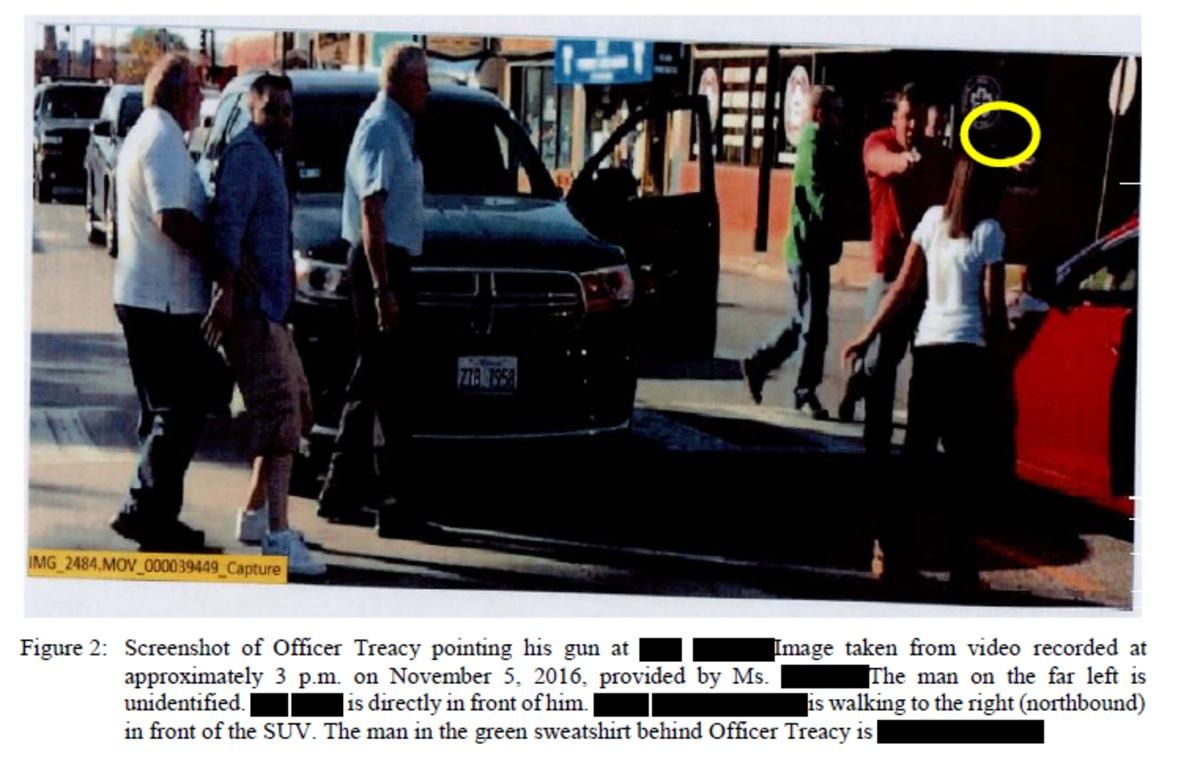 Officer Joseph Treacy, right, is pictured during a shooting along 111th Street in the Mount Greenwood neighborhood on Nov. 5, 2016. (COPA)
Officer Joseph Treacy was named in four lawsuits in the past six years that cost taxpayers $524,000, according to the analysis.
But he has not worked a single shift as a police officer since 2018, collecting more than $440,000 in disability payments through August 2025, according to records obtained by WTTW News.
Reached by phone by WTTW News, Treacy declined to comment.
With the approval of the board of the Policemen’s Annuity and Benefit Fund of Chicago, Treacy, 42, will continue to receive 75% of his annual salary until his 63rd birthday, or he is no longer disabled and returns to work.
Treacy, who has been a member of CPD since 2006, will be eligible to retire with full benefits in 2036. The nature of his disability was not disclosed in the records obtained by WTTW News, but he was listed as being injured while on duty.
The number of officers on medical leave and long-term disability has become an increasing source of frustration for members of the Chicago City Council, who are scrambling to close a projected $1.15 billion gap in its 2026 budget.
Getting officers back to work after they are injured is one of the biggest challenges facing city officials trying to maximize every dollar spent by CPD, said Era Patterson, interim executive director of the Office of Public Safety Administration during a budget hearing earlier this month.
Patterson told alderpeople she was hopeful an ongoing audit would give officials a roadmap to reduce costs and get more officers back to work quicker.
Between 2007 and 2018, Treacy, who was assigned to a gang enforcement unit, faced 31 misconduct investigations, according to records obtained by WTTW News. The complaints include allegations of illegal search and excessive force claims that Treacy stole money while on duty, records show.
Chicago taxpayers paid $225,000 to the family of an Indianapolis man shot and killed by Treacy and another officer in 2016 after he pointed a gun at them during a brawl that exacerbated racial tension in Mount Greenwood.
That was the largest payout to resolve a lawsuit naming Treacy, records show.
The agency tasked with investigating misconduct by Chicago police ruled the officers were justified in shooting Joshua Beal.
Beal, 25, of Indianapolis, and his family were traveling along 111th Street on Nov. 5, 2016, as part of a funeral procession through a part of the city’s Far Southwest Side home to many Chicago firefighters, police officers and city workers. More than 80% of Mount Greenwood’s residents are White.
Beal and his family, who are Black, had just buried their cousin, when they got into an altercation with Treacy near the entrance to Mount Olivet Catholic Cemetery, records show. The lawyer representing Beal’s fiancée and their two children in the lawsuit against the city claimed the melee began when Treacy used a racial epithet to refer to members of Beal’s family.
Beal’s shooting touched off days of protests in Mount Greenwood, with groups demanding police reform and racial justice as part of the movement known as Black Lives Matter. Some residents of Mount Greenwood reacted to those gatherings with hostility and racist statements, while others held counter demonstrations to support Chicago’s police and fire departments.
Treacy was suspended for 90 days for failing to register a gun with CPD as required, but records show he did not serve that suspension.
The lawsuit filed by Beal’s family disclosed that Treacy owned several military-style weapons, including an AR-15, an Extar EXP 556, a semi-automatic pistol, as well as a Century Arms VZ, an AK/Kalashnikov-style firearm, according to descriptions of the weapons included in court records.
Treacy was injured during the melee that led to Beal’s death, suffering an “unspecified injury to the face, abrasion of the elbow” and neck pain, records show.
Treacy was also named in lawsuits alongside former Officer David Salgado and former Sgt. Xaiver Elizondo. Both were found guilty in 2019 on charges of conspiracy and obstructing justice in their roles as tactical officers.
Between 2016 and 2018, taxpayers paid $1,000 to resolve a fifth lawsuit naming Treacy and $57,500 to resolve a sixth lawsuit naming Treacy, court records show.
Treacy appears to have been disciplined a total of four times by CPD officials, including for the gun violation in 2016, records show.
In 2010, Treacy was convicted of DUI in Indiana and hit with a 25-suspension in 2011. Also in 2010, CPD officials suspended Treacy for an additional 12 days after he engaged in an unauthorized pursuit that ended in a crash that seriously injured a member of the public, according to records obtained by WTTW News that showed that pursuit was not investigated until 2014, Treacy was not suspended until 2017 and the case was closed in 2018.
In 2018, Treacy was suspended for 20 days after he improperly searched a vehicle in 2017 while working with Elizondo and Salgado.
A 2017 probe by the U.S. Department of Justice found that Chicago police officers were rarely held accountable for misconduct because of badly broken systems as well as a “code of silence” among officers that allowed them to act with impunity.
Note: This article was originally published Sept. 23, 2025, and updated with video Sept. 29, 2025.
WTTW News coverage of policing and police reform is supported by The Joyce Foundation.
Contact Jared Rutecki: @JaredRutecki | [email protected]
Contact Heather Cherone: @HeatherCherone | (773) 569-1863 | [email protected]