Education
Northwestern President Michael Schill, Who Led University Amid Hazing Scandal and Funding Freeze, Announces Resignation
 (Courtesy of Northwestern University)
Northwestern President Michael Schill, who has led the Evanston university amid periods of turmoil that included student protests, a widespread hazing scandal within the athletic department and federal funding cuts that forced layoffs, has announced he is stepping down.
Schill, 66, said it has been his “profound honor” to lead Northwestern as its 17th president over the past three years
“In that time, our community has made significant progress while simultaneously facing extraordinary challenges,” he said in a statement. “Together, we have made decisions that strengthened the institution and helped safeguard its future.”
The university’s Board of Trustees is expected to name an interim president “soon.” According to Northwestern, Schill will remain in his role until that interim is selected and will continue to work with the board on efforts to restore Northwestern’s frozen federal funding.
Schill is expected to take a sabbatical upon stepping down, but will return to teach and conduct research as a faculty member at Northwestern’s Pritzker School of Law.
“In spite of many headwinds, President Schill and his administration worked diligently to defend Northwestern’s mission and accomplished lasting achievements that contribute robustly to Northwestern’s continued advancement among the great universities in the United States and around the globe,” Board of Trustees Chair Peter Barris said in a statement.
Schill faced tumultuous times during his tenure, most recently as Northwestern cut approximately 5% of its staff budget in July through the elimination of 425 positions amid an ongoing battle with the Trump Administration, which has frozen federal funding earmarked for the university.
That freeze is part of a broader push of using taxpayer dollars to pressure major academic institutions to comply with President Donald Trump’s political agenda and to influence campus policy.
In April, Northwestern said it had received stop-work orders on around 100 federal grants, but Schill and other university leaders said their financial issues go beyond the funding freeze, stating in July that higher education in general “faces tremendous and mounting headwinds.”
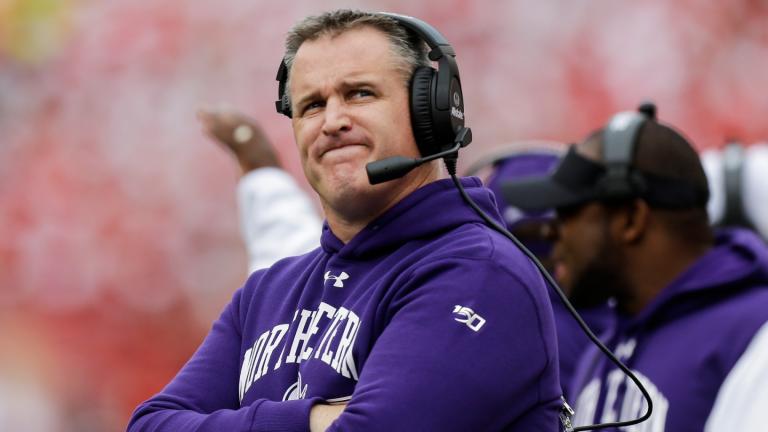
Schill also dealt with the wake of bombshell hazing allegations first made by former university football players in 2023 that ultimately led him to fire longtime Wildcats head coach Pat Fitzgerald.
The hazing allegations extended back far before Schill’s time as president, and included allegations of “forced participation, nudity and sexualized acts of a degrading nature, in clear violation of Northwestern policies and values.”
While the hazing allegations centered on the football program, student athletes from Northwestern’s volleyball and baseball teams also made allegations of separate misconduct.
At the time, Schill said Fitzgerald was “responsible for the culture of his team” and said his termination was due to the coach’s “failure to know and prevent significant hazing in the football program.”
Fitzgerald — who has repeatedly denied any knowledge of these activities — filed a $130 million wrongful termination lawsuit against Schill and the university, which the parties ultimately resolved through an undisclosed settlement last month.
The university has also settled lawsuits filed by numerous former football players and has since instituted new rules and regulations to protect student athletes.
In his resignation letter, Schill noted that, from the beginning of his term, Northwestern faced “serious and often painful challenges.”
“In the face of those challenges and the hard, but necessary choices that were before us,” he said, “I was always guided by enduring values of our University: protecting students, fostering academic excellence, and defending faculty, academic freedom, due process and the integrity of the institution.”
During Schill’s tenure, the university also faced extensive student-led protests in early 2024 including pro-Palestinian encampments that took over Deering Meadow for days following the launch of the war between Israel and Hamas.
Northwestern ultimately came to an agreement with protesters to end the encampment, while still allowing peaceful protests on campus — a move Schill later defended during his testimony on Capitol Hill.
“We had to get the encampment down,” he testified before a House committee in May 2024. “The police solution was not going to be available to us to keep people safe, and also may not be the wisest solution as we’ve seen at other campuses across the country.”
Northwestern has said it has since updated its policies to curb antisemitism on its campuses, which it claims has resulted in a dramatic decrease in the number of reported incidents. Even so, the Trump administration has since launched investigations into allegations the university engaged in “antisemitic harassment and discrimination.”
Before coming to Northwestern, Schill — a Schenectady, New York native — served as the University of Oregon’s president from 2015 until 2022 and as dean of the University of Chicago’s law school.
According to the university, under Schill’s leadership, Northwestern rose to its highest-ever ranking (No. 6) on the U.S. News & World Report list of top universities and recorded their second- and third-highest fundraising years on record.
“It has been my privilege,” he said, “to work alongside extraordinary colleagues and to witness firsthand the resilience, generosity, and strength of the Northwestern community.”
The Associated Press contributed to this report.