Crime & Law
What Happens During a Prison Lockdown? With Illinois Seeing Historic Highs, We Asked Incarcerated People
About three years into his incarceration, Calvin Merritte said he saw Menard Correctional Center’s cafeteria for the first time this summer.
Up until then, he’d only received food in his cell. The prison, located along the Mississippi River in southern Illinois, did not run out-of-cell food service from Jan. 1 through mid-July of this year, according to records. Not only that, the general population was provided outside time in the yard just 56 times, law library 40 times and commissary 95 times.
Menard has been on lockdown nearly every day since September 2023, according to data from the Illinois Department of Corrections. Lockdowns, according to officials, are largely the result of short staffing. On average, Menard has only been able to staff 44% of the prison so far this year, according to emails.
Menard, the largest maximum-security prison for men in the state, isn’t the only facility facing heightened lockdowns — Illinois is currently experiencing the highest amount of prison lockdowns in the state since 2020.
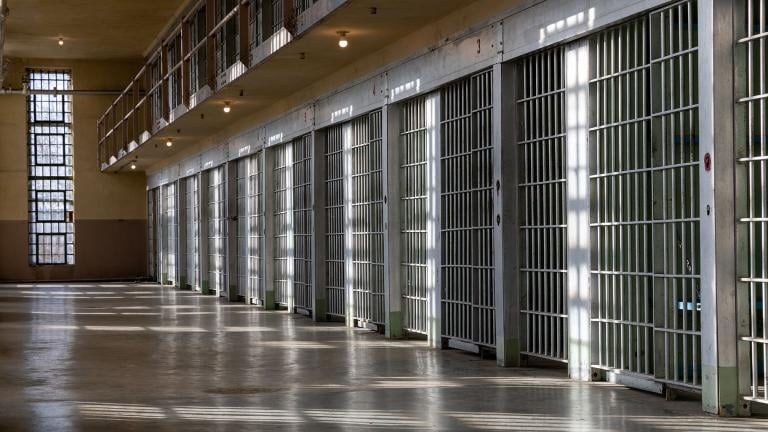
Lockdowns can be indistinguishable from solitary confinement-like conditions, with those incarcerated given little yard time and limited access to educational programming and commissary. The vast majority of the lockdowns are ”administrative-based,” a term for more routine disruptions to facility operations, often linked to insufficient staffing levels. “Incident-based” lockdowns are used in the event of a critical incident that impacts facility security, and have shrunk since 2020.
The record high is in large part due to staffing shortages, according to IDOC data. For example, in May, 86% of lockdowns were due to a lack of staff, data shows.
In response to questions around incentivizing and retaining staff, department officials said they have taken “proactive measures” to mitigate the impact of staffing shortages. An IDOC spokesperson pointed to recent agreements to establish additional training academies for staff and expanded recruitment efforts.
The union that represents most correctional staff, AFSCME Council 31, also said the additional training academies have improved the pace of onboarding new staff.
People are suffering because of lockdowns, according to Jennifer Vollen-Katz of the John Howard Association, a prison watchdog group. To mitigate that, she said IDOC should look at consolidating facilities.
“At a certain point, operationally, IDOC has got to adjust,” Vollen-Katz said. “If you cannot get enough people to work in your facilities, that tells me that we’re running too many facilities, that we are not staffing people in the right places to meet the needs that are most urgent and important for the people who are incarcerated.”
To understand the impact of lockdowns, WTTW News sent a list of questions to those incarcerated at three prisons in Illinois with particularly high lockdown numbers: Menard, Pinckneyville, a medium-security prison for men, and Logan, a facility for women north of Springfield.
Below find their responses to our questionnaire, with some answers edited only for length.
WTTW News: Are you currently on lockdown?
Jason Wilson, incarcerated at Menard Correctional Center since 2024
Technically we are not on lockdown but we’re always in our cell 24/7 except for the days that they feel like giving us yard or if we have some type of pass to come out to see the nurse or law library. There is no day room, we do not get a hour out of our cells everyday to interact with each other. We are supposed to get 2 yards per week but we barely get the because the institution is always saying they are short of staff.
Rafael Kennedy, incarcerated at Menard Correctional Center since 2023
That’s a constant here in Menard; the prison make-up is the old maximum security format. Most people are told about 23 and 1 that’s 23 hours in the cell and 1 hr out of cell time. The 1 hour out of cell was counted for the walks to chow and showers being provided everyday, but we don’t get showers everyday. It’s only 3 times a week and they haven’t ran chow since b4 covid so the food comes to the cell in effect. Menard is a 24-24: that’s 24 hours in the cell and none out unless visits, sick call passes, or mental health, commissary, programs, are in your schedule for that day. On average in a 30 day span at least 20 days are spent 24hrs straight in the cell.
When you’ve been on lockdown, how do you pass the time inside your cell?
Jason Wilson, incarcerated at Menard Correctional Center since 2024
There is not much to do in the cell besides watch TV or stream music, movies, games or news on our tablet which they are overcharging us for. They are charging us $1.20 per hour subscriptions to stream, so for instance to stream for 5 hours per day it would add up to $180 per month.
Angela Bowers, incarcerated at Logan Correctional Center since 2013
I would have conversations with the women next door, below me, above me or on the wing connected a lot of serious bonds were formed like this its helps one hold on.
Calvin Merritte, incarcerated at Menard Correctional Center since 2022
I might socialize with guys on the gallery because I’m like a social butterfly. I talk to people about the law and pretty much a whole bunch of stuff. We can’t go to the law library. [Since January, Menard’s law library has been run just 40 times, according to data from IDOC] The reason that I’m able to help people out is because I got an amazing memory. If I read something one time, I can remember it. And then I’ve been studying law for so long, I know case law, like off the top of my head. Like for health care, if they denied you medical attention? I know it’s Estelle vs. Gamble. If they deny us access to the law library, I know it’s Lewis vs. Casey from 1996. If it’s excessive force, I know the leading case on that is Hudson vs. McMillan from 1992. It ain’t that many rights that we have as prisoners, but the few that we do have, I know the lead cases on them.
What services are you typically not receiving while on lockdown?
Rafael Kennedy, incarcerated at Menard Correctional Center since 2023
No programs, no nothing lockdown is literally being locked in a cell and only allowed out for a shower after 7 consecutive days of a lockdown. Shower then returned back into the cell. Food, and everything comes to the cell to us.
Ricardo Vasquez, incarcerated at Pinckneyville for almost three years
While on lockdown we do not go to school, gym, yard, and visitations are routinely cancelled. Our loved ones drive 5 hrs and visits are cancelled with little to no warning. They’ll tell you that they call our family ahead of time. but here’s an example: visits are at 8:30am. it takes 5 hours to drive from Chicago to Pinckneyville, they will call at 7am and say the visits are cancelled.
Terrance Scott, incarcerated at Menard Correctional Center for 10 years
At the beginning of a lockdown I’m not allowed visits or video visits, there’s no religious programs, no phones, no yards, and no showers (until after 72 hrs).
How do lockdowns impact you and your mental or physical well-being?
Angela Bowers, incarcerated at Logan Correctional Center since 2013
Being confined for amounts of times uses to give me bouts of depression but after a while I got use to them as long as it did not accompany other security measures then I could create a routine like deep clean the first day sleep the second do legal work the third and mix in smaller task.
Terrance Scott, incarcerated at Menard Correctional Center for 10 years
Since I’ve been here lockdowns have changed but being in a cell for over 24 hrs at a time without fresh air or to be able to exercise break your body down (which is the physical aspect). After so long of being in a cell is mentally disturbing it get so bad at times it make me want to shut down mentally is make me distant and sometimes leave me in a bad mood.
Jason Wilson, incarcerated at Menard Correctional Center since 2024
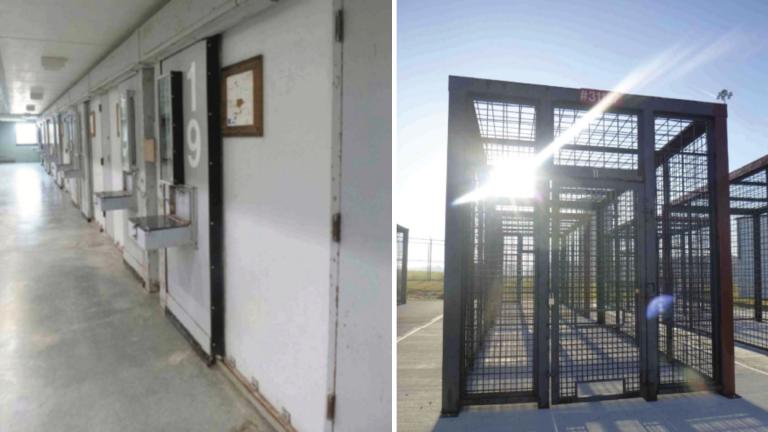
When I come out the cell I feel like a dog that’s been in a crate for days at a time sometimes it’s weeks that I don’t get to leave this cell and I’m happy and excited just to come out the cell and go right to another cage. They wonder why most inmates are so aggressive. Put a dog in a cage for days and keep antagonizing him and see how he starts to act. It’s affecting my physical wellbeing because I don’t get proper exercise, my body feels like it’s deteriorating cause I sit in the same spot everyday all day and I’m being fed food that I know isn’t healthy for me.
Angela Wells, incarcerated at Logan Correctional Center for 12 years
It feels like prison inside prison, the walls was closing in Well at one point our psych doctor didn’t renew our mental health medication everybody that took mental health meds were about to “quote on quote” ring each other necks.
Contact Blair Paddock: @blairpaddock.bsky.social | [email protected]