Business
Quantum Computing Campus Touted as ‘History-Altering’ Picks Former U.S. Steel South Works Site
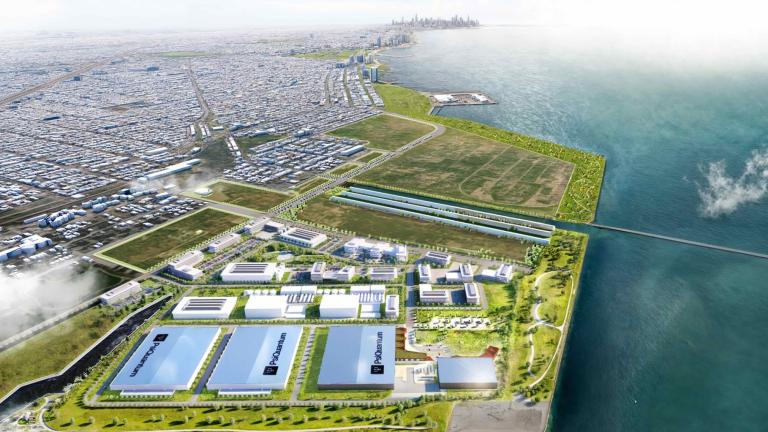
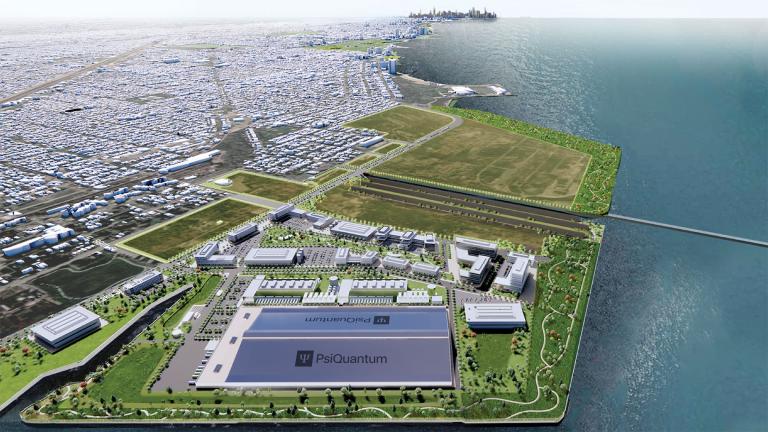
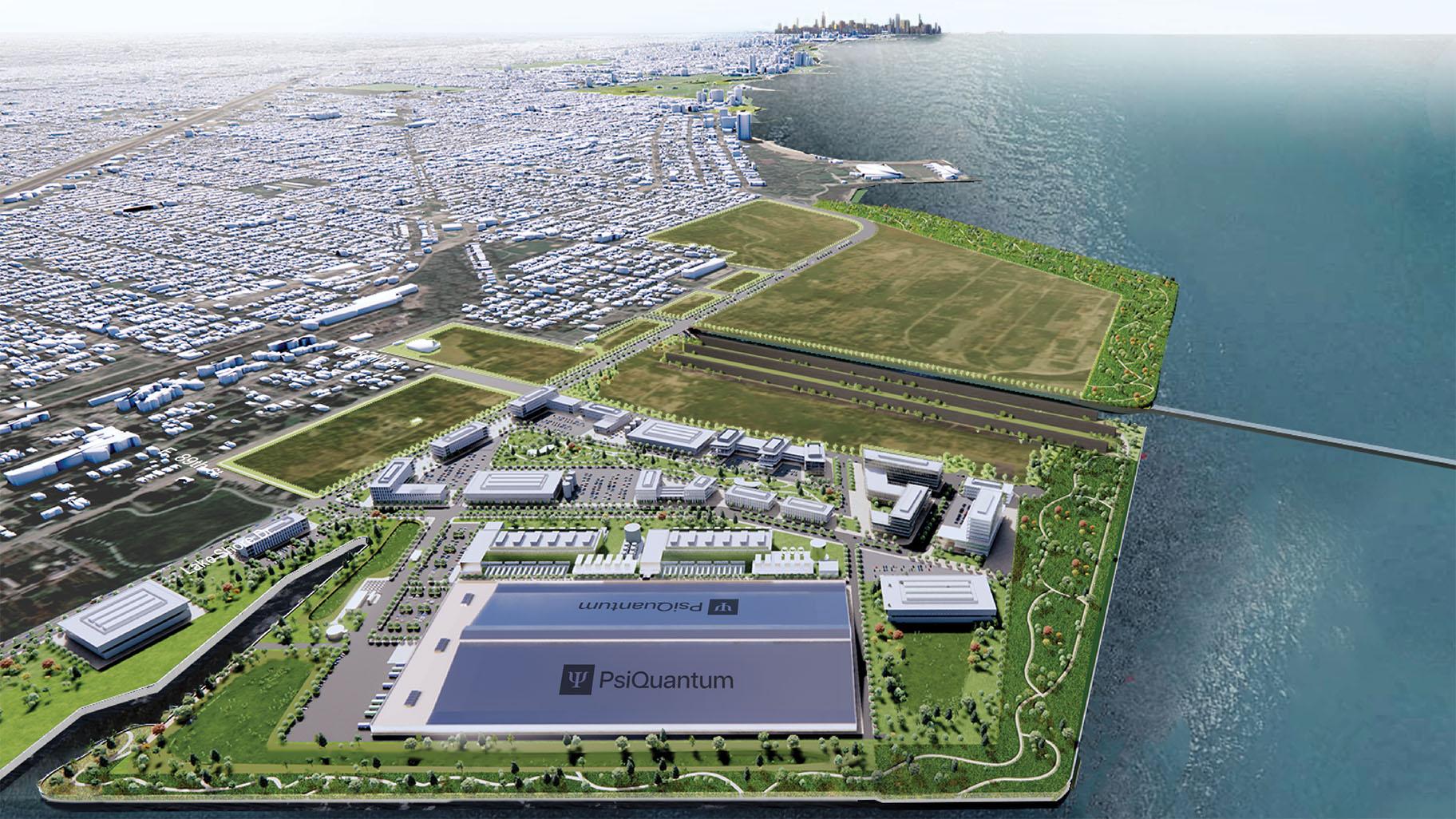 A rendering of the Illinois Quantum and Microelectronics Park proposed for the Southeast Side. (Credit: Lamar Johnson Collaborative)
The first major quantum computer in the country — a machine that its creator promises “will change how the world lives, works and heals” — will be assembled in Chicago.
The news was announced Thursday by California-based PsiQuantum, with state and local government agencies all celebrating the endeavor.
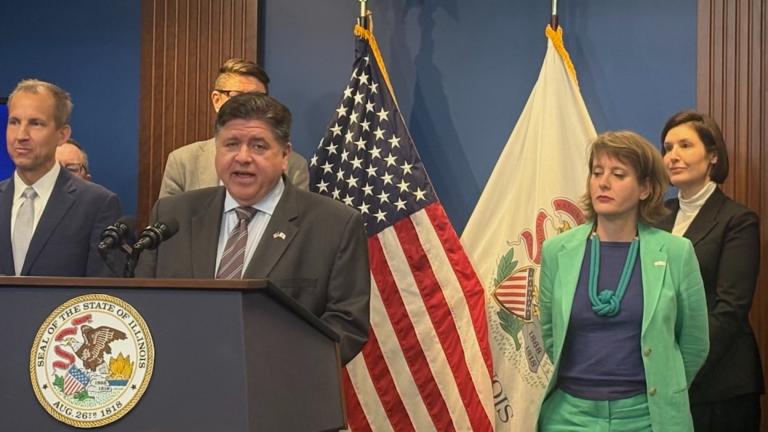
“Right here beneath our feet will be a catalyst for a potential revolution in science and technology in the betterment of life for all humankind,” said Illinois Gov. J.B. Pritzker, who aims to make Illinois a global leader in quantum. “We intend to drive innovation on a history-altering scale and provide unprecedented economic opportunity for the people of this great city and state.”
PsiQuantum, which is set to receive $200 million in tax incentives for its work in Illinois, will serve as the anchor tenant of a quantum campus on the city’s Southeast Side that, at the behest Pritzker, the state is allocating $300 million from this year’s budget to build.
Cook County government is also supporting the park with $5 million and a new property tax incentive program, board President Toni Preckwinkle announced.
“Other countries, particularly China, have made significant investments in quantum and we need to accelerate our efforts to catch up,” Preckwinkle said. “Today stands as yet another reminder that world class, technological opportunities and achievement can and will come into being not just in Silicon Valley or in Boston, but on the Southeast Side of Chicago.”
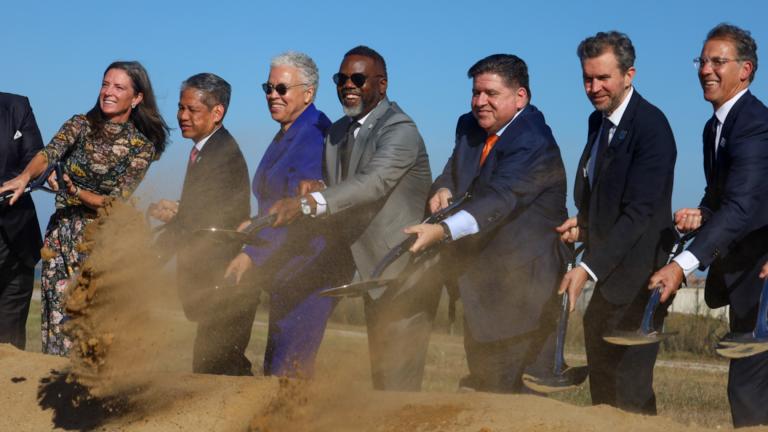
Officials also revealed Thursday that the quantum campus, formally called the Illinois Quantum and Microelectronics Park (or IQMP), will be located at the former U.S. Steel South Works site, transforming an industrial area abandoned since 1992 that Mayor Brandon Johnson said is “long overdue for transformation.”
“This was a bustling steel mill that produced a million tons of steel each year, shaping the face of our nation through skyscrapers, trains, bridges and cars,” Johnson said.
The quantum park, he said, will once again “revitalize this community and reconnect the people of the southeast side of Chicago to opportunities in this thriving economy.”
Jeremy O’Brien, PsiQuantum Corp.’s CEO and co-founder, said the site’s history is not lost on the company.
“It’s been a long time since this plant hummed with industry,” O’Brien said. “Yet just like that U.S. Steel facility, quantum computing will be the fulcrum of a new innovation community. It will serve as a critical foundation for critical industries in Illinois and across the United States, steering a new industrial revolution.”
The “first U.S.-based utility-scale quantum computer” that PsiQuantum will build, O’Brien said, has the potential to play a role in the development of new life-saving drugs, electric batteries and solar cells.
PsiQuantum hopes to begin the work as soon as possible.
Area residents affiliated with the Alliance of the SouthEast expressed reservations, however, with both a lack of community involvement and concerns over the environmental impact of the heated water likely to be released into Lake Michigan from computer cooling systems.
The alliance is concerned the heated water could lead to algae and toxin growth that would hurt aquatic life and make the water unsafe to drink.
“We don’t want our communities to be left behind,” said community organizer Sam Corona in a press release. “We look forward to a working partnership for a successful development that supports our community, without displacement, ensures the next generation advances into a digital economy, and the environment is not at stake for our future.”
The organization said neighbors demand meetings with the Pritzker and Johnson administrations to also address issues like jobs, construction and the impact of the park on property value and rent prices that could lead to residents getting displaced.
What is Quantum?
Quantum technology can be thought of as modern computing — on steroids.
“In a few short years, it’s predicted that quantum will soon touch all aspects of our lives,” Preckwinkle said. “It will revolutionize the way we approach challenges, providing unprecedented insight to the mysteries of traffic jams, diseases and even the economy.”
Pritzker, a self-proclaimed “quantum geek,” is working to make it such that Illinois can lay claim to as America’s quantum capital
“Today we bring ourselves a step closer to our quantum future, opening up a world of possibilities in everything from climate solutions to national security to healthcare and beyond,” Pritzker said. “And in doing so, we are bringing jobs and opportunity and are laying the groundwork, the foundation, for long-term, broad-based economic prosperity for the state of Illinois.”
According to information provided by the Pritzker administration, PsiQuantum will cover 300,000 square feet “with room to grow” at the state quantum park, and will create 150 jobs in fields like engineering and non-technical positions in sales and finance.
Pritzker’s efforts to galvanize Illinois as the nation’s quantum leader has won praise from business groups, though some lawmakers have grumbled about Illinois spending on quantum, given other state needs and when the park’s anchor tenant, according to a Reuters report in September 2023, has a valuation of $3.15 billion.
Last week, Pritzker jointly announced with the U.S. Department of Defense that the Defense Advanced Research Projects Agency will base its new Quantum Proving Ground program for testing computing prototypes at the IQMP.
At Pritzker’s urging, the state budget allocates a half billion dollars this year to quantum — the $300 million on the quantum park coupled with $200 million in matching funds for quantum research, the bulk of which ($140 million) will go to DARPA’s testing program.
That half billion does not include the $200 million PsiQuantum is set to receive over the next 30 years in incentives, such as tax credits for job creation, tax breaks on equipment and grants for energy readiness and workforce development training.
Previously, Illinois spent $200 million to support the Chicago Quantum Exchange, a hub for universities, labs and companies to trade information and train a workforce in quantum.
Contact Amanda Vinicky: @AmandaVinicky | [email protected]