Politics
City Council Votes 28-21 to Rid CPD of Officers With Ties to Extremist Groups
The Chicago City Council voted 28-21 Wednesday to approve a measure designed to rid the Chicago Police Department of officers with ties to hate groups and far-right extremist organizations.
The ordinance crafted by Ald. Matt Martin (47th Ward) bans officers from “actively participating” in extremist and anti-government groups like the Proud Boys and Oath Keepers.
Martin said the measure would not solve all of the problems facing the city in combating extremism.
“One proposal is not a silver bullet,” Martin said. “But we should do what we can, when we can.”
The City Council has also banned those who took part in the Jan. 6, 2021, attack on the U.S. Capitol — which included members of the Proud Boys and Oath Keepers — from working in city jobs after most were pardoned by President Donald Trump.
Ald. Anthony Napolitano (41st Ward) said the measure was crafted by those who were unable to “defund the police” in an effort to “demonize” the police.
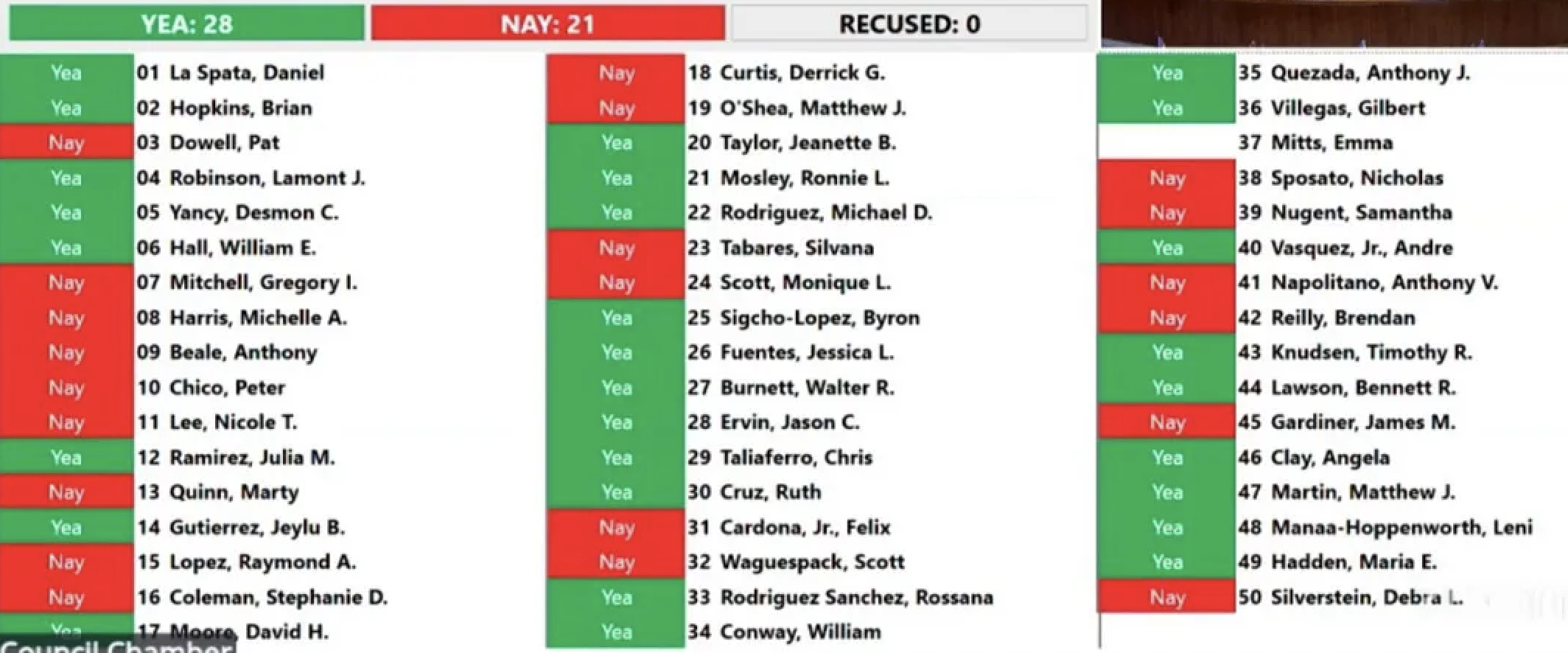 A breakdown on a vote on the proposal designed to rid the police department of police officers with ties to extremist groups.
The vote on the measure, which has taken more than a year to reach a final vote, was delayed a month after several alderpeople suggested that the ban should apply to all city employees, not just CPD members.
There are no public allegations that city workers in any department other than CPD have documented ties to anti-government or extremist groups.
When Martin originally introduced the measure, it applied to all city employees. However, in response to concerns from the Chicago Department of Law that a broad ordinance would be unlikely to withstand a legal challenge, Martin agreed to narrow the scope.
An analysis of the ordinance by the Department of Law, released shortly before the vote, warned alderpeople that any attempt to expand the ordinance could violate employees’ First Amendment rights and pose legal peril for the city.
“If the city has to defend the legality of this ordinance in a lawsuit, it would need to not only be able to show that it is possible for city operations to be negatively impacted by extremist speech and action, but that in all instances, the city’s operations would necessarily be impacted by the expressive activity,” according to the unsigned analysis. “If the city is challenged and cannot prove this, the law would almost certainly be immediately overturned, and it may lead to legal or financial liability for the city.”
Courts have been more willing to uphold restrictions on speech and assembly for law enforcement employees than for other public employees, according to the analysis. It would not compromise the city’s operations if a member of the Department of Streets and Sanitation’s tree trimming crew was a member of the Proud Boys in the same way that it would if a police officer empowered to arrest and use force against members of the public was a member, according to the analysis.
“Due to law enforcement’s unique and vital role and responsibilities, a law more narrowly focused on the expressive activities of members of the police force and the attendant effect on government operations has a stronger legal basis,” according to the analysis.
A CPD spokesperson told WTTW News that the department “is supportive of this measure and believes every city employee should be held to the same standards outlined in this proposed ordinance.”
The measure would give the Civilian Office of Police Accountability the authority to probe officers accused of “actively participating” in extremist and anti-government groups like the Proud Boys and Oath Keepers.
Before President Donald Trump returned to office in January 2025, the FBI labeled the Proud Boys as an antisemitic white supremacy organization and considered the Oath Keepers a “large but loosely organized collection of individuals, some who are associated with militias” who have vowed to “not obey unconstitutional (and thus illegal) and immoral orders.”
Members of the Proud Boys and Oath Keepers participated in the Jan. 6, 2021, U.S. Capitol insurrection. Leaders of both groups were convicted of seditious conspiracy before being pardoned by Trump.
The measure specifically prohibits CPD members from participating in groups that advocate the overthrow of any level of U.S. government by violence.
The measure defines active participation in an extremist organization as paying dues, attending meetings, recruiting others or posting and sharing content online that promotes extremist activities.
The proposal also prohibits officers from engaging in the “planning, execution, or other material support of hate crimes and hate incidents.”
Officers would also be prohibited from “knowingly displaying paraphernalia, words, or symbols in support of extremist activities,” according to the proposal.
WTTW News coverage of policing and police reform is supported by The Joyce Foundation.
Contact Heather Cherone: @HeatherCherone | (773) 569-1863 | [email protected]