Politics
Anjanette Young Renews Push for State Law to Ban No-Knock Warrants, Block Officers From Pointing Guns at Kids
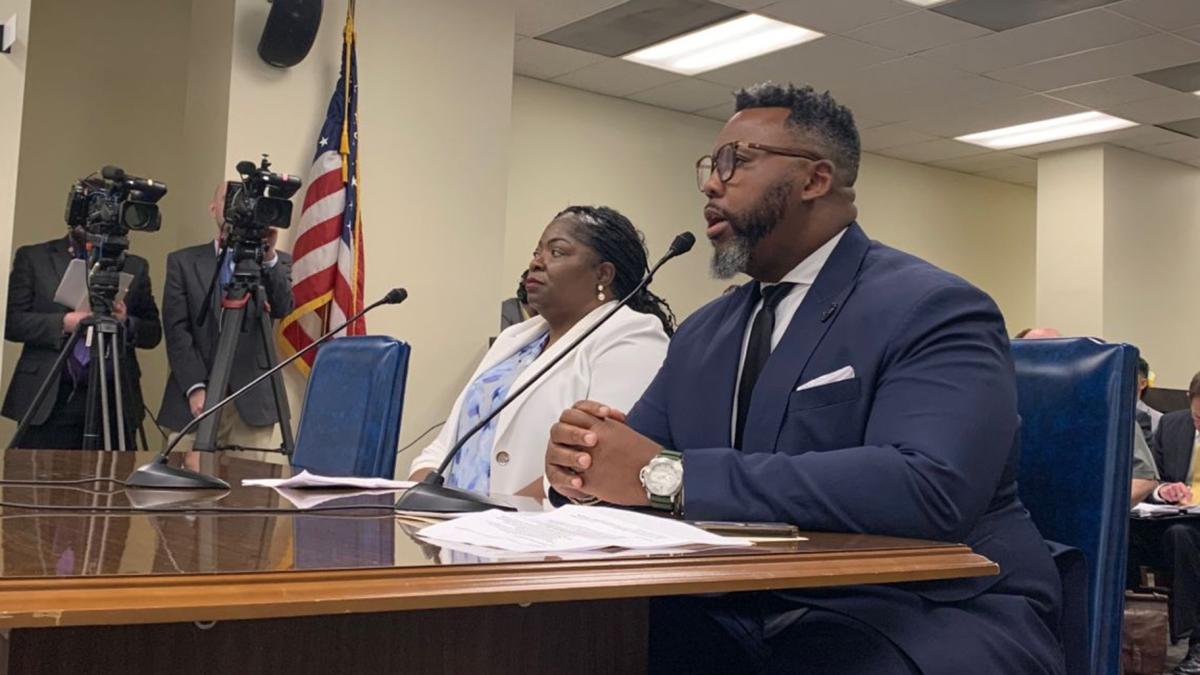 State Rep. Kam Buckner (D-Chicago), right, presents a bill in the House Judiciary Criminal Committee on Tuesday, March 18, 2025, alongside Anjanette Young. (Ben Szalinski / Capitol News Illinois)
Anjanette Young, a social worker who was handcuffed while naked during a botched 2019 Chicago Police Department raid, renewed her push Monday for a new state law that would ban officers from serving no-knock warrants or from pointing guns at children during raids.
Seated next to state Rep. Kam Buckner (D-Chicago), Young urged state lawmakers to pass House Bill 1611, dubbed the Anjanette Young Act, to impose new limits on how, when and why police departments across the state serve search warrants.
“A system that avoids accountability does not offer safety,” Young told the Illinois House Judiciary Criminal Committee.
Buckner said lawmakers must act to ensure that officers who enter private homes with force do so while protecting the human dignity of everyone present.
“This is not anti-law enforcement; this is pro-public safety,” Buckner said.
The proposed law would ban no-knock warrants in all but “exigent circumstances” where the safety of officers or others was threatened, according to the bill.
In addition, the proposal would require officers to wait at least 30 seconds before entering a home with a search warrant if they do not get an immediate response.
Had that provision been in place in February 2019, Young would have had a chance to finish getting dressed after arriving home from work before officers burst into her apartment, looking for someone who did not live there.
The measure would also ban pointing a gun at anyone younger than 18 unless they present a clear and present danger.
In February, a federal jury ordered the city to pay $5.7 million to a family with four children, determining that a botched 2018 Chicago police raid of their Back of the Yards apartment violated their civil rights.
The jury found that the officers, who were looking for a man who did not live in the family’s apartment, improperly pointed guns at the children.
A similar bill won the endorsement of the committee in March 2025, but failed to advance through the Illinois House or Senate.
Despite repeated pledges by Mayor Brandon Johnson to impose strict limits on how search warrants are used in Chicago, the mayor has yet to formally introduce to the City Council a measure named for Young designed to do just that.
The measure is unlikely to pass the City Council in the face of opposition from Chicago Police Supt. Larry Snelling, who has defended the department’s newly finalized search warrant policy, which is set to take effect in the coming months.
Ald. Maria Hadden (49th Ward), the lead sponsor of the Anjanette Young ordinance, urged state lawmakers to pass the law during Monday’s hearing, saying it would make people safer.
“Hopefully, the state can give the city a bit more of the nudge that we need,” Hadden said.
The new CPD search warrant policy, which was finalized Dec. 26 with no public notice, will take effect once officers are trained on the new rules and a new electronic search warrant reporting application is developed.
After the botched February 2019 raid of Young’s home created a political firestorm, the federal court order known as the consent decree that requires CPD to change the way it trains, supervises and disciplines officers was expanded to include search warrants.
That launched years of negotiations between CPD’s leaders, city lawyers, the attorney general’s office and the coalition of police reform groups that sued the city to force it to agree to federal court oversight.
In May 2024, U.S. District Court Judge Rebecca Pallmeyer declined to ban officers from executing warrants to search for evidence of minor offenses; to ban officers from pointing guns at people during raids; or to require that officers wait for a minimum amount of time before making forced entry into a home or apartment at the request of the coalition.
City lawyers and police leaders fought those demands for more than four years.
CPD’s new search warrant policy includes a provision “acknowledging search warrants are a traumatic experience” and directs officers to exercise caution and use tactics designed “to minimize potential trauma and minimize intrusion and damage to homes and property.”
Unless it is an emergency, officers are only allowed to serve warrants between 6 a.m. and 10 p.m., under the new policy.
Officers are also required to “avoid handcuffing or intentionally pointing firearms at children unless reasonably necessary,” according to the new policy.
In addition, the new policy requires officers to knock and announce that they have a search warrant and give the residents “a reasonable opportunity to comply.”
Since 2019, the number of homes searched by CPD dropped more than 83%, according to CPD data.
Officers served just 228 residential search warrants in 2025. In comparison, the department executed 1,382 search warrants in 2019.
Just two warrants served in 2025 were no-knock warrants, according to data provided to WTTW News after a Freedom of Information Act request.
Since 2019, CPD has served just 16 no-knock warrants, city data shows.
No-knock warrants, which allow officers to enter a home without first announcing their presence, must be approved by a deputy chief and can only be used in cases where there is a documented “danger to life or safety,” according to the policy.
WTTW News coverage of policing and police reform is supported by The Joyce Foundation.
Contact Heather Cherone: @HeatherCherone | (773) 569-1863 | [email protected]